
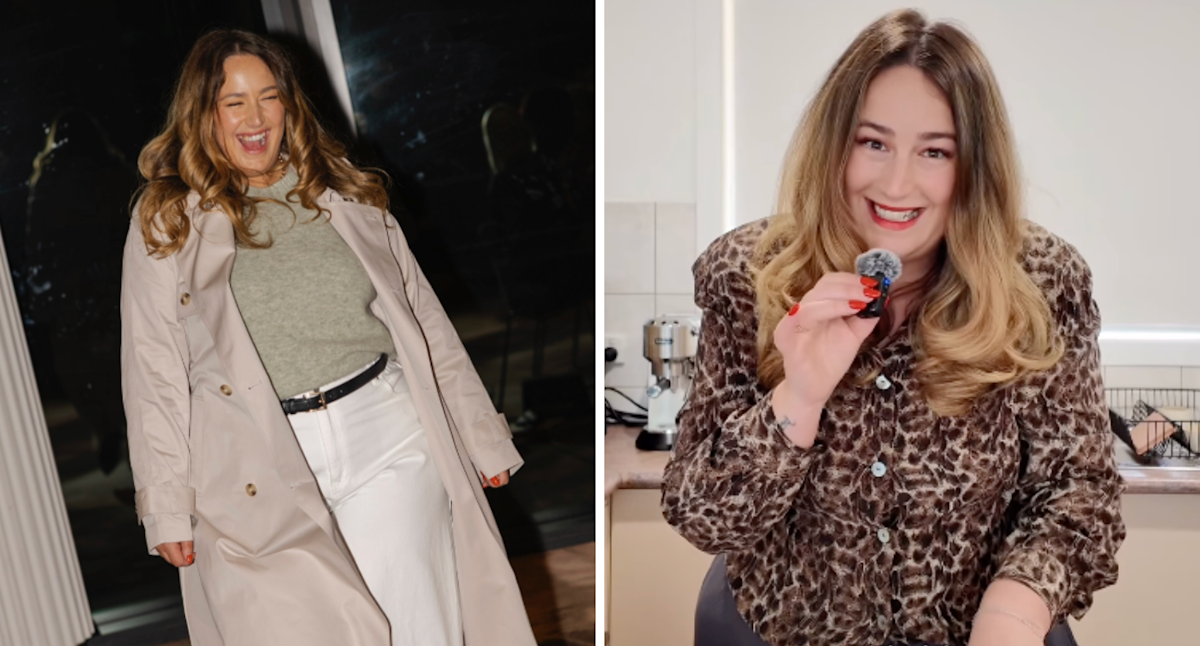
 Emma Edwards, founder of The Broke Generation, came up with the ‘Rule of Three’ when deciding whether to add new items to her wardrobe. (Source: Emma Edwards/Instagram)
Having spent the year analysing my buying mistakes and unravelling why my wardrobe has been such a sinkhole for my money over the years, I came up with the Rule of Three: three questions I could ask myself when deciding whether or not to buy something.
I spent a long time working out how I could condense my learnings down into something that could signpost better buying decisions in the future.
I deeply understood them while I was in the safe cocoon of the Wardrobe Project, but would I still listen when I was able to buy again?
RELATED
I knew I needed something to anchor everything I’d learned into my buying decisions if I had any hope of putting my learnings into practice.
That’s what led me to come up with the Rule of Three.
This question began as ‘will I still like this in three years’, but I found my answer was invariably ‘yes’.
That’s partly because I’d tell myself I’d like something in three years if it meant I could justify buying it, and partly because it’s hard for us to view our future self as a real person.
Psychologically, that person is a stranger, and the life they’ll be living isn’t something we can fully conceptualise.
By flipping it to ask if it’s something I’d have liked three years ago, it grounds us in the passage of time, and shows us just how much we can change in three years. What were you doing three years ago? Who were you three years ago?
Emma Edwards didn’t buy anything new for one year and it changed her relationship with money. (Source: Emma Edwards/Instagram)
Now it’s not to say that if your answer is ‘no’, you can’t buy it. You might not have liked it three years ago because you weren’t a parent then, or you lived in a different place then, or you’ve evolved and grown since then.
This time anchor is an important pause point to remind you that you change, and life changes. Trends or styles or even things we identify with can feel timeless in the moment, but actually may not reflect who we are when we zoom out.
This question has evolved from my attempts to make myself come up with three different outfits to wear an item with before I’d purchase it. As with my first question, I found it was easy for me to barrel on through and scrounge up three outfits in my mind just to justify the purchase.
By changing the question to refer to contexts, I’m forced to not only consider outfits I’d build with the item, but where I’d actually wear them. This prompts a sort of mental visualisation of how you will actually wear the clothes in your real life.
Story Continues
If your mind goes to fancy dinners or parties or glossy work meetings, you can check yourself and think, hey, when was the last time I dressed like Miranda Priestly’s first assistant trying to get to fashion week?! Oh, wait, never! Boom. Purchase mistake swerved.
This is an interesting one, and I need you to not take it too literally. Of course, it’s unlikely that you’ll wear an item every day for the next three weeks. I’m not expecting you to rock into your all-staff Teams meeting wearing a cocktail dress. But the thread I’m pulling at here is steamrolling those impulse purchases of things that aren’t quite right.
I have endless examples of purchases I’ve made of things that didn’t fit quite right, or that I liked in theory but wasn’t 100 per cent sure on.
If I’d asked myself if I’d have been happy to wear that item every day for the next three weeks, I could’ve caught those excuses I was making before I purchased.
The key here is giving yourself a pause point to assess the concessions you’re making for an item that’s less than perfect.
You can mould the Rule of Three to suit what works for you, and I trust that you’ll trust yourself(!) enough to discern when your answers are signalling towards a ‘yes’ or a ‘no’.
The beauty of these questions is that they’re complex. They’re not simple answers that you can easily override with an impulse and a hunger for a dopamine hit. They’re things you really need to think about, and they’ll get you thinking about how the item actually fits into your life.
Financial behaviour specialist Emma Edwards, founder of The Broke Generation, is sharing her radical personal finance experiment: a whole year without buying a single item of clothing.
No new outfits, no second-hand finds, not even rentals. What began as a no-buy challenge soon became a powerful lesson in self-worth, resilience, and the surprising freedom of living with less.
Edited extract from The Wardrobe Project: A year of buying less and liking yourself more by Emma Edwards (Wiley, $34.95), available 26 November at all leading retailers.
Get the latest Yahoo Finance news – follow us on Facebook, LinkedIn and Instagram.