
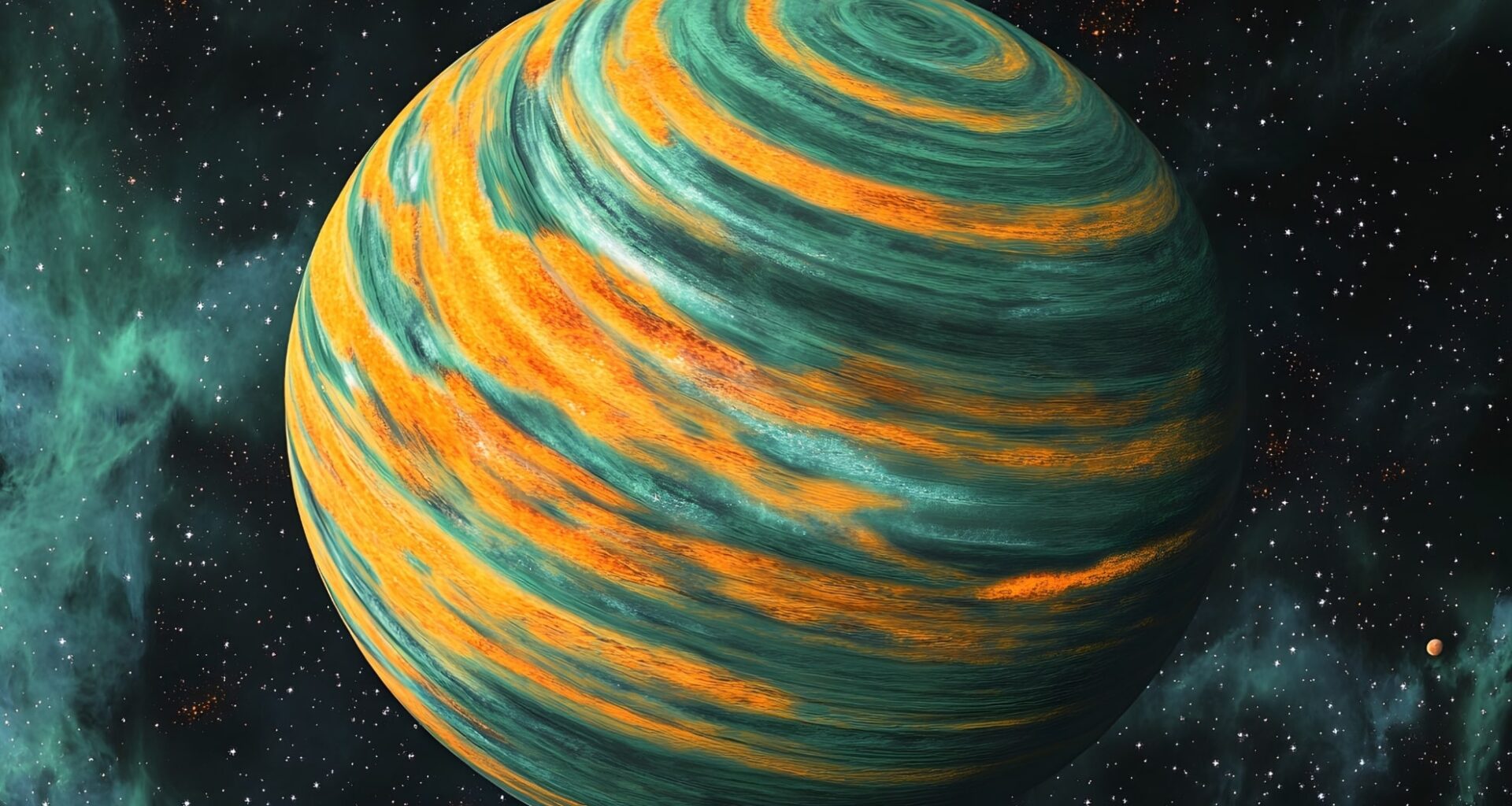
New research reveals that these colossal worlds likely have highly turbulent, chaotic atmospheres, defying the typical image of smooth, banded clouds. A study focused on the exoplanet VHS 1256b shows how these Super-Jupiters could look radically different from what we’ve come to expect from gas giants.
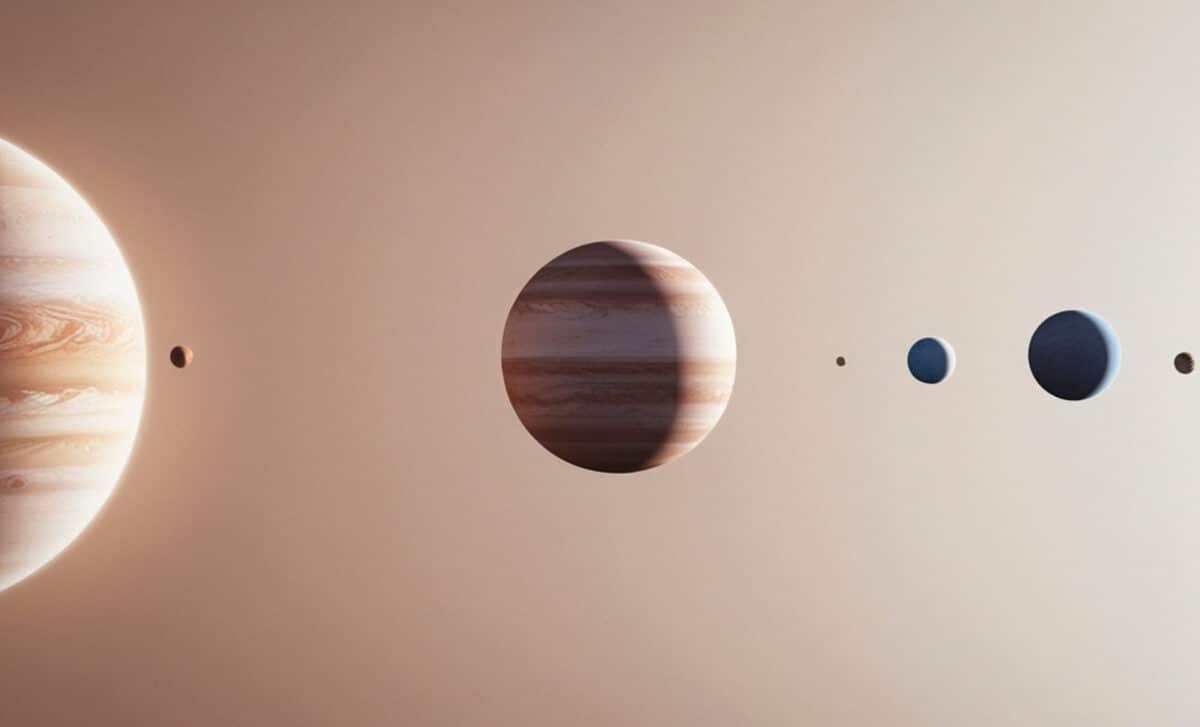
Jupiter, the largest planet in our solar system, has long been a model for understanding gas giants. It features distinct banded clouds caused by winds circulating parallel to its equator. However, according to a new study, Super-Jupiters are so much hotter that their atmospheres react differently to heat, creating turbulence that disrupts the traditional cloud patterns.
Redefining the Image of Super-Jupiters
Super-Jupiters, planets with masses greater than 10 times that of Jupiter, have generally been imagined to look like larger versions of the gas giants in our solar system. Artistic renderings have often shown them with similar banded cloud structures, influenced by winds and heat exchange in their atmospheres. However, new findings challenge this assumption. According to the research published in Science Advances, these Super-Jupiters are far warmer than Jupiter, which causes their atmospheres to behave differently.
The heat in Super-Jupiters drives intense energy into their atmospheres, creating regions of turbulence that break apart the usual cloud bands. The turbulent nature of these atmospheres results in a more chaotic appearance, with storms that can be vastly different from the calm, structured clouds of Jupiter and Saturn. In short, many Super-Jupiters may look radically different from what we have come to expect from their smaller cousins, reports Science Alert.
 © SUMALI IBNU CHAMID from Alemedia.id / Canva
VHS 1256b: A Window into the World of Super-Jupiters
To test the idea that Super-Jupiters have chaotic atmospheres, researchers examined the exoplanet VHS 1256b, which has a mass of about 20 Jupiters. This planet is one of the few exoplanets that scientists can directly image, and observations from the James Webb Space Telescope (JWST) have provided valuable insights into its characteristics. According to the study, VHS 1256b appears reddish, with a surface temperature of approximately 1300 K, much hotter than Jupiter’s 170 K.
The JWST images show that, despite its size and warmth, VHS 1256b does not exhibit the same kind of banded cloud structure that Jupiter does. Instead, the planet’s atmosphere varies in brightness due to the presence of large, dusty storms. These fluctuations in brightness resemble those observed in smaller stars, further emphasizing the chaotic nature of Super-Jupiter atmospheres.
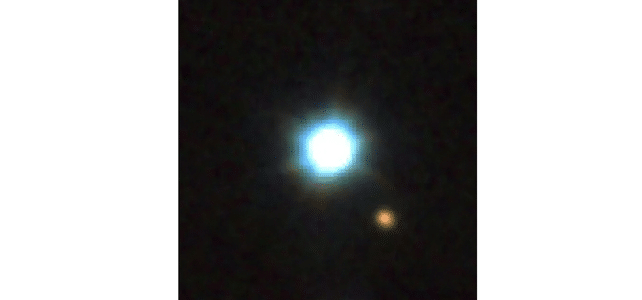 A direct image of the exoplanet VHS 1256b and its star. (ESO/VHS)
More Than Just Bigger Planets
The research on VHS 1256b challenges the long-held assumption that Super-Jupiters would resemble an amplified version of Jupiter. While Jupiter’s cloud bands are shaped by winds that move in predictable patterns, the atmospheres of Super-Jupiters like VHS 1256b are much more volatile.
Super-The study found that the intense heat from these massive planets disrupts the structure of their clouds, creating an environment more like a stormy, turbulent atmosphere than the calm, banded appearance we see on Jupiter.
The discovery of these chaotic atmospheres has significant implications for our understanding of exoplanets. It suggests that many Super-Jupiters may not have the same characteristics as the gas giants in our solar system, forcing scientists to reconsider how they study and classify these massive planets.