
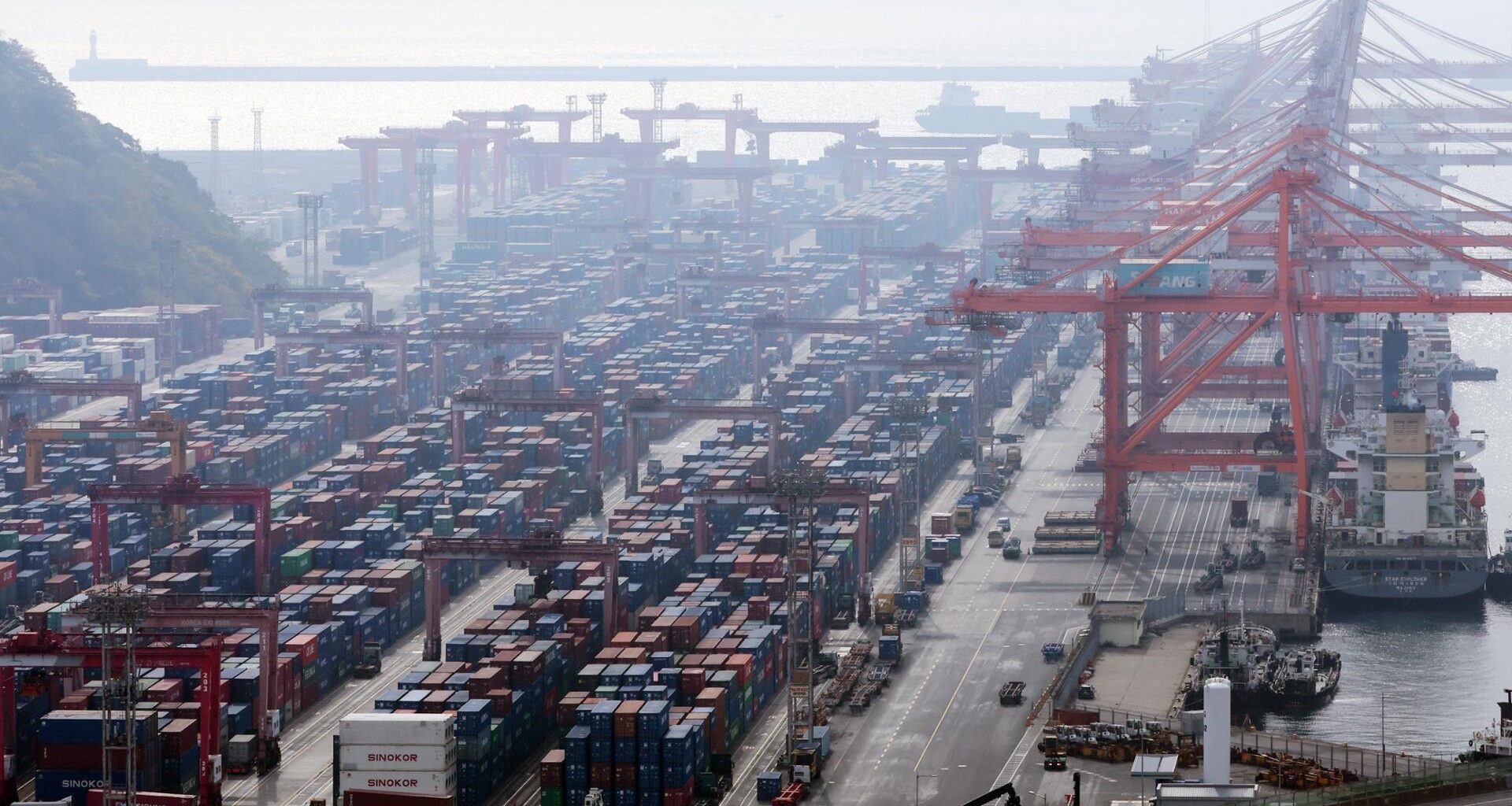
Export and import cargo containers are stacked at Busan Port, Dec. 1. Yonhap
Korea’s export growth is increasingly dependent on semiconductors, deepening polarization in the export structure despite increases in total outbound shipments, data showed Sunday.
Although the country is on track to see its exports exceed $700 billion for the first time this year, strong performance in a limited number of sectors has masked widespread weakness across the broader export base, where many industries are slipping into a prolonged downturn.
According to the Ministry of Trade, Industry and Resources, only five of Korea’s 15 flagship export items posted year-on-year growth during the January-November period, when outbound shipments totaled $640.2 billion, a 2.9 percent year-on-year increase.
Among the five sectors, meaningful gains were largely confined to semiconductors, ships and biohealth, which rose 19.8 percent, 28.6 percent and 7 percent, respectively. By contrast, automobiles and computers posted only marginal increases of 2 percent and 0.4 percent, respectively.
Exports in the 10 other sectors contracted at an alarming pace, each recording clear year-on-year declines. Shipments of general machinery fell 8.9 percent, petroleum products 11.1 percent, petrochemicals 11.7 percent and steel 8.8 percent. Displays also slid 10.3 percent, while textiles dropped 8.1 percent, home appliances 9.4 percent and secondary batteries 11.8 percent.
In particular, the weakness in machinery, steel, petrochemicals and secondary batteries was attributed to eroding competitiveness in the face of China’s industrial expansion and aggressive low-cost competition.
Semiconductors, by contrast, are enjoying a historic upswing fueled by the global boom in artificial intelligence (AI). Demand has surged alongside increased investment in AI servers and data centers, signaling the onset of a supercycle.
Chip exports reached a record $152.6 billion through November, accounting for 28.3 percent of the country’s total exports — nearly triple their share from the early 2000s.
The growing concentration of exports in a single sector is raising concerns that the semiconductor supercycle, driven by soaring demand and prices, may not be sustainable in the long term.

President Lee Jae Myung speaks at a briefing on vision and development strategy for the semiconductor sector at the presidential office in Yongsan District, Seoul, Wednesday. Yonhap
Experts warn that under such an imbalanced export structure, any cooling of the semiconductor market could undermine Korea’s economic stability. Because semiconductors are highly sensitive to global IT cycles and shifts in AI-related investment, a downturn could have wide-ranging repercussions, weighing simultaneously on exports, growth, employment and fiscal conditions.
In its economic and industry outlook released Nov. 24, the Korea Institute for Industrial Economics and Trade said the semiconductor sector is likely to continue expanding exports of high value-added products such as high-bandwidth memory next year. However, it projected a sharp slowdown in overall export growth due to base effects and stabilizing demand, with the export growth rate expected to fall to 4.7 percent next year from an estimated 16.6 percent this year.
“While prices for legacy chips rose more sharply than anticipated this year, forecasts for next year were made more conservatively,” said Kim Yang-paeng, a senior researcher at the institute. “As AI shifts from training-oriented models to inference-focused applications, semiconductor demand could moderate.”
The Bank of Korea also issued a warning in its latest review of economic conditions, noting that while the AI revolution represents a long-term megatrend, the risk of a sharp market correction cannot be ruled out.
“The current semiconductor boom is a double-edged sword, as heavier reliance on the sector could magnify the impact of any downturn compared with past cycles,” the central bank said.
Ji Man-soo, a senior researcher at the Korea Institute of Finance, stressed that Korean companies must adopt sector-specific strategies as China’s low-cost push persists.
“Consumer goods makers need to clearly differentiate their products from Chinese rivals through quality and branding, while firms in capital goods and intermediate materials should prioritize stable customer relationships by leveraging supply chain interdependence rather than competing solely on price,” he said.