
By Lee I-chia / Staff reporter
Obesity is a chronic disease that can be treated with comprehensive and lifelong care, so people should not expect a one-time treatment through medication, the Taiwan Medical Association for the Study of Obesity said yesterday, as it released the 2025 Clinical Practice Guidelines on Adult Obesity in Taiwan.
The clinical practice guidelines were announced at the 25th annual congress of the association in conjunction with the 9th Japan-Korea-Taiwan Symposium on Obesity at National Taiwan University Hospital’s International Convention Center in Taipei.
The association said the new guidelines align with the WHO’s latest fact sheet on obesity and its global guidelines on the use of glucagon-like peptide-1 (GLP-1) therapies in treating obesity, issued earlier this month.
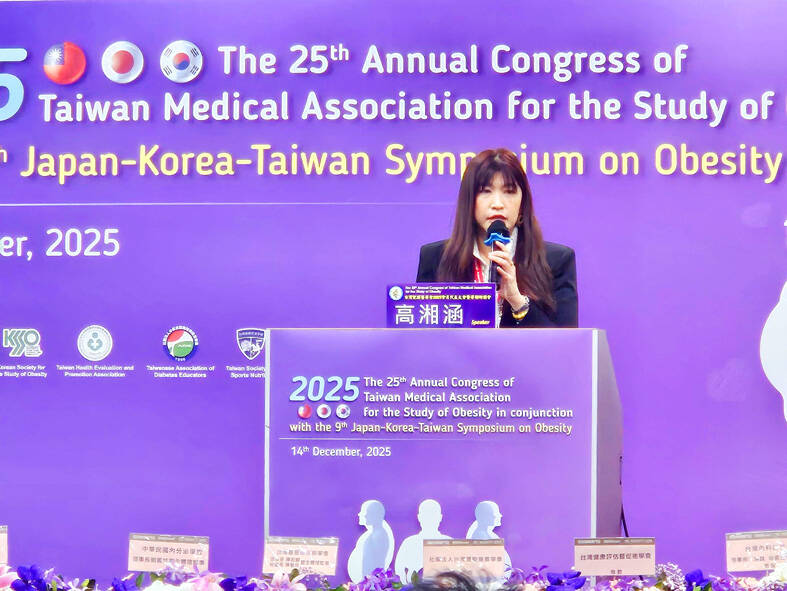
Photo: CNA
Association president Lin Wen-yuan (林文元) said the WHO’s new guidelines recognize that obesity is “a chronic disease that can be treated with comprehensive and lifelong care,” and that GLP-1 therapies might be used by adults for the long-term treatment of obesity, adding that it also stressed that medication alone could not reverse the serious health challenge.
The WHO classifies obesity as “a chronic, relapsing disease arising from complex interactions between genetics, neurobiology, eating behaviors, access to healthy diet, market forces and the broader environment.”
GLP-1 therapies could support people in overcoming obesity, as “a part of a comprehensive approach that includes healthy diets, regular physical activity and support from health professionals,” the WHO says.
Lin said the 2025 Clinical Practice Guidelines on Adult Obesity in Taiwan redefined obesity — not only looking at a person’s body mass index (BMI), but also their waist circumference, body composition and metabolic risks — allowing the diagnosis to be more refined.
The guidelines also added more diversity to the recommended treatment of obesity, including lifestyle adjustments, nutrition intake and regular physical activity plans, mental support, medications (including GLP-1 therapies), endoscopic bariatric therapy, and bariatric surgery, he said.
Moreover, the guidelines provide more customized care recommendations for different groups of people with obesity, including elderly people, pregnant women or women going through menopause, he said.
They also emphasize patient-centric treatment with empathetic communication, while refusing stigmatization, he said.
The WHO defines obesity as having a BMI of 30 or higher in adults, and Taiwan’s guidelines define it as a BMI of 27 or higher.
Association secretary-general Kao Hsiang-han (高湘涵) said according to the new guidelines, people with a BMI of 27 or higher, along with at least one comorbidity, are eligible for GLP-1 therapy, while people with a BMI of 24 to 27 are overweight, meaning that they are advised to first receive lifestyle intervention for several months before considering the use of GLP-1 therapies.
However, Lin said the association has also observed abusive use of GLP-1 therapies, such as being used by people who are not obese or excessive use, which could cause health risks including substantial muscle loss.
People should only receive GLP-1 therapies prescribed and monitored by health professionals, he added.
Additional reporting by CNA