
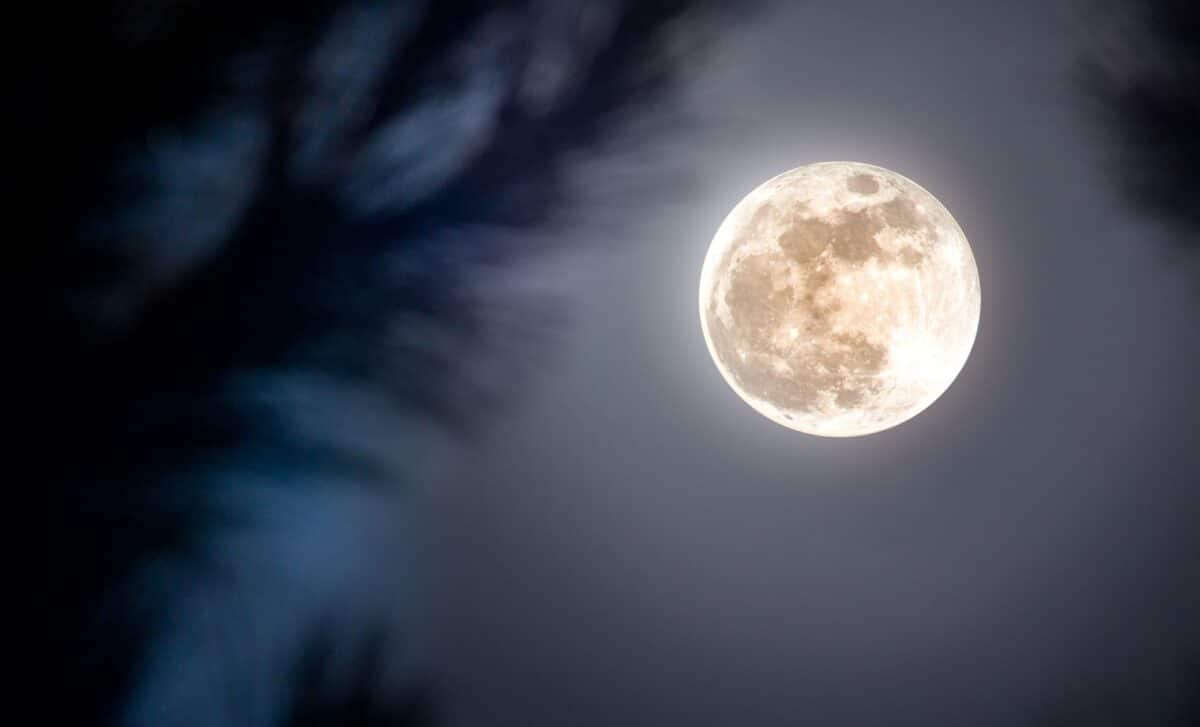
For decades, scientists have held to the idea that the Moon was formed by a single, massive impact between Earth and a Mars-sized body known as Theia. But recent research suggests the truth might be more complicated. New models propose that the Moon’s birth could have involved not one, but three significant collisions in the early days of the solar system.
This new hypothesis could solve some lingering questions about the Moon’s composition and its connection to Earth. The three-impact theory challenges the traditional single-impact model, which has struggled to explain certain chemical differences between Earth and the celestial body.
The Traditional Model: One Giant Impact
The most widely accepted explanation for the Moon’s formation has been the giant impact theory. According to this model, Earth collided with Theia, a body roughly the size of Mars, around 4.5 billion years ago. The impact sent a massive amount of debris into space, which eventually coalesced to form the Moon. This theory has been supported because it explains many of the similarities between Earth and the Moon, particularly their compositions.
However, some problems remain. For instance, the Moon and Earth have subtle differences in chemical composition, such as variations in their oxygen isotopes, which are difficult to reconcile with the idea that the lunar body formed solely from Earth’s debris. This has led researchers to reconsider the single-impact hypothesis and explore alternative explanations, such as the possibility of multiple impacts.
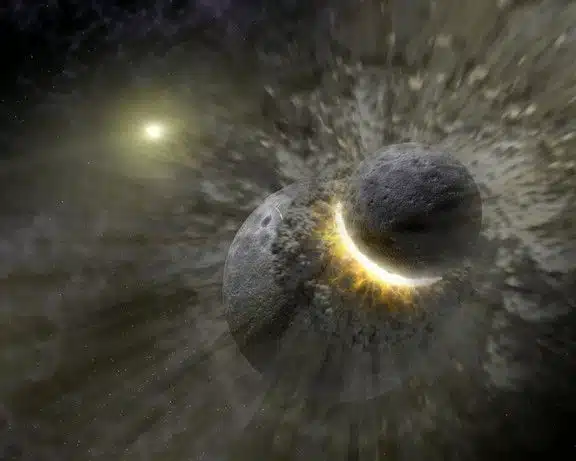 Earth’s Moon is thought to have formed in a tremendous collision. Credit: NASA
A New Theory: Three Impacts Instead of One
Recent research, available onMonthly Notices of the Royal Astronomical Society, suggests that the Moon’s formation could have been the result of not one, but three major impacts.
According to this model, Earth was struck multiple times by objects of varying sizes, including Theia, over the course of its early history. These successive collisions would have contributed to the accumulation of material that eventually formed the Earth’s satellite.
This multi-impact theory offers a more satisfying explanation for the chemical and isotopic differences between Earth and the Moon. For example, it could account for the Moon’s relatively lower density compared to Earth, as well as the differences in their isotopic makeup. Multiple impacts would have allowed the lunar sphere to gather material from various sources.
“After three impacts, we put enough mass into orbit to make a full moon,” said Philip Carter at the University of Bristol.
Shifting Views on the Birth of the Solar System
A multi-impact scenario suggests that Earth’s early history was even more chaotic than previously thought, with numerous large bodies colliding with our planet over time.
Also, the Moon’s formation is crucial to understanding Earth’s long-term climate stability. The Moon’s gravitational influence has helped stabilize Earth’s axial tilt, contributing to a relatively stable climate. If the silver sphere was formed through multiple impacts, it may also change how we think about the conditions that allowed life to develop on Earth.
Testing the New Model
Although the three-impact theory is still a hypothesis, scientists are working to test it through computer simulations and analysis of lunar samples. If proven correct, this new model could significantly alter our understanding of the Moon’s origin and the early dynamics of the solar system.
“To actually calculate everything in detail is still really hard to do,” explained Robert Citron at the Southwest Research Institute in Colorado. “Personally, I favour this multiple-impact model over the canonical single-impact model.”
The challenge remains that much of the evidence from Earth’s early history is difficult to uncover. However, if this idea holds true, it could offer the missing piece of the puzzle that has perplexed scientists for decades about Earth’s companion.