
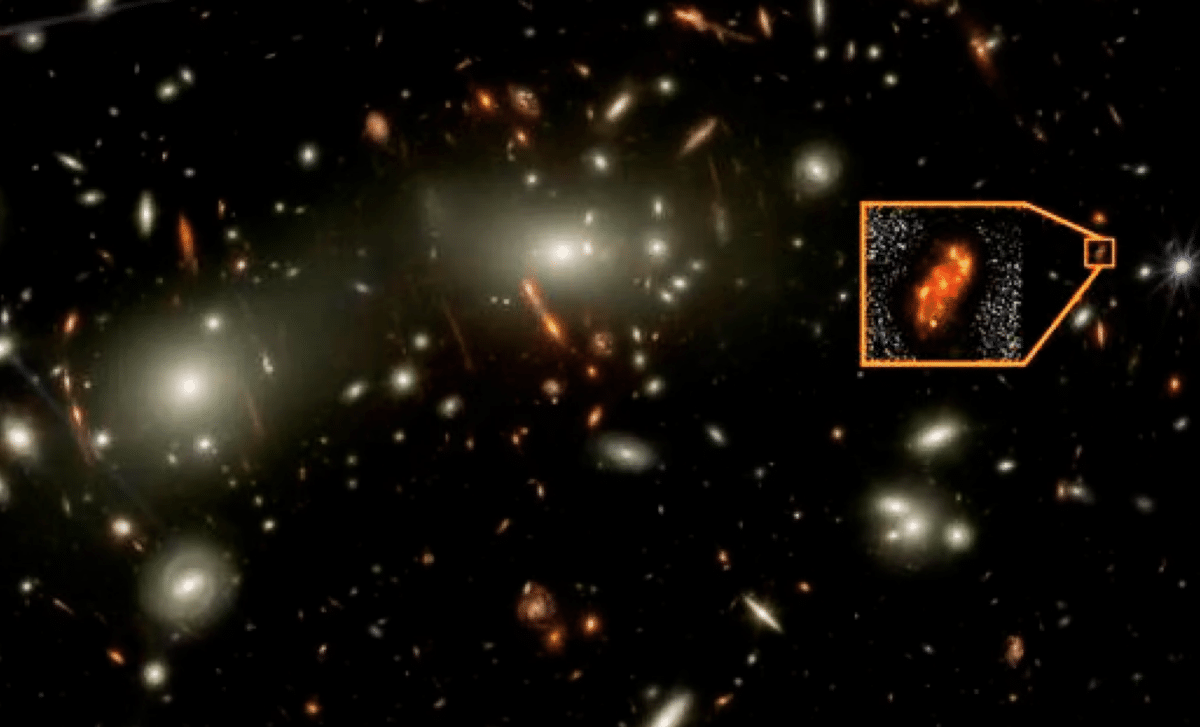
The discovery of a distant, well-structured spiral galaxy named Alaknanda has astounded scientists, revealing new insights into the early universe’s ability to form galaxies in an orderly manner. Observed by NASA’s James Webb Space Telescope, the galaxy challenges previous assumptions about cosmic evolution. Published in Astronomy & Astrophysics, this groundbreaking study sheds light on the rapid formation of galaxies in the young universe.
Alaknanda: A Glimpse into the Early Universe’s Galactic Formation
The Alaknanda galaxy, discovered by astronomers using the James Webb Space Telescope, presents a mystery that researchers are eager to solve. Located about 12 billion light-years away, this galaxy was formed when the universe was just 1.5 billion years old, a mere fraction of its current age. For decades, scientists assumed that galaxies in the early universe were too turbulent to form the clean, organized spiral structures we see in more mature galaxies like the Milky Way. Instead, it was believed that young galaxies were chaotic, marked by irregular shapes and intense star formation. The detection of Alaknanda, however, is forcing astronomers to reconsider these assumptions.
The study, published in the Astronomy & Astrophysics journal, brings a new perspective on how early galaxies could have formed with remarkable speed and order. Unlike previous models that predicted slower, more disorderly galaxy development, Alaknanda’s structure suggests that the physical processes involved in galaxy formation might be far more efficient than current theories account for.
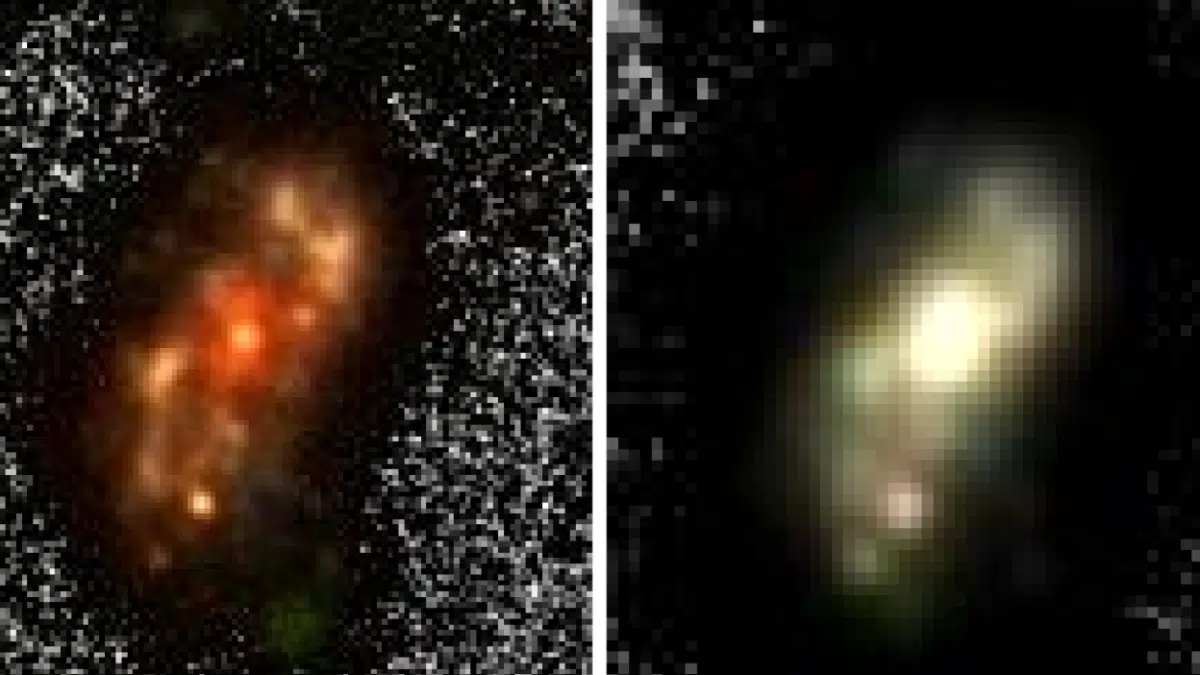 Left panel: Image of Alaknanda in rest-frame near-ultraviolet filters. The star-forming regions in the spiral arms form a beads-on-a-string pattern, characteristic of UV emission from massive stars in star-forming regions. Right panel: Alaknanda as seen in rest-frame optical filters. The spiral arms are less prominent and the underlying disk is clearly seen.
© NASA/CSA/ESA, Rashi Jain (NCRA-TIFR)
Challenging Long-Standing Theories: A Rapid Formation of a Spiral Galaxy
One of the most surprising aspects of Alaknanda is its spiral structure, which was thought to emerge only much later in the universe’s timeline. The galaxy’s two prominent spiral arms are remarkably smooth and well-ordered, characteristics that would have taken far longer to form in older models. Alaknanda, which spans approximately 32,000 light-years, is not just a distant, blurry image; it is a detailed, rotating disk with a clear pinwheel shape, showing that even at a mere 1.5 billion years old, galaxies could settle into well-defined forms.
Rashi Jain, the lead author of the study, emphasized the implications of this finding:
“The physical processes driving galaxy formation — gas accretion, disk settling, and possibly the development of spiral density waves — can operate far more efficiently than current models predict. It’s forcing us to rethink our theoretical framework.”
These findings suggest that the universe’s early conditions were more conducive to rapid galaxy formation than we previously understood, shaking the very foundations of our models.
Gravitational Lensing: A Natural Phenomenon That Revealed Alaknanda’s Secrets
One of the key techniques that allowed astronomers to observe Alaknanda in such detail was gravitational lensing, a natural phenomenon where the gravity of a massive galaxy cluster bends and magnifies the light from distant galaxies. This magnification process allowed the James Webb Space Telescope to capture incredibly detailed images of Alaknanda, revealing its structure and star-forming activity in a way that was previously impossible.
Gravitational lensing is like a cosmic magnifying glass, helping scientists study distant galaxies with far more precision than would otherwise be possible. In the case of Alaknanda, it enabled researchers to observe the bright, distinct clumps of newborn stars along its spiral arms, which form as gas collapses into dense pockets that ignite new stars. This level of clarity was crucial in understanding how Alaknanda could have developed its spiral structure so quickly in the early universe.
The Mystery of Star Formation: How Alaknanda Defied Expectations
Despite the vast distance separating us from Alaknanda, astronomers were able to estimate the age of its stars with remarkable accuracy. By analyzing the galaxy’s light across 21 different wavelengths, from ultraviolet to infrared, they concluded that its stars are only about 200 million years old. This rapid star formation means that Alaknanda experienced a burst of star birth not long after its formation, which is highly unusual for a galaxy so early in the universe’s history.
This burst of star formation challenges traditional models of galaxy evolution, which assumed that star formation would be a slower, more gradual process in the universe’s youth. Instead, Alaknanda’s stars are being created at a rate much faster than the Milky Way does today, roughly 63 new stars per year — dozens of times faster than our own galaxy. This suggests that Alaknanda is still in an active growth phase, and its structure could change further as more stars and gas are incorporated into its evolving spiral disk.