
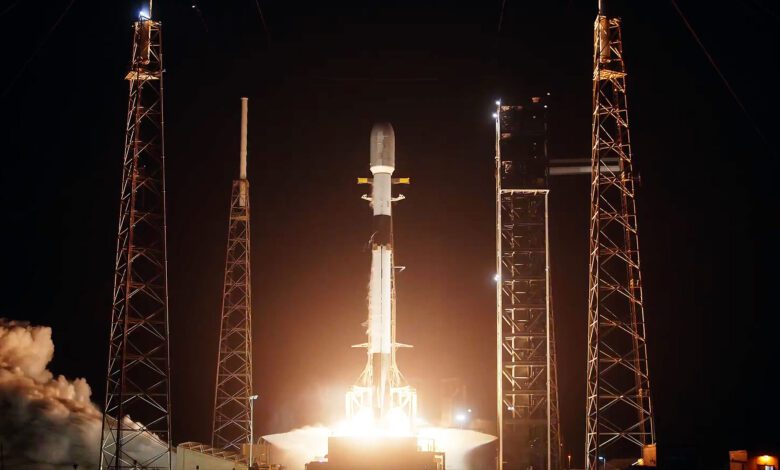
Early Monday morning, while most Florida residents were still asleep, the sky over Cape Canaveral lit up with a bright flash: a SpaceX Falcon 9 rocket confidently launched from the SLC-40 pad, defying unfavorable weather forecasts. This time, 29 new Starlink satellites were sent into orbit to expand the global satellite internet network. The launch took place at 12:25 a.m. Eastern Time, and just 8 minutes and 40 seconds later, the two-stage rocket reached space, leaving behind threats of strong winds and thick clouds.
The flight took place under conditions where weather risks could have scrubbed the mission, but the SpaceX team decided not to delay the launch. After reaching orbit, the Falcon 9’s upper stage was set to deploy the Starlink Group 6-82 satellites about an hour later, following a brief coasting phase and a second ignition of the Merlin engine.
Meanwhile, the rocket’s first stage, having completed its mission, separated and embarked on its independent journey back to Earth. Using its own engines, it made a gentle landing on the autonomous drone ship “A Shortfall of Gravitas” in the Atlantic Ocean. This marked the ninth flight for booster B1092, underscoring the high reliability and reusability of SpaceX technology.
Launch series
This launch continued the company’s intense schedule: just a day earlier, another batch of Starlink satellites was deployed from the California site. In doing so, SpaceX demonstrates its ability to carry out complex operations almost without interruption, utilizing different launch sites on both U.S. coasts.
Monday’s mission marked the 163rd Falcon 9 launch in 2025, with the next launch scheduled just a day later—on Tuesday, December 16, from Kennedy Space Center. This pace enables Elon Musk’s company not only to maintain, but to accelerate the rollout of its global satellite network.
Technology and ambition
Each Starlink launch is more than just another batch of satellites—it’s a step toward creating affordable internet access in the most remote corners of the planet. Reusable Falcon 9 boosters significantly lower mission costs and speed up the deployment of new satellites. This time, all flight stages proceeded as planned, and the first-stage landing once again proved the effectiveness of SpaceX’s chosen strategy.
SpaceX continues to advance its technology, making spaceflight safer and more predictable. Despite weather challenges, the team of engineers and operators ensured the successful execution of all tasks related to launch and landing.
Global coverage
The Starlink network already covers much of the globe, providing high-speed internet in regions where traditional providers cannot offer reliable connectivity. Each new launch brings the company closer to its goal of making the internet truly global and accessible to millions of users.
SpaceX’s plans include further expanding its satellite constellation and developing new technologies to increase bandwidth and reduce signal latency. Several more launches are expected in the coming months, which will boost coverage density and improve service quality.
If you didn’t know, SpaceX is a private aerospace company founded by Elon Musk in 2002. It became the first in the world to return a rocket’s first stage to Earth for reuse. The Starlink program launched in 2019 and has already placed thousands of satellites into orbit, providing internet access in dozens of countries. The company actively collaborates with NASA and other international organizations, and its missions regularly set new records for launch frequency and reliability.