
Back to Article List
Saturn’s moon Titan reappears from occultation, then passes south of fainter moon Tethys later this evening.
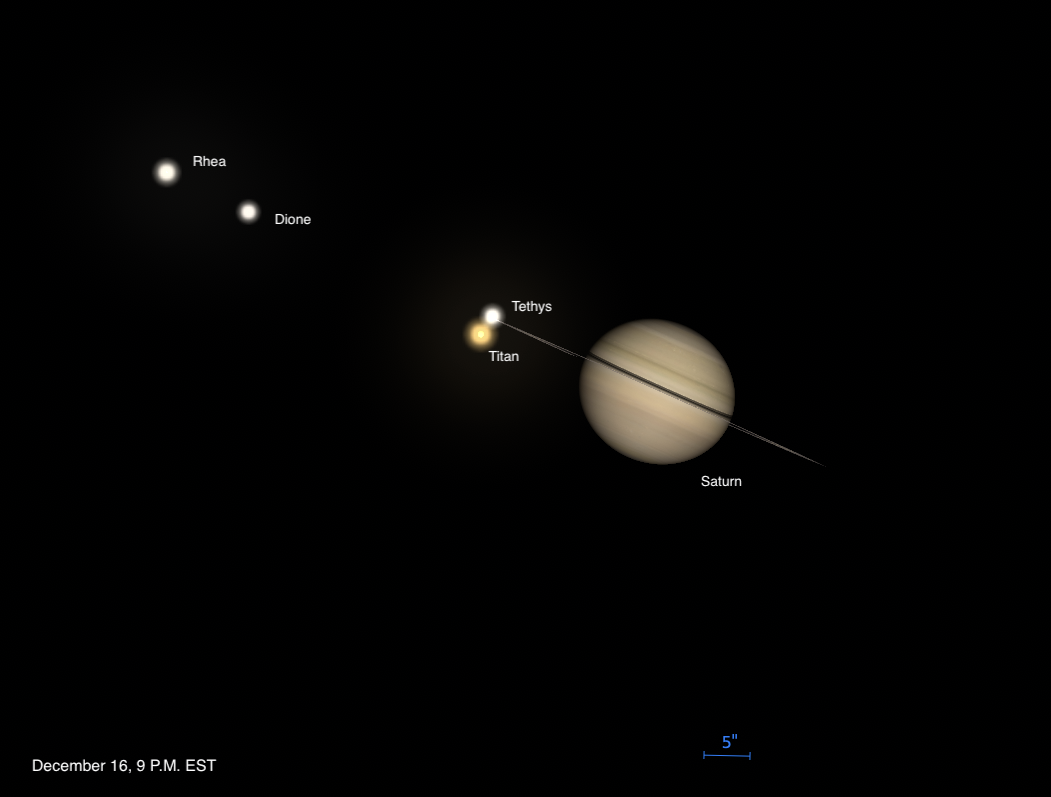
Titan and Tethys make a close pass near the eastern edge of Saturn’s rings on the evening of December 16, with Rhea and Dione also visible to the east of the planet. Credit: Stellarium/Oleg Pluton
On December 15, the moon Titan will reappear from occultation for observers in Europe and the U.K., subsequently engaging in a close apparent conjunction with Tethys near Saturn’s eastern rings, visible from the U.S.
During the December 15 observation period, Saturn will be well-placed at approximately 45° above the southern horizon, facilitating telescopic viewing.
The morning of December 17 features a celestial alignment of the waning crescent Moon and Mercury, separated by an angular distance of approximately 10 degrees in the southeastern pre-dawn sky.
Telescopic observation on December 17 reveals Mercury as a magnitude -0.5 object, 6 arcseconds in apparent diameter and 82 percent illuminated, with the first-magnitude star Antares also rising near its position.
Looking for a sky event this week? Check out our full Sky This Week column.
December 15: Dione and Titan play tag
We’re zooming in on Saturn tonight for some action among its moons, starting with Titan reappearing from occultation in an event visible to observers in Europe and the U.K. The large moon appears at the southeastern limb (south of the rings) around 21:56 UT (4:56 P.M. EST) — this is very shortly after sunset on the U.S. East Coast and will likely be difficult or impossible to watch from this location in the still-bright sky.
Shortly after sunset, Saturn will appear some 45° high in the southern sky, the brightest light in this region and easy to center in a telescope.
U.S. observers will be able to catch 10th-magnitude Tethys and mid-8th-magnitude Titan passing each other near the eastern edge of the rings just after 9 P.M. EST. Prior to this time, Titan is south of the rings and moving east, while fainter Tethys is approaching the planet, nearly in line with the edge-on ring system. Shortly after 9 P.M. EST, the two moons are 2” apart as Titan slides south of Tethys. As with the meetings of Dione and Titan last night, this will be at the resolution limit of some telescopes and observers might see the two moons appear to merge rather than pass.
After this time, Tethys will likely be lost as it moves in front of the rings and prepares to transit Saturn, while Titan will continue pulling away to the east.
Sunrise: 7:16 A.M.
Sunset: 4:36 P.M.
Moonrise: 4:17 A.M.
Moonset: 2:01 P.M.
Moon Phase: Waning crescent (8%)
*Times for sunrise, sunset, moonrise, and moonset are given in local time from 40° N 90° W. The Moon’s illumination is given at 10 P.M. local time from the same location.
The morning sky of December 17 brings a lovely scene as the crescent Moon joins bright Mercury in the southeast before sunrise. The pair stands 10° apart in the predawn sky, about 9° above the horizon by 6:45 A.M. local time. The Moon is in southeast Libra, visible as a 6-percent-lit waning crescent at this time with only a sliver of its western limb illuminated. Our satellite sits to the upper right of Mercury; the planet is in far eastern Scorpius, preparing to move into Ophiuchus (where it will reside by tomorrow morning). For now, the claws of Scorpius sit between the Moon and Mercury.
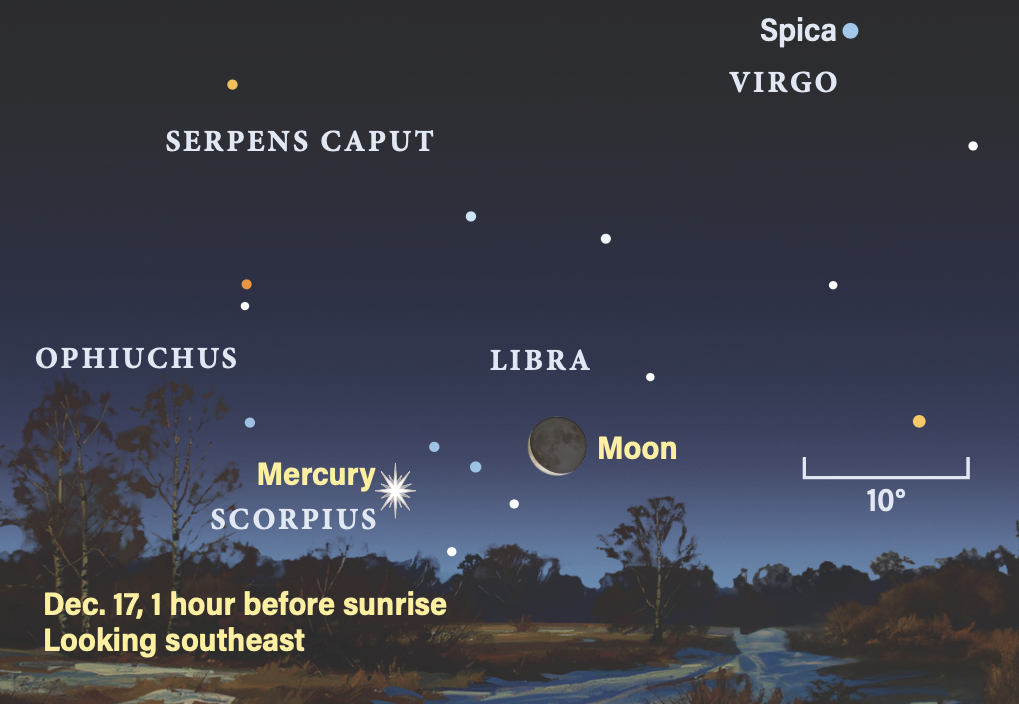
The thin crescent Moon, lit by earthshine, joins bright Mercury in the morning sky before dawn Dec. 17. Credit: Astronomy: Roen Kelly
Through a telescope, magnitude –0.5 Mercury appears 6” wide and is 82 percent illuminated. If you have a clear southeastern horizon, keep an eye out for Antares, Scorpius’ 1st-magnitude alpha star, as it rises around 6:30 A.M. some 6.5° to Mercury’s lower right.