
Measures target dollar shortages as won slides; presidential office seeks support from top conglomerates
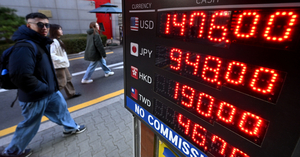
 An electronic board at a currency exchange shop in Myeong-dong, central Seoul, shows the won quoted at 1,476 per dollar, Thursday. (Im Se-jun/The Korea Herald)
The Korean government on Thursday rolled out a package of measures to overhaul its foreign exchange framework, aiming to correct structural supply-demand imbalances blamed for the won’s recent weakness.
With the Korean won struggling to hold its value against the dollar, tumbling to its weakest in eight months on the prior day, the local authorities are deploying measures across multiple fronts to support the won.
“In the past, when Korea was a net external debtor, we were focused on blocking dollar inflows as limiting the level of external debt was the top priority,” a Finance Ministry official said at a press briefing held Thursday.
“With the rise of overseas investment leading to structural outflows, however, it is necessary to dismantle outdated regulations that restrict inflows and open channels to improve supply-demand.”
In an effort to encourage local banks to provide more dollar supply, regulations related to advanced foreign-currency liquidity stress tests for local financial institutions will be suspended until the end of June next year.
Stress tests are conducted to measure how well financial entities could withstand the worst-case market scenario, which in turn pressures them to beef up their dollar holdings to secure foreign currency liquidity.
“Conservative domestic financial institutions, including banks, tend to hold far more foreign currency than required by supervisory standards in order to prepare for unexpected shocks,” the official said.
“Suspending the requirement is expected to have the greatest impact among the measures, in terms of releasing dollars into the market.”
The government will also raise the cap on banks’ currency forward positions, allowing banks to have more flexibility in their foreign currency management.
Though foreign banks’ Korean subsidiaries — including Standard Chartered Bank Korea and Citibank Korea — borrow foreign currency from their overseas headquarters and deploy it in the local market, they have been subject to the same 75 percent regulatory ratio as domestic lenders.
The authorities plan to raise the cap for the entities to 200 percent, giving them more room to bring in offshore dollars to the domestic market.
In addition, the authorities will further ease restrictions on the domestic usage of foreign currency-denominated loans.
While local residents were barred from borrowing foreign currency and converting it into won for use at home, the government partly allowed exporters to take out foreign currency loans for domestic facility investments following the won’s drop at the end of last year.
Under the latest measures, such loans will also be permitted for exporters’ domestic working capital purposes, meaning day-to-day operational needs.
With the won’s latest decline partly driven by foreign capital outflows from the equity market, the authorities said they will adopt measures to encourage capital inflows into Korea, such as clarifying that foreign-listed companies are recognized as professional investors and promoting the use of integrated accounts for foreign investors.
On the same day, Kim Yong-beom, the presidential chief of staff for policy, convened an emergency meeting with representatives from seven top conglomerates in the country, including Samsung, SK, Hyundai Motor, LG, Lotte, Hanwha and HD Hyundai.
Local companies’ rising tendency to hold on to their dollar earnings, instead of converting them into won, has been pointed out as a factor driving the won’s decline. In recent weeks, the government has repeatedly stressed the need for companies to commit to stabilizing the market.
Though the presidential office did not disclose the details of the meeting as of press time, the meeting was set to focus on the latest developments in the forex market and measures to ease the downward pressure on the won.
silverstar@heraldcorp.com