
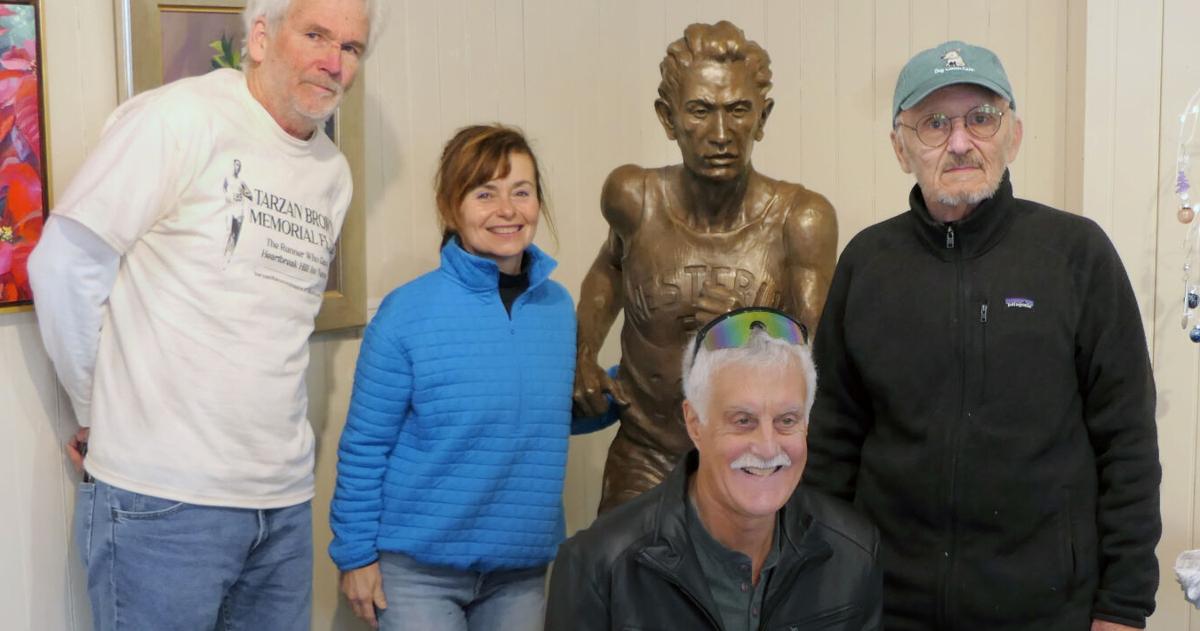
WESTERLY — Two employees from the town’s department of public works came to the rescue earlier this week by helping place a heavy bronze statue honoring the late Ellison “Tarzan” Brown in its temporary home inside the former Westerly Train station at the Artists’ Cooperative Gallery of Westerly.
Brown, a member of the Narragansett Indian tribe of Rhode Island, was a legendary runner who came in 13th in the 1935 Boston Marathon with a time of 2:33:40, despite minimal training, wearing old sneakers and running the last 5 miles barefoot. Born on Sept. 22, 1913, in the Christian Hill section of Westerly, Brown, known for his natural athleticism and strength, earned the nickname “Tarzan” due to his love for climbing trees and swinging from branches.
When the roughly 250-plus pound, six-foot statue created in his likeness arrived on Railroad Avenue Thursday afternoon — in the back of a rented U-Haul truck driven by Joseph Pellegrino and accompanied by James Hirst — after a two-hour drive from a foundry near Boston — the question of how to maneuver the sculpture from its secure lodging in the back of the truck and into the gallery hung in the December air along with the opinions of onlookers who began to gather and offer advice.
Pellegrino and Hirst, both longtime local runners and members of the Westerly Track & Athletic Club, are also founding members of the Ellison “Tarzan” Brown Memorial Fund — along with Larry Hirsch, Nick Bottone Jr., Tarzan Brown’s nephew, Byron “Benny” Brown and his granddaughter and Tarzan’s grand-niece, Summer Gonsalves.
The non profit organization was founded earlier this year with the goal of raising funds to have a bronze statue made of the legendary Westerly native who the name “Heartbreak Hill,” a difficult climb along the Boston Marathon route.
In an interview earlier this year, Hirsch, who was himself a nationally ranked Masters runner, called Tarzan Brown, “a true, true hero.”
Once much of the money was raised, the group commissioned Westerly sculptor Serena Bates to design and create the statue, then began scouting locations for its permanent placement.
Various spots were explored and discussed, from the Tomaquag Museum’s future location at the University of Rhode Island to Wilcox Park. Finally, with permission from the Town of Westerly, the group decided on Rooney Park, the small piece of land next to the train station owned by the town. A small cement slab was poured and prepared earlier this year, but the decision was made to wait until spring when temperatures are more conducive, to secure the statue in place.
“Maybe on the same day as the day as the Boston Marathon,” said Bates as she waited by the train station for the statue to arrive. Until then, she said, the Tarzan Brown statue would be housed in the cooperative gallery.
“They are graciously hosting,” Bates, a member of the gallery, said with a smile.
On Thursday morning, Pellegrino and Hirst had traveled to Canton, Massachusetts to pick up the statue at the foundry where they had help securing the sculpture safely in the truck.
When they arrived in Westerly, however, only Bates, her husband, Rick Mann, Bottone, and John Chen, a Westerly native who lives in California, but is in town for the holidays, were in attendance.
“I’m only here because Larry (Hirsch) called me and told me the statue was arriving,” said Chen with a laugh as he scratched his head with the others, contemplating the best way to get the 250-pound statue safely down from the truck and into the building.
“We had an uneventful trip until now,” said Pellegrino with a chuckle, as he pondered the situation.
That’s when Hirsch, who was directing operations from his home, placed a call to Town Manager Shawn Lacey.
Within minutes, Tracy Pityer and Caleb Dimock, members of the Westerly department of public works, arrived and set to work.
After several anxiety-producing minutes, with some people watching and everyone else working together, the men safely lowered the statue onto a dolly.
“Beautiful,” shouted Bates, as she clapper her mittened hands. “Beautiful.”
Moments later, the men engineered the statue through the gallery doors and into its winter home, beside two colorful Rosemary Webber oil paintings, “Poinsetta,” and “Celebrate the Season.”
“I chose a great day to be here,” said artist Donna Mazzone of West Greenwich who was tending the gallery for the afternoon.
“We’re very proud of all the work coming together,” said Hirst with a sigh.
“It’s been a long and fruitful journey,” said Pellegrino. “I am just so grateful to the town. It’s amazing how fast it all came together.”
“Just look at all the history here,” said Pellegrino as he stared at the statue, “and the statue.”
In an email Friday afternoon, Town Manager Lacey called the statue “a great tribute to Tarzan” and to the whole community.
“It’s a symbol of what we can do when we work together,” Pellegrino said.
It’s important to keep the awareness of Brown and his legacy, alive, Pellegrino added. “Even by today’s standards, he was amazing as was his record.”
Tarzan Brown won the Boston Marathon in 1936 (2:33:40) and 1939 (2:28:51) and competed in the 1936 Olympic marathon in Berlin.
It was during the 1936 Boston Marathon, when he was 22, when Tarzan overtook runner Johnny Kelley, who had been in the lead, on one of the hills near the end of the course, breaking Kelley’s heart. Boston Globe sports editor Jerry Nason, who had been watching Kelley, coined the name “Heartbreak Hill.”