

It’s a big call to say a meal was life-altering, but for Stephen Harris, it was a 1992 lunch that put him on the path to becoming chef-proprietor of one of Britain’s most loved and lauded restaurants, The Sportsman in Whitstable, Kent.
Harris had studied history, played punk music and worked as a teacher before ending up in finance in London, a role that meant plenty of fine dining. Then, one extraordinary lunch switched on a light bulb, a Michelin-starred light bulb, that led him to swap the spreadsheets for stove tops.
“I didn’t even know what a Michelin star was”, he recalls, “I went to a two-star restaurant on Park Lane and it was perfection. That restaurant went on to get three stars, Nico Ladenis’s Chez Nico.” He was floored by the quality, the service, the dishes.
As a keen home cook, he found himself breaking it all down in his mind, “like I always do.” He figured, “It’s only a bit of meat with gravy and some potatoes and veg,” and remembers thinking, “Why can’t you do this in a pub? Wouldn’t it be great?”
That lunch led to his career pivot. “All my friends thought I was mad because I left my quite well-paid job in finance and I ended up as a commis chef in a restaurant down in Waterloo.”
He wanted to open his own place and his thought process was, “I wouldn’t think I could open a solicitor’s office without any experience. The only way to do it was to start at the bottom.” Conscious he was starting his cooking career later than usual, Harris eschewed a cookery course and instead turned to his extensive selection of cookbooks to teach himself:
“Meat, fish, academic books, I learned it all.” He says his academic background helped as he cross-referenced recipes and chefs. “I would look at the differences between, say, Nico Ladenis’s sauces and Marco Pierre White’s and decide which method I liked best.”
I was looking for the restaurant to have some really unique ideas
Books such ase Alastair Little’s Keep it Simple, Harold McGee’s On Food and Cooking, and Elizabeth David’s works became essentials. He’d focus a week at a time on a kitchen section – pastry, sauces, fish.
In 1999, he opened The Sportsman in a rundown pub in Kent – long before local and seasonal menus were de rigueur. It went on to earn a Michelin star in 2008 and has held it ever since. The Sportsman has won a myriad of other accolades since then and is considered an institution in the restaurant world, and a beacon for showcasing the bounteous Kent larder that surrounds it.
Harris grew up surrounded by that larder in the 1970s, picking fruit in summer and cooking with his mother – unusual, he says, for boys at the time. He tried to take cookery classes at school, but because his friend also wanted to do so and the pair were seen as disruptive, it didn’t happen.
Instead he absorbed knowledge from all around him – his home kitchen, from his first girlfriend’s mother who loved to entertain, and from cooking in France in his 20s, when he fed his work crew out of necessity. Later, in his finance days, eating out became another kind of education as he dissected meals and recreated them at home, “slowly becoming more obsessed”.
His latest book, The Sportsman at Home, reflects the innate curiosity he’s always had about food and cooking along with his methodical reading of cookbooks. His recipes are clear and approachable and the writing is thoughtful and brilliant.
Organised into relaxed chapters – Assembly, Dinner, Tea, An Ode to Cream, and Christmas – it invites readers into both his home and restaurant kitchens, which feel like extensions of one another.
In his Christmas chapter, he tells us that they’ve celebrated the day at the pub every year since 1999. “It is now seen as disloyalty to even think of arranging an alternative.”
His menu stays classic – turkey, ham, all the trimmings – because Harris is a self-confessed traditionalist.
His only “cheffy” touch is cooking the turkey sous vide. “Turkey is a pale meat anyway, and the idea of getting into the kitchen at 8am on Christmas morning to start cooking is not my idea of fun.”
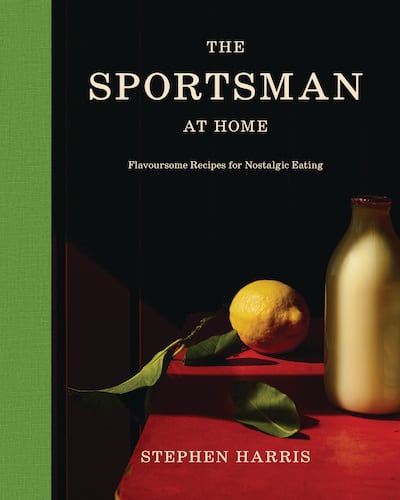 The Sportsman at Home cover. Photograph: Kim Lightbody
He starts his Christmas puddings in November, putting them together with his son Stanley. He also makes mince pies to leave out for Santa, a recipe he tweaks each year, “as a new idea always catches my eye”.
The book version features a crumble topping and tangerine sugar that would pair well with his orange-infused custard from the chapter, An Ode to Cream. Yes, he has a chapter dedicated to all things cream, which has long fascinated him.
When he was a child, he didn’t really like milk, but cream, that was another story. “I’d open the cream for apple pie on a Sunday, and I’d just have to have a couple of spoons from it.” It was the memory of cream from his childhood that went on to shape the Sportsman’s menu: “I’d be whipping the cream and my mum would always say, ‘Don’t over whip it, you’ll get butter’.”
Years later, in his restaurant kitchen, these words came back to him. He (purposefully) overwhipped some local unpasteurised Jersey cream, and made butter. It became the start of The Sportsman’s hyper‑local ethos. “I was looking for the restaurant to have some really unique ideas. Making our own butter, and this extreme kind of local idea came from that.”
In his pastry chapter, Baking and Making, Harris notes he never shared other chefs’ reluctance to take on desserts. “I had taught myself how to make mousses, ice creams and all sorts, and loved the slightly more precise nature of the work.” He shares decadent tarts, crumbles and cakes and even a recipe for Irish soda bread – is there an Irish connection?
“A few”, he says. His great-grandmother came to England from Co Clare, and when he was a child, his father worked in Dún Laoghaire for a while, so he visited Dublin in the 1980s, when the local bread made a lasting impression on him.
The last time he came to Ireland was in 2017 to cook at the West Waterford Festival of Food with Paul Flynn, a chef he’s unwittingly been connected to since that life-altering lunch in Chez Nico, because Flynn was the one in the kitchen that day.
Harris would love to cook in Ireland again, and with another book already in the works, there’s every chance he will. And he’s got plans for plenty more books.
“I’ve got a whole load of ideas and I hope each one would be slightly different and original. I’m really chuffed that people are still interested”.
Extract from The Sportsman at Home by Stephen Harris (Quadrille, £30.00)Christmas Ham Glazed with Mustard and Brown Sugar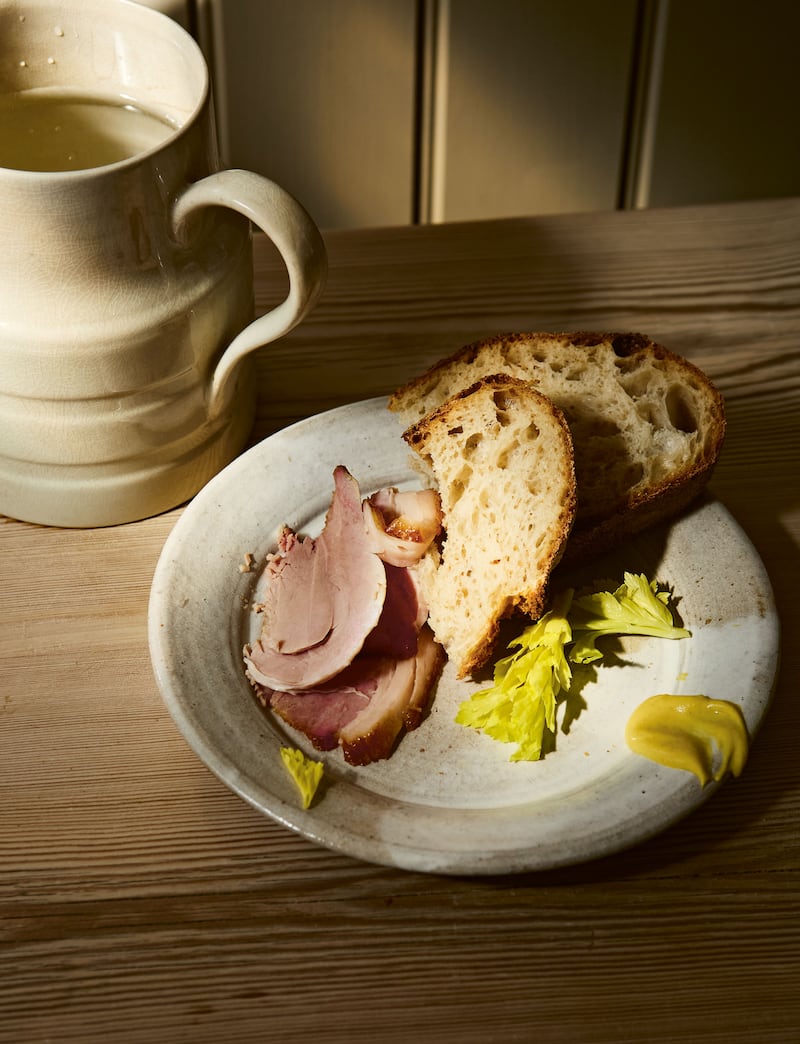 Christmas ham glazed with mustard and brown sugar. Photograph: Kim Lightbody
For years, I was mildly confused by the terms used when talking about ham – gammon, green, hock, dry cured and brined – and I allowed myself to stay that way until I decided to make my own one year, and now, I’m going to pass my learnings on to you.
When we talk about ham, we are dealing with the back leg of the pig, which can be divided into three parts: the hock (below the knee joint); the thigh, and the upper leg. In the past there have been discussions about the merits of bone-in or bone-out but I think, unless your kitchen is the size of a small country and your cooking and chilling capacity is similar, it’s best to go for bone out.
The three types of cut are then salted so they become gammon, and then smoked. If unsmoked, it is also known as green gammon. But back to salting. There are two ways that the ham can be salted, either by a brine – which is a solution of salt – or by dry curing, where the salt is rubbed into the meat dry.
I asked my butcher about his preference, and he said his were lightly dry cured so the meat wasn’t too salty, so before cooking, I’d recommend you also speak to your butcher. Before everyone had refrigerators, gammon could be very heavily salted as this preserves the meat for longer, so it can be the case that using older methods means you’ll need to take this into account for your own joint.
The next choice to be considered is the method of cooking, namely in water or in the oven.
Whether you boil or roast your gammon, it needs to be cooked to 65 degrees in the middle, and my preference is to cook it in water first, because I like to serve a couple of slices with parsley sauce after this first stage, then leave the rest of the ham for glazing in the oven.
I always make my ham a day or two before Christmas, and I remove the skin once boiled in water, but not the fat. The skin is the thin layer on top of the fat, and should peel off easily before the ham has cooled completely. At this point, once I’ve hived off my slices for the parsley sauce treatment, I score the fat and glaze it with a mixture of brown sugar, mustard, soy sauce and apple juice and roast in the oven.
Once cooked, I tend to leave it on the counter for cold cuts, sandwiches and general snacking between Christmas and New Year. The ham sandwich with scalp-tingling amounts of mustard that I eat in the evening on Christmas Day is without doubt one of my food highlights of the year.
Serves 10-12
• 3.2kg unsmoked (green) boned gammon (uncooked ham) joint (mine was dry salted but was not heavily salted)
• 2tbs Dijon mustard
• 2tbs dark brown soft sugar
• 4tbs light soy sauce
• 4tbs apple juice
• Pinch of chilli (hot pepper) flakes
Put the ham into a large saucepan and cover it with water. Bring to the boil, and when it is nearly boiling, pour off the water. This will remove some of the saltiness and any impurities from the outside of the ham.
Cover the ham with fresh water, then bring to a simmer again and cook for three hours. The water temperature should be around 75 degrees and, when cooked, the internal temperature of the ham should reach 60 degrees when measured on a probe thermometer.
Remove the pan from the heat and leave the ham in the cooking water to cool for a few hours. This will stop the ham from drying out.
When the ham is cool enough to handle, remove it from the pan and place on a cutting board. Use a small knife to remove the layer of skin on the top of the ham, being careful to leave the fat (this will likely entail removing the string that is tying the boned joint together).
I use my fingers to get between the skin and the fat and then it peels off easily. It is now ready to be glazed, but can also be eaten now.
Preheat the oven to 180 degrees fan.
Combine the mustard, sugar, soy sauce, apple juice and chilli flakes in a small saucepan and boil until they form a sauce.
Score the fat on the top of the ham and brush it generously with the glaze. Place the ham in a roasting tin and bake in the oven for 20–30 minutes until sticky and browned, basting once. Remove the ham from the oven and serve. It will keep, covered, in the refrigerator for several days.
Sprouts, Chestnuts and Bacon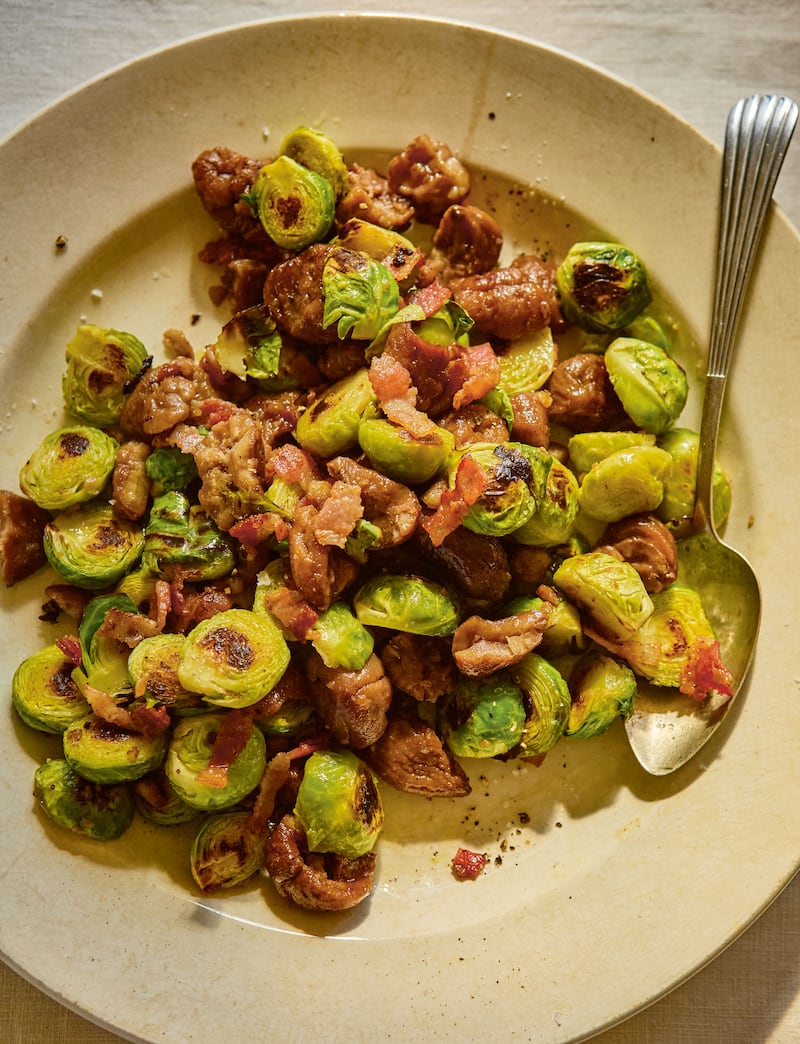 Sprouts, chestnuts and bacon. Photograph: Kim Lightbody
There comes a time in most people’s lives when they realise that sprouts are delicious – but there is no harm in helping this process along by adding some bacon and chestnuts. This is real Christmas food for me, and essential with the turkey or goose.
Serves four
• 4 thick slices of unsmoked back bacon, cut into batons
• 20 sprouts, halved
• 200g tin of chestnuts
• Knob of unsalted butter
• Salt
Fry the bacon in a dry frying pan until the fat starts to render and brown, around five minutes.
Remove the bacon to a plate but leave the fat in the pan. Add the sprouts cut side down and fry over a medium heat until they start to brown and soften, around 10 minutes.
If they threaten to burn before they are cooked, add a splash of water and carry on cooking until a knife easily penetrates a sprout.
Add the chestnuts and heat through, then return the bacon to the pan and add a knob of butter. Toss until melted and coating the sprouts and chestnuts. Check the seasoning and add salt of needed.