
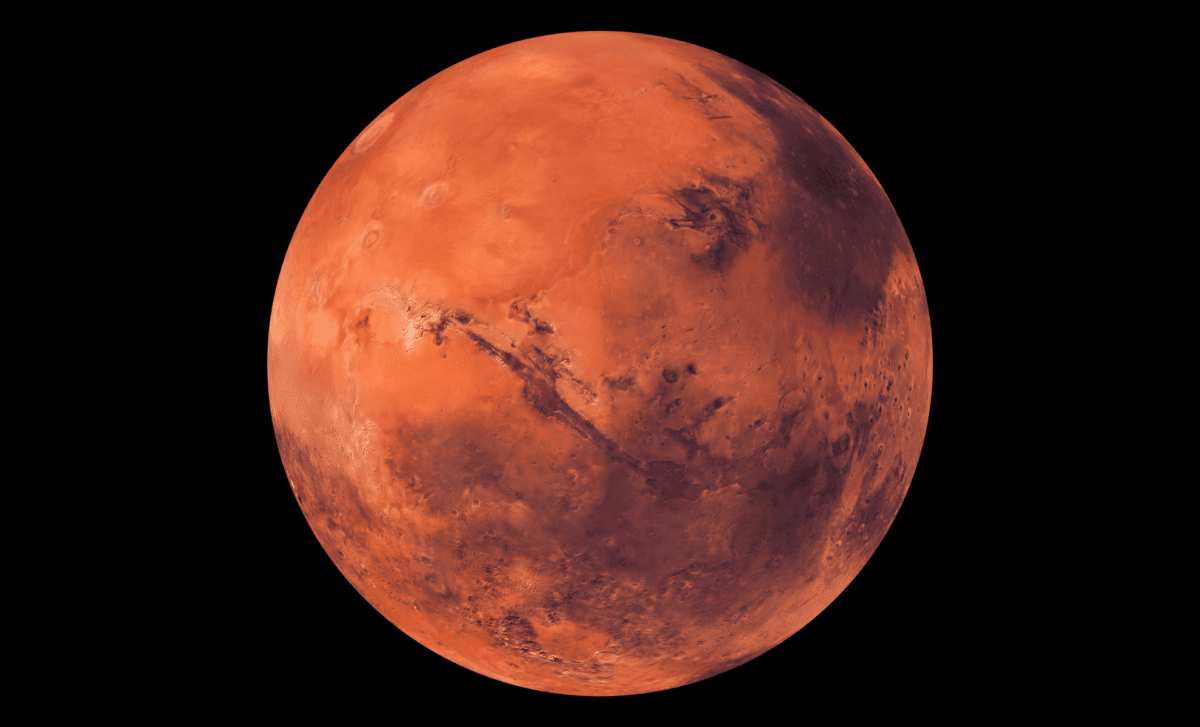
In a groundbreaking study published in Advances In Atmospheric Sciences, researchers from the Institute of Atmospheric Physics (IAP) of the Chinese Academy of Sciences have developed the GoMars model — an advanced simulation that reproduces a full Martian year on Earth. The project represents a major step in understanding how the Martian atmosphere behaves and evolves, offering critical insights for future Chinese missions to Mars.
Simulating Mars On Earth: A Leap Toward Understanding An Alien Climate
The GoMars project aims to replicate the entire atmospheric cycle of Mars, including dust storms, temperature fluctuations, and carbon dioxide cycles that define the planet’s harsh environment. Built as a next-generation Mars General Circulation Model (MGCM), it simulates an entire Martian year — equivalent to roughly 687 Earth days — capturing subtle patterns invisible in shorter simulations.
Researchers say this model represents China’s first fully independent framework capable of integrating data from Mars orbiters and rovers into a cohesive simulation.
“The Martian dust cycle is a complex system with significant diurnal, seasonal, and interannual variability. Accurately simulating this cycle remains a core goal—and a major challenge—in the development and refinement of Mars general circulation models (MGCMs), which will support China’s future Mars exploration missions,” said Liu Shuai, a Ph.D. candidate at IAP and first author of the study.
Through GoMars, scientists can now analyze how dust lifting, atmospheric circulation, and solar radiation interact to produce the planet’s global dust storms — events capable of enveloping the entire planet and blocking sunlight for weeks.
Pioneering The Next Generation Of Planetary Climate Models
Unlike earlier atmospheric models that relied heavily on NASA or ESA datasets, GoMars incorporates a blend of international observations and localized computational parameters. The team leveraged supercomputing systems in Beijing to simulate intricate dust and temperature dynamics that determine how Mars’ thin atmosphere redistributes heat.
This deep modeling approach is helping scientists decode patterns in pressure gradients and thermal tides, revealing why the Martian atmosphere is so sensitive to small perturbations in dust density. The team believes these findings will play a decisive role in shaping China’s next Mars orbiter mission, expected in the early 2030s.
“Our next step will focus on enhancing the model’s resolution while continuously optimizing its dynamical core and physical parameterizations,” said Prof. Dong Li, co-author of the study. “Key improvements will include integrating more realistic data on surface dust and sand sources, refining the representation of dust-related physical processes, and expanding the model to simulate the Martian water cycle.”
From Simulation To Future Missions: Why GoMars Matters
According to Advances In Atmospheric Sciences, the GoMars initiative not only enhances China’s independent capacity in planetary science but also contributes to the global understanding of extraterrestrial climates. The model’s high-resolution framework can be adapted to explore exoplanetary atmospheres or simulate other terrestrial planets with similar thin atmospheres, such as Venus or Titan.
The results also carry practical implications for mission planning. Predicting dust storm seasons and atmospheric turbulence will help engineers design lander systems, aerobraking maneuvers, and power management strategies for solar-based missions. As China advances its Tianwen program, GoMars could become the central predictive engine behind surface operations, human habitat testing, and long-duration robotic explorations.