

Published
19/12/2025 às 22:53
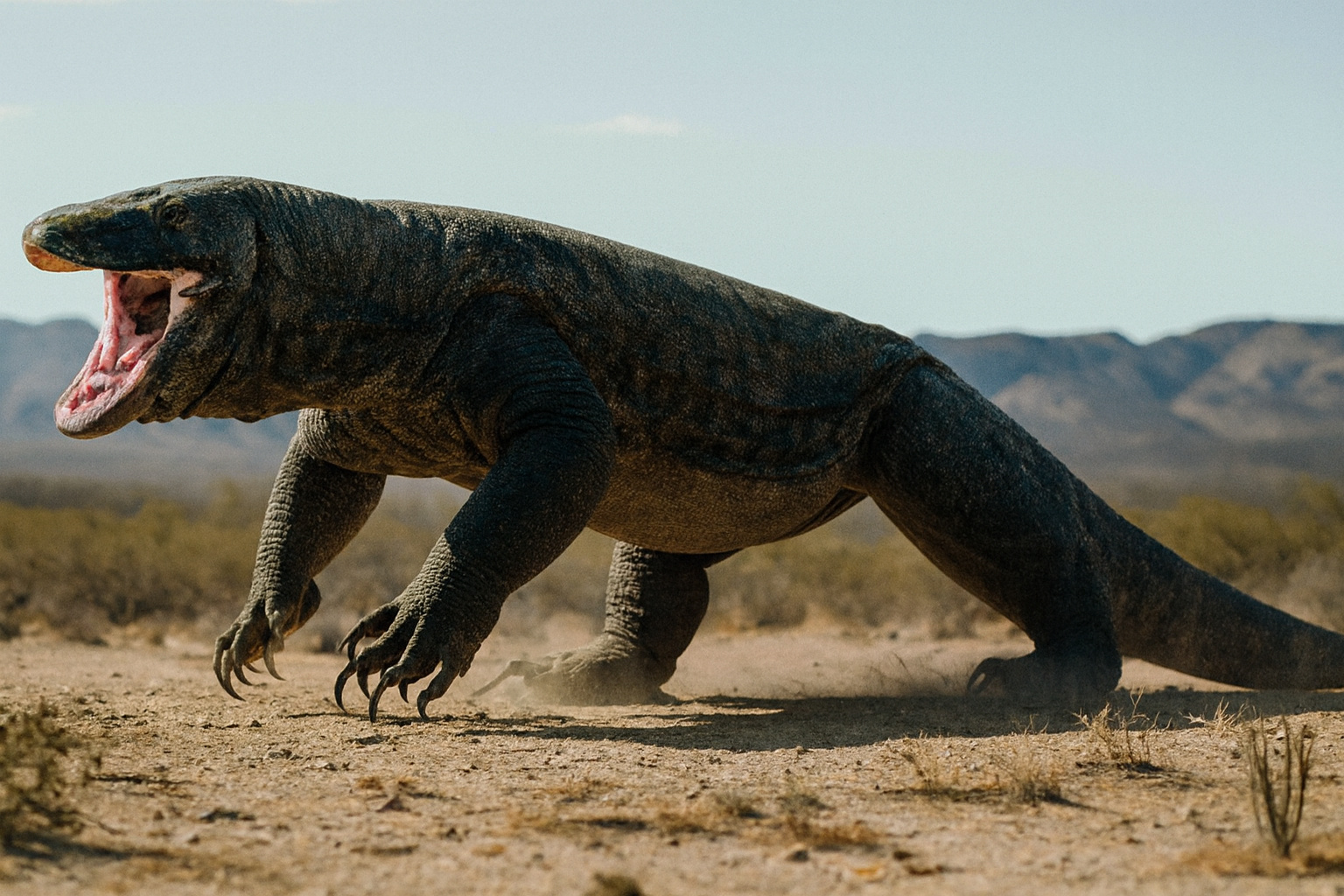
Long before human presence dominated Australia, a colossal predator reigned supreme on dry land. megalania, scientific name Varanus priscusThis pushed lizard gigantism to its highest documented limit. A distant relative of the Komodo dragon, it wasn’t just bigger—it was… Faster, more aggressive, and potentially poisonous., becoming one of the most feared terrestrial predators of the Pleistocene. The most widely accepted estimates indicate that Megalania could exceed 6 meters long, with some studies suggesting even larger individuals. Their weight is estimated between 600 and 1.000 kg…depending on the specimen and the reconstruction model. In scale, this places it… about the size of a compact car, something unprecedented among terrestrial lizards.
For direct comparison, the komodo dragonThe largest lizard alive today rarely grows larger than… 3 meters and weighs about 70 to 90 kgMegalania could be twice as long and up to ten times heavier.
Where did he live and when did he dominate Australia?
Megalania inhabited Australia during the Pleistocene, approximately between 2 million and 40 thousand years agoTheir fossils have been found in various regions of the continent, indicating a wide distribution in open plains, savannas and semi-arid areas.
— ARTICLE CONTINUES BELOW —
This period coincided with the presence of a rich Australian megafaunaincluding giant kangaroos, diprotodonts (rhinoceros-sized marsupials), and large flightless birds—ideal prey for a predator of this size.
Venomous bite and active hunting
Like modern monitor lizards, Megalania possessed venom glandsEvidence suggests that its bite matched severe mechanical trauma with anticoagulant and hypotensive toxins, capable of causing shock and hemorrhage in the prey.
Contrary to the image of a slow reptile, Megalania was a active hunter:
He used short ambushes and explosive attacks;
It could pursue prey for moderate distances;
It used repeated bites to quickly weaken large animals.
The strategy is similar to that of modern Komodo dragons, however. on a much larger and more lethal scale..
Anatomy designed for mastery.
The body structure of Megalania reveals a predator designed for dominance:
robust skull, with serrated and curved teeth;
muscular neck and torso, capable of stabilizing large prey;
strong members, supporting a gigantic body on solid ground;
long and heavy tail, used for balance and possibly as a defensive weapon.
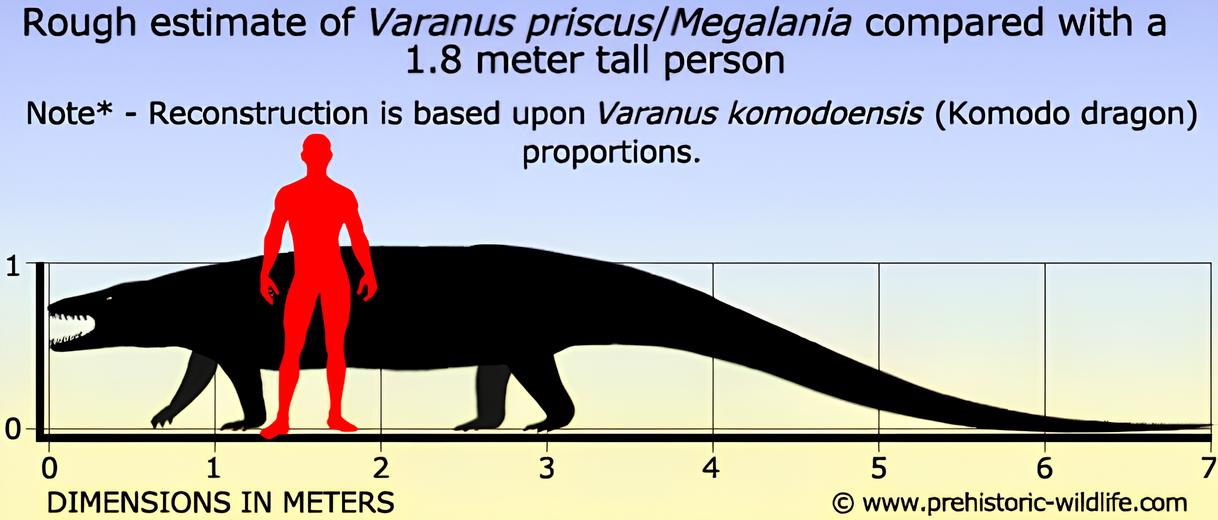 Credits: Prehistoric Wildlife
This combination made Megalania virtually unbeatable in direct confrontations.
There are indications that Megalania lived alongside early humans in Australia.Although there are no direct accounts, the temporal coexistence suggests that occasional encounters could have occurred—an extremely dangerous scenario.
Its extinction is associated with climate changes, reduction of megafauna (their main prey) and possibly, indirect human pressureWhen the large prey disappeared, such a specialized and gigantic predator lost its basis for survival.
The biggest lizard the Earth has ever seen.
Megalania represents the peak of gigantism among terrestrial lizardsNo living species has come close to its size, strength, or ecological role.
He wasn’t just a larger version of the Komodo dragon — he was a terrestrial apex predator that defined the biological limit of the group..
Its existence shows that, under ideal conditions, evolution can create creatures that today seem almost impossible outside of fiction.