
When the film Top Hat first opened, in 1935, Europe and the United States were still feeling some of the effects of the first World War – and, as if that weren’t enough, the US was also in the midst of the Great Depression. The musical comedy, starring Fred Astaire and Ginger Rogers, with songs by Irving Berlin, provided relief from everyday woes.
Astaire plays Jerry Travers, a tap dancer who’s in London to star in a new show, with Rogers as Dale Tremont, a budding actor whom he ends up pursuing. They first meet when she stomps up to his hotel room, which is above hers, to complain about the noise he’s making as he practises.
The swiftly moving narrative, which hinges on a case of mistaken identity, is steeped in lavish sets and costumes, all neatly sewn up with superb song and dance – including tunes that have since been canonised in the Great American Songbook, among them Puttin’ on the Ritz, Cheek to Cheek and Let’s Face the Music and Dance.
Watching Top Hat today transports you to another era, one that exemplifies the stunning simplicity of Hollywood’s golden age – and one that Irish audiences will have a chance to see when see a stylish new stage version of the film comes to the Bord Gáis Energy Theatre, in Dublin, in January.
It’s directed and choreographed by Kathleen Marshall, whose passion for classic movie musicals runs deep. Growing up in Pittsburgh with theatre-loving parents, she was mesmerised by That’s Entertainment, a compilation that MGM released in the mid-1970s, to mark its 50th anniversary. The film featured some of the best-known song and dance routines from the 1920s and 1930s, narrated and hosted by the stars themselves.
Marshall began her career performing in musicals such as Cats, which opened the door to choreography. She since has earned a stellar reputation for re-creating classics such as Anything Goes and The Pajama Game, both of which earned her Tony Awards – and, in the case of Anything Goes, an Olivier as well.
“I always say when you work on a show, you’re dealing with when it was written, when it takes place and today,” she says. “So now we’re looking back. We give our audiences the sensation that the audiences had in 1935 of seeing this story. But we’re also looking at it from a contemporary point of view, in terms of behaviour.
“We’ve made adjustments so now you’re seeing something period but that it’s still relatable. You can understand these characters and their motivations, and it can still speak to you and give you kind of the same sensation that the movie audience had in 1935.”
 Top Hat runs at the Bord Gáis Energy Theatre next January.
Jerry is played by Phillip Attmore, who regards Astaire as one of his “livingroom teachers” – the others were Gene Kelly and Gregory Hines – because of the amount of time he spent watching them on screen when he was growing up in Los Angeles.
He became so captivated that by the age of 10 he had the confidence to contact Hines, his tap idol, directly. By then Hines had established a new, freer form of tap, and had starred in films such as White Nights and The Cotton Club (which was directed by Francis Ford Coppola), modern-day takes on the Astaire-Rogers classics.
“I was so young, practically a baby, and in my best business voice I got in touch with his manager and said, ‘My name’s Phillip Attmore, and I’d like to speak to Mr Hines, please.’ Then I left a message. It was just a shot in the dark. I’d say about a month later I was in the bathroom and my brother said, ‘Phillip, Phillip, Gregory Hines is on the phone!’
“I remember his voice was so warm and so encouraging. He asked me how long I’d been dancing at that time, which wasn’t very long, yet the thing that I remember him saying that has been etched on my heart was, ‘Keep dancing.’ It was very simple, but it stuck with me.”
Dale is played by Amara Okereke, an English actor whose West End career began when she was a child, with a part in the musical 13. Since then she has appeared in London productions of Les Misérables and My Fair Lady, among other roles.
She’s very conscious of the way the film’s original audience would have perceived Top Hat. It’s “set in a time where socially the world was kind of crumbling,” she says. “The economy was abysmal. Fascism was on the rise. And yet people still wanted to feel good.
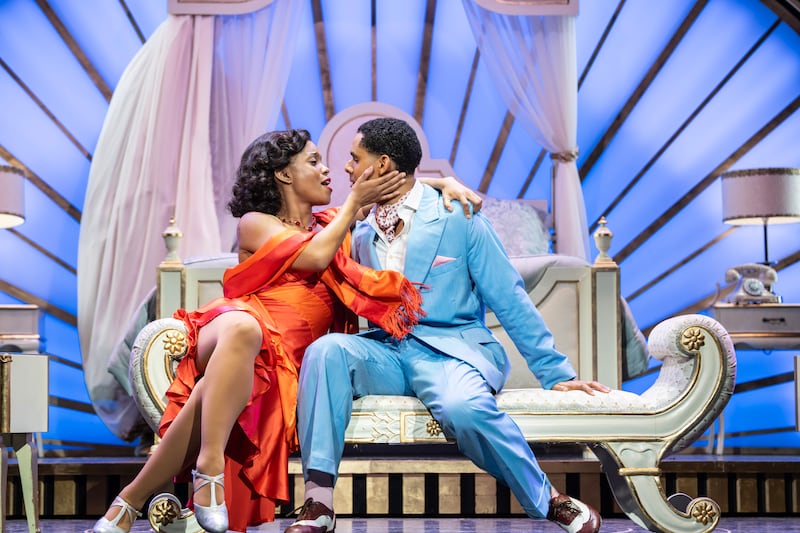 Amara Okereke as Dale Tremont and Phillip Attmore.
“I think we go through cycles in history where things might be great and then they start to fall again. But we still want to enjoy the hopefulness of being a human being who makes mistakes and falls in love.
“In all of this the language of music and dance makes the characters melt for one another. I think audiences really do feel that. It creates this sense of warm nostalgia.”
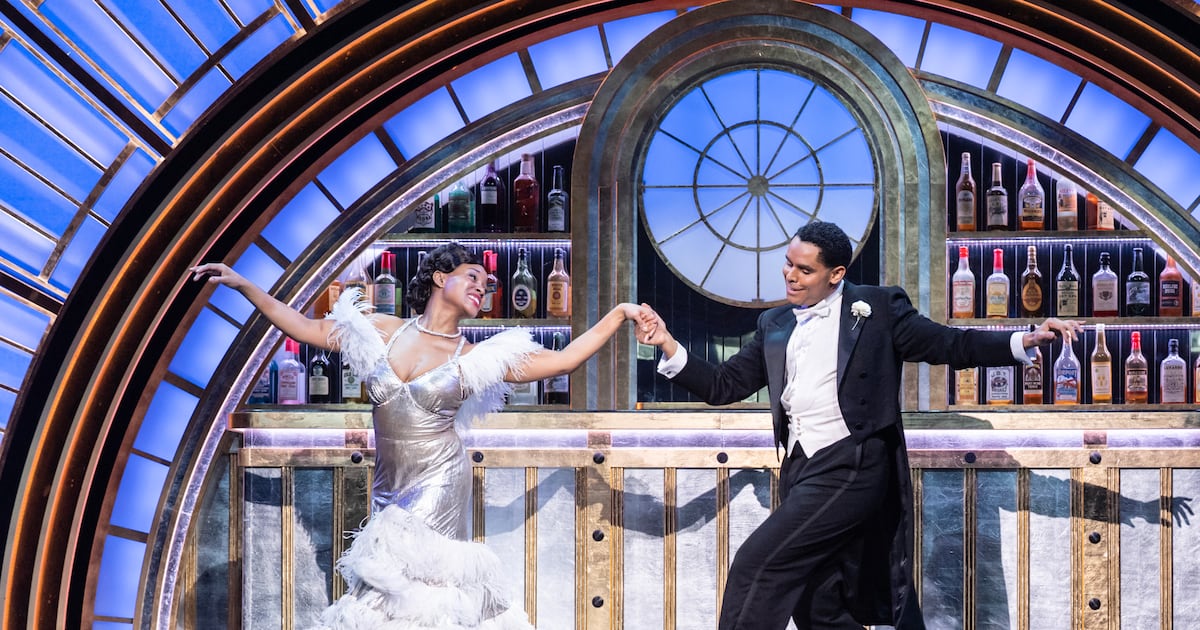
The stage musical’s choreography blends tap and ballroom with an air of ease and casual sophistication, true to Astaire and Rogers’s signature style. In Marshall’s version of Cheek to Cheek, Jerry and Dale glide across an art-deco set that looks like a club in 1930s New York, moving in tandem as if floating across the floor.
Their duet later segues into a dynamic top-hat-and-cane ensemble routine for a larger cast, danced with energy and precision (and featuring tailcoat tuxedos).
“Certainly everything Fred Astaire did was so rhythmically complex and interesting,” Marshall says. “And I think Phillip has Fred Astaire’s sort of style but blended with a more modern tap style … He combines that more hard-hitting aggressiveness of tap dancers today with classical ballroom style, which gives it this kind of contemporary edge. I think he’s unique in that way.”
Marshall’s choreography is matched by Yvonne Milnes’ costumes and Peter McKintosh’s sets: the impact of each dance is magnified by its details, from the feathered ballroom gown that Dale wears in Cheek to Cheek to the silver cocktail shaker in Jerry’s hotel room. The glamour, movement and music carry Top Hat from the last century into this one.
“Dale and Jerry have a very clear story,” Marshall says. “It can be seen in their three big duets. The first, Isn’t This a Lovely Day?, is a flirtation, a little seduction. It’s playful and it’s really them falling in love. Then their second big duet, Cheek to Cheek, is giving in to the passion, even though she’s resisting because of the mistaken identity … And then Let’s Face the Music and Dance is what they believe are their last few moments together. It’s kind of elegiac and bittersweet.
“So they have a very clear journey in their dancing. I think it helps to understand that sometimes you’re telling a story through dance and sometimes you’re just creating a mood or creating whatever emotion that you’re portraying.”
The clarity of these scenes also makes the lighthearted story easy to follow. In the midst of the lead duo’s performances, Dale’s best friend, Madge, plays matchmaker, with many accidental interruptions by her unsuspecting husband, Horace, who’s also producing Jerry’s new show. Horace’s butler, Bates provides constant comic relief while trying to unite the two lovers – not to be outdone by an over-the-top Italian fashion designer, Alberto Beddini. It’s a dream for performers wanting to feature their talents.
“Top Hat is a beautiful invitation to be able to pull out the whole tool bag,” Attmore says. “Sometimes I can only use bits, but I feel like Top Hat is an opportunity to be able to sing, to be able to dance, to get the comedy out, and then also to do styles from tap dancing to ballroom and jazz and theatrical dance.”
Okereke saw the stage version of Top Hat for the first time when Lucy St Louis, star of West End productions of The Phantom of the Opera and Wicked, was playing Dale.
“The feeling of joy that was radiating off everyone in the audience, including myself,” she says. “You can’t help but smile, because this is some of the best music ever written. It’s some of the most beautiful choreography. You have this incredible set. You have these beautiful costumes.
“And in a world where there is so much darkness, this is exactly what you need to escape to. And I think that’s why audiences really, really are with us on this show.”
Top Hat is at the Bord Gáis Energy Theatre, in Dublin, from Tuesday, January 27th, until Saturday, January 31st