
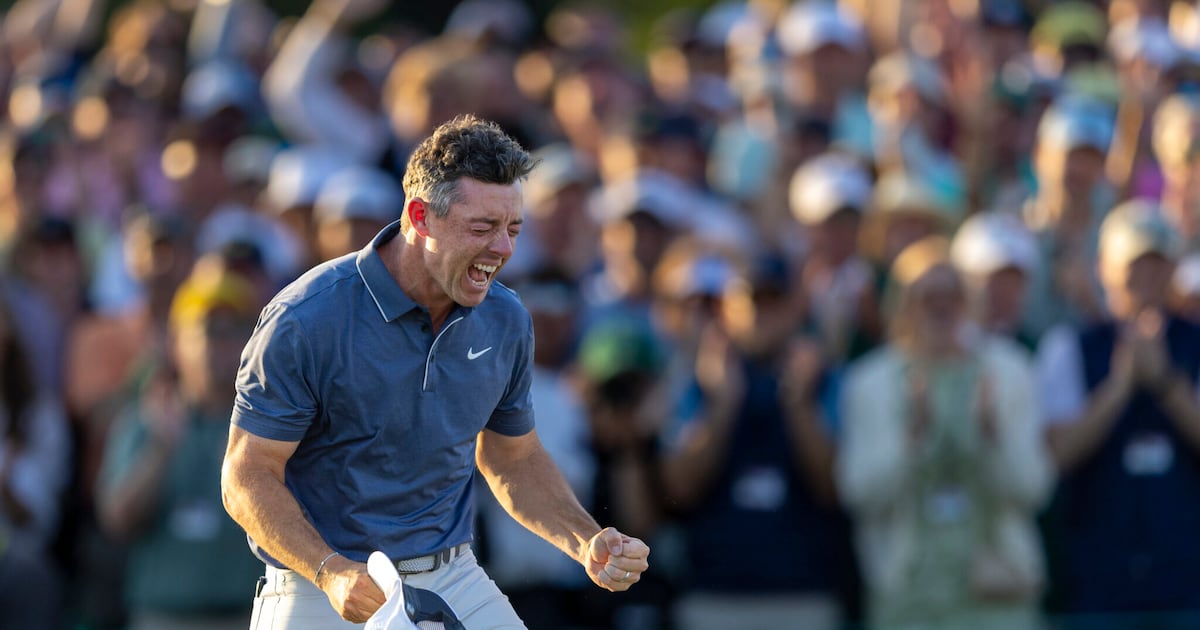
Rory McIlroy has spent his career in and out of the dock. Sometimes the charges were trumped up, sometimes he had a case to answer. Gawping from the gallery, you rooted for the defence and nodded with the prosecution: he was ballsy, he was soft, he was brilliant, he was exasperating. The verdicts never stuck. New evidence would emerge. There would be an appeal.
In the final round of the Masters, McIlroy kept changing his plea. His long career as one of the most compelling sportspeople on the planet was reduced to 18 holes and a sudden-death playoff, as if it had been distilled to the pure drop and poured into a shot glass.
Remember how it rolled? McIlroy stood on the first tee with a two-shot lead and double-bogeyed the opening hole. After the second hole, he was a shot behind; after 11 holes he was four in front; after 14 holes he was one behind. From first shot to last, everything you believed about McIlroy was confirmed and denied.
The burning attraction of McIlroy is his supernatural talent and his Everyman shortcomings. Anybody who has ever played golf and had a good score in the making has put the ball in the water, like McIlroy did, or in the trees, like McIlroy did, or missed short putts, like McIlroy did. His brilliance has a celestial source, but his fallibility has one foot in our realm.
“My battle today was with myself,” McIlroy said in his victory press conference at Augusta. “It wasn’t with anyone else. You know, at the end there, it was with Justin [Rose, in the playoff], but my battle today was with my mind and staying in the present. I’d like to say that I did a better job of it than I did. It was a struggle, but I got it over the line.”
In an interview on The Shotgun Podcast last week, he returned to that theme: “If I was ever going to do it at Augusta, it was always going to have to be that way,” he said. “Just, throwing up all over myself for the last few holes.”
Uniquely in elite sport, when McIlroy speaks about himself, he has a capacity to act for the defence and the prosecution. At Augusta, more than anywhere else, the interrogation has been relentless: on the course, in front of the microphones, but also, of himself, by himself. In the end, those were the only questions that mattered. Only he knew the doubt he harboured and the scale of it.
On the first tee, he said, his legs felt “like jelly” there was a “knot” in his stomach, he had barely eaten all day. If you watch enough sport, you will have heard athletes and coaches say a million times that “they had no doubt” about winning. It is always a lie. McIlroy didn’t say he had no doubt.
When McIlroy holed the winning putt and became just the sixth player in history to complete the career Grand Slam, the pat conclusion was that he had “fulfilled his destiny”. That makes it sound like it was predetermined, or it was bound to happen in the end, and nothing could be further from the truth.
First, he had to confront the possibility that it would never happen. He double-bogeyed the 13th and bogeyed the 14th; he torched a four-shot lead. He faced a meltdown; he won. The measure of McIlroy’s strength was his weakness.
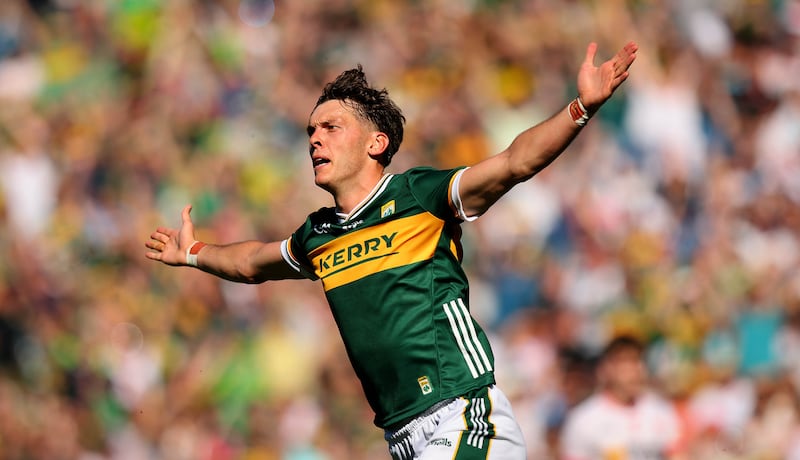 Kerry’s David Clifford celebrates scoring the first goal of the All-Ireland semi-final against Tyrone. Photograph: Ryan Byrne/Inpho
McIlroy has been dealing with great expectations since he was a teenager. David Clifford has too. This year, Gaelic football was the frog kissed by the princess. New rules allowed forwards greater freedoms and in that balmier climate Clifford bestrode the summer.
There has never been any ambiguity about his role and his duty to the jersey. Whether Kerry win or lose, Clifford’s performance is never estranged from the outcome. In 2024, when Kerry’s season scarcely got off the ground, Clifford’s dull form was cited as a primary cause. Among the elite teams in football and hurling, no other player carries such a load.
In Kerry football, the canonisation process takes its lead from the Vatican. Miracles must be verified. For Clifford, the process has been telescoped. Too much has happened already; there are too many witnesses.
In the seven games that Kerry played in the All-Ireland series, Clifford attempted 64 shots from play, 38 more than Kerry’s next most prolific shooter, according to Christy O’Connor. When his 22 assists are factored in, Clifford had a direct involvement in a third of Kerry’s scores. In the All-Ireland final he kicked nine points from eight shots, including three two-pointers; his direct marker, Brendan McCole was so consumed by trying to spancel Clifford’s threat that he didn’t touch the ball for the first 60 minutes.
For great forwards especially, All-Ireland finals are days of reckoning. Other games are too easily forgotten, or too readily reduced. All-Irelands, though, have a permanence in the collective memory. “There was never as much pressure on a player going into an All-Ireland final,” said the former Kerry captain Dara Ó Cinnéide in the build-up. It is what everyone felt.
Greatness comes with this tax. There is no allowance for failure, or mediocrity or retreating into the pack. Along the way, Clifford needed to find an accommodation with the things he must do. Understanding all this, Clifford did what he did.
“David has a unique temperament,” said Jack O’Connor, the Kerry manager. “But how he deals with the weight of expectation? I have no idea.”
There is a reluctance in Kerry to compare players from different generations. What’s the point? You only end up reducing a player you loved, for the sake of what? But they have never seen anyone like Clifford, they accept that.
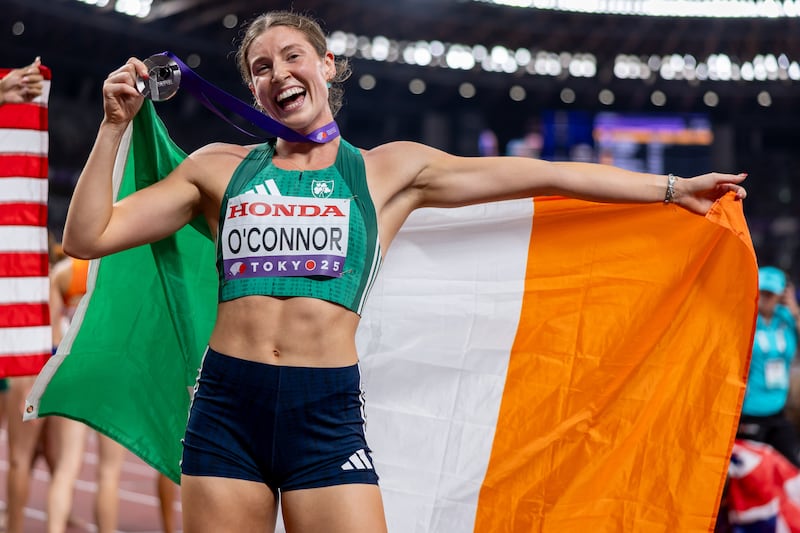 Ireland’s Kate O’Connor celebrates with her silver medal from the women’s heptathlon event at the World Athletics Championships. Photograph: Morgan Treacy/Inpho
For Kate O’Connor, the expectations came from within. What did everybody else expect? Outside of the athletics community, who was paying attention? At the 2023 Europeans she had finished a creditable 13th; at the Paris Olympics, an admirable 14th. She was young and improving and talented. The annals of Irish track and field, though, was full of athletes who carried that profile on to the world stage and blended into the pack, patted on the head and patronised.
O’Connor made a pact with herself to be different. “I didn’t let anything stop me and that’s probably one of the things I learnt this year, to never be small – be big, take up room, and know that you belong in these kind of places,” O’Connor said in a BBC interview a fortnight ago.
“My outlook on sport is different and my expectations of myself are different and for the rest of my athletics career I will strive to win medals. I’m not just there as a place holder, I want to be the best.”
In different words, it is what we have heard Daniel Wiffen, Rhys McClenaghan and others say. It is the new language of Irish sport. Irish athletes are no longer fearful of what their ambition sounds like when they say it out loud. It feels like another part of the contract with themselves. They’re not afraid of winning, or where the baldheaded pursuit of winning might leave them on a bad day.
O’Connor had dark days when nobody was really looking. In 2021 an injury forced her to miss the Tokyo Olympics and a year later an injury ruled her out of the European Championships too. Sport is full of suffering that often leads to nothing except more suffering. It is not a transactional relationship. Happy endings are precious and much rarer than we notice.
“It’s one thing knowing that you’re capable of it,” O’Connor said after her silver medal at the World Championships, “it’s another thing going and doing it.”
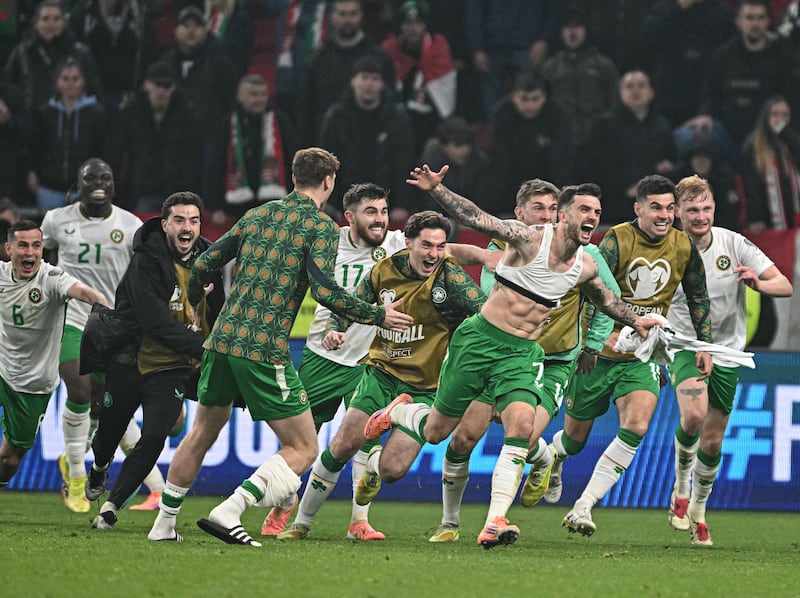 Troy Parrott celebrates scoring the winning goal for the Republic of Ireland against Hungary. Photograph: Attila Kisbenedek/AFP via Getty Images
Troy Parrott must know those feelings. People had given up on him, quietly. Bulletins from his club performances in the Netherlands were not embedded in the weekend’s sports coverage, as they have been since his hat-trick for Ireland in Budapest. The excitement that followed him to Spurs as a precocious teenager had dissipated.
When Parrott arrived in Excelsior Rotterdam for the 2023/24 season it was his fifth loan move. In 113 appearances for his four previous loan clubs he had scored just 16 goals. He was still just 21 years of age and along the way there had been injuries and loss of form and good reasons why his gallop had slowed. But the resilience and the self-belief that must have protected him from outright failure are not self-fulfilling qualities. He made an investment in himself that could have gone either way.
Parrott’s goals against Portugal and his everlasting hat-trick against Hungary were a defibrillator for the broken heart of Irish football. After the agonies of the performances against Armenia, home and away, and sundry other causes of despair, all of us were guilty of scoreboard journalism, reporters and fans alike. A couple of miraculous wins acted as a general absolution.
The joy was instant and innocent and pure and sentimental and reverberating. It covered more of this island than any mobile phone network. Membership of that feeling was free.
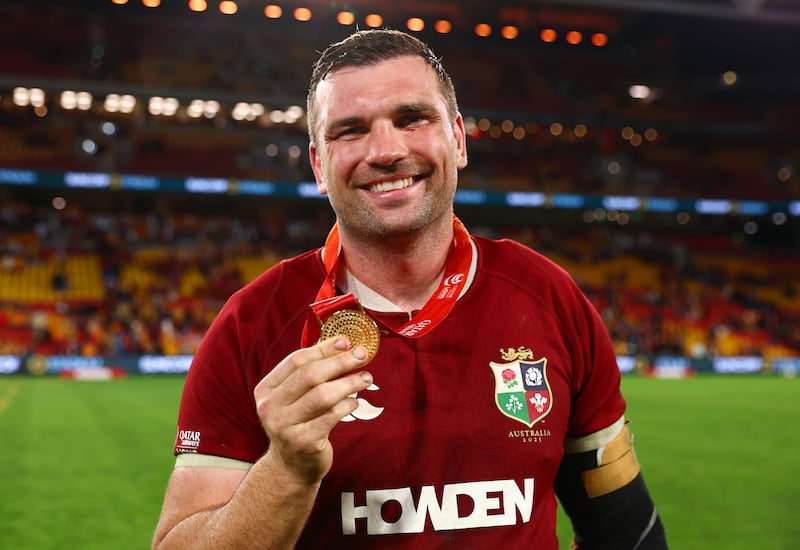 Tadhg Beirne with his Player of the Match medal after the Lions’ win over Australia in the opening Test of this summer’s series. Photograph: Chris Hyde/Getty Images
There is a bit of Troy Parrott in Tadhg Beirne, and a bit of him in Shane Lowry. Just less than 10 years ago Beirne arrived in Llannelli with the skeleton of his career. The only car he could afford was a nine-year old Vauxhall for two and a half grand; he borrowed to buy. After six years at Leinster, the break-up had been long and one-sided. Gather the shavings of his game time for the first team and it amounted to about 40 minutes. They didn’t believe in him; he needed to find something in himself.
Beirne’s stamina and his unending commitment to improvement has been one of the most remarkable stories in Irish rugby. The Lions is just one metric: four years ago, he played only 16 minutes in the Test matches; this time, in Australia, he played every minute of the Tests and was named Player of the Series. Other Irish players in the last 10 years were more lavishly gifted, but none has been more admirable.
Sport is full of TikTok moments. Parrott’s winner against Hungary will live forever on small screens. For young people, though, golf is a harder sell. It goes on too long. It has a charisma problem. There is no market for two-putt pars in the 24/7 world of online sharing.
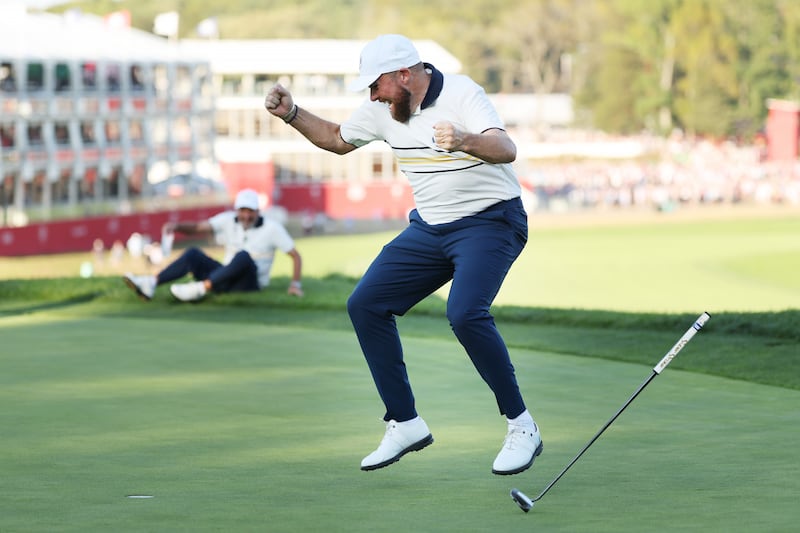 Shane Lowry celebrates a putt to see Europe retain the Ryder Cup. Photograph: Richard Heathcote/Getty Images
At the Ryder Cup, though, Shane Lowry had a crossover moment. Unlike other sports, golf gives you latitude to think and time to stew. Parrott’s finish was instinctive, a wonder of split seconds. Standing on the 18th fairway at Bethpage Black, though, Lowry knew exactly what he was facing: a half-point in his match would retain the Ryder Cup.
Walking up the fairway he turned to his caddie Darren Reynolds and laid it on the line for himself. “I’ve got an opportunity to do the greatest thing I’ve ever done,” he said. No go-back. Open-eyed, he did it.
Lowry danced across the green in a move straight from the fag-end of a wedding. At Aintree, five months earlier, Willie Mullins’s emotion had a different expression. Mullins wins more or less every day he goes to the races, and no matter how big the prize, he is a picture of modesty and restraint. But at Aintree his son Patrick won the Grand National on Nick Rockett, a horse that Mullins trained, and he surrendered to the moment.
Niall Hannity interviewed him on Racing TV as he left the parade ring afterwards, and under his shade of his fedora, the emotion was still red on his cheeks and in his eyes. “I watched it in JP [McManus’s] box,” Mullins said “and I was just doing my best to breathe and keep breathing … And it just started to happen, and I broke down.”
This year, we had our share of that. Glory be.