
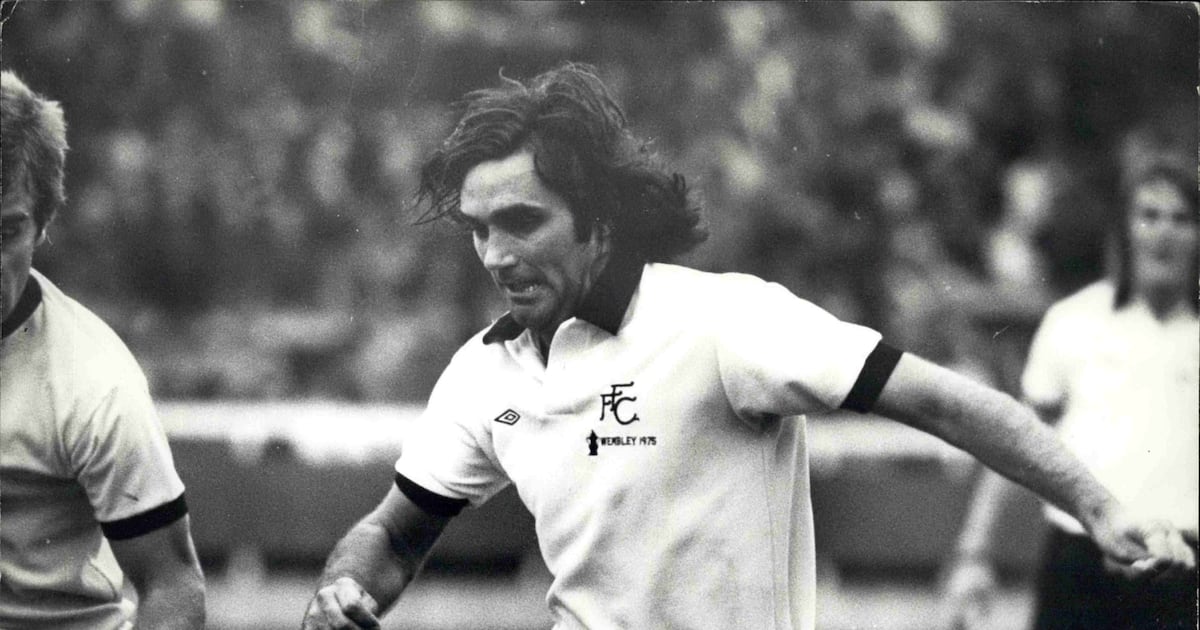
George Best was often called the fifth Beatle, but when we see soccer’s self-destructive genius take to the rubble-like surface at Turner’s Cross stadium in Cork in TG4’s gripping documentary George Best i gCorcaigh (TG4, 8.15pm), he looks more like a washed-up rocker whose best days are behind him.
It was January 1976, and Best was more in love with booze than the beautiful game.
Still, at 29, he retained the aura that made him a sports star unlike any other, and people came out in their thousands to see him play for Cork Celtic.
“He was still handsome – god, he was beautiful and tanned,” recalls TV presenter John Creedon, who saw both of the games he played in Cork – the first at the relatively luxurious Flower Lodge in December 1975, the second at Celtic’s crumbling home ground, Turner’s Cross, early into the new year.
The story of how Best came to play for Cork Celtic three times – twice at home, once away – is a fascinating portrait of a prodigy in decline and of a city about to slide into a lost decade of economic ruin. Cork would bounce back and Best would briefly shine back in the UK for Fulham – a return to form that makes his Celtic sojourn all the stranger.
He had been hired more for his name than his talents. Eager to shore up their patchy finances, the struggling Celtic had seen an opportunity with Best – a lost soul since his Trojan partying had led to his dismissal from Manchester United.
Oddly, Irish soccer in the mid-1970s was the Saudi Arabia of the day. Just as fading stars today head to the Middle East to make a quick buck, so former greats would descend on the League of Ireland, hoping for one last pay cheque.
They included World Cup winners like Bobby Charlton, Bobby Moore, and Germany’s Uwe Seeler. None, however, had the same box-office appeal as Best, whom Celtic were paying £1,000 a game (about £15,000 in today’s money).
Half of Cork had gone along, even fans of Celtic’s arch-rivals, Cork Hibs (who had Celtic use of Flower Lodge). The only one who wasn’t interested in the circus was Best himself. A few hours before kicking off against Drogheda, he had tucked into a steak dinner and proceeded to waddle about apathetically. He was not so much a shadow of his former self as a pickled parody, his skills dulled by years of over-indulgence.
“The excitement around Cork was incredible,” recalls Jimmy Barry Murphy, the Cork football and hurling legend. “We went to see magic, but it just didn’t happen.”
[ Fallible, flawed, ethereal, genius: Remembering George Best – 16 years onOpens in new window ]
Best put in more effort in the second game, which took place on the cratered surface of Turner’s Cross. He could have scored a goal too, had former Chelsea player Bobby Tambling not insisted on taking the penalty Celtic were awarded (Tambling missed).
Some 12,000 had gone to the first game, but the crowds were dwindling, and Celtic decided they’d had their money’s worth, so the arrangement was brought to a conclusion.
The end would come for Celtic themselves not long after, when they went bust and so joined Drumcondra United, St James Gate, and Home Farm and others on the roll-call of former LOI clubs. Best would fade into history too – addicted to alcohol, he died in 2005 at the age of 59.
[ Outstanding George Best, a footballer for all seasons in any eraOpens in new window ]
But those who saw him play still had their memories – whether of Manchester United at his peak or of him stomping around Turner’s Cross, not yet 30 and already a cautionary tale. George Best i gCorcaigh tells that story with great warmth and poignancy – while never shying away from the fact that it is, at heart, a tragedy.