
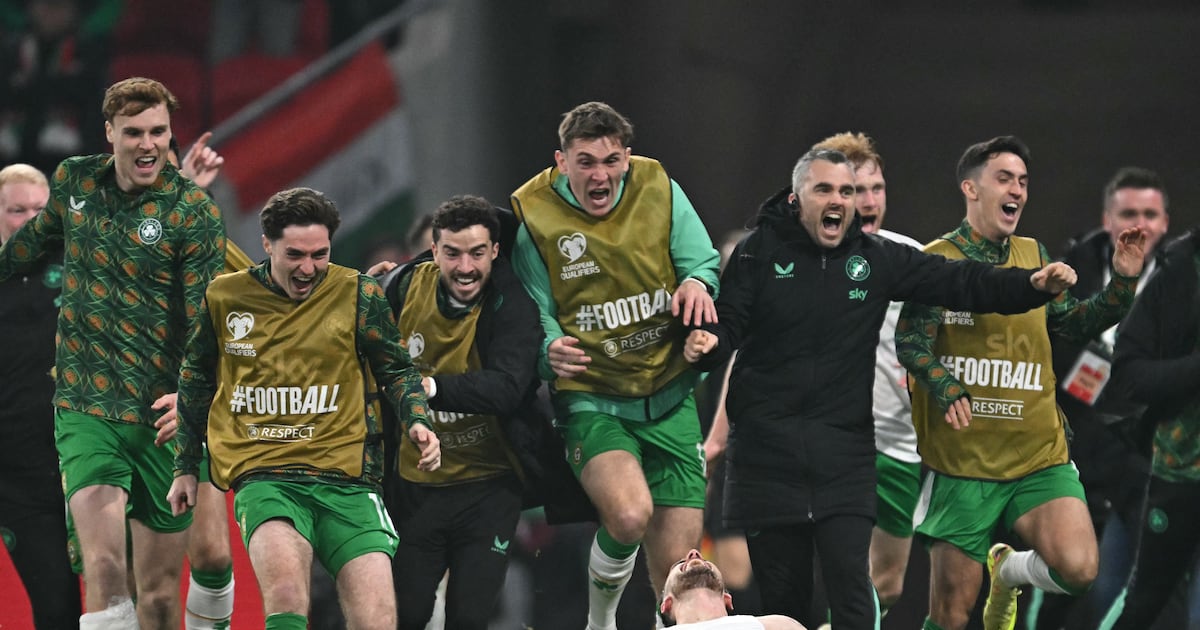
The late, late Troy show in Budapest
World Cup qualifier: Hungary 2 Republic of Ireland 3, November 16th
An easy one this year. It felt like every football fan in the world saw the goal and the celebration. What most of them couldn’t know, though they might have guessed at it from the sheer disbelieving joy on the faces of those Irish players, was how much it meant to us to have a victory like that after the 10 years we have been through. All those lost years of what Stephen Kenny called the “jilted generation”. The sense that had seeped into us of Irish football being trapped in structural decline that was long, slow, grinding and terminal.
In his team talk after the win, Heimir Hallgrímsson warned the players against the false friends who would already be swarming into their texts trying to pal up with them. “We all have a lot of friends when we win,” noted the manager. Good advice, which the FAI will surely ignore if some exciting potential granny-rulers suddenly feel the stirrings of a long-forgotten Irishness as the World Cup draws near.
Hallgrímsson told the players to enjoy the moment but to remember it was just the start of a journey: “Success is a continuous journey in the right direction,” he said. He urged them to look forward to bigger tests, even greater moments.
It’s right and good that ambitious sportsmen should always be thinking: what’s next? But that’s for them, not the rest of us, who should instead simply give thanks that we got to live that moment together.
Already this 2026 World Cup has given us far more than we expected. Those of us who have been watching Ireland longer than any of these players have been alive know something they don’t: it doesn’t get any better than this. Admittedly, this is one of those rare cases when you really would be happy to be proved wrong. – Ken Early
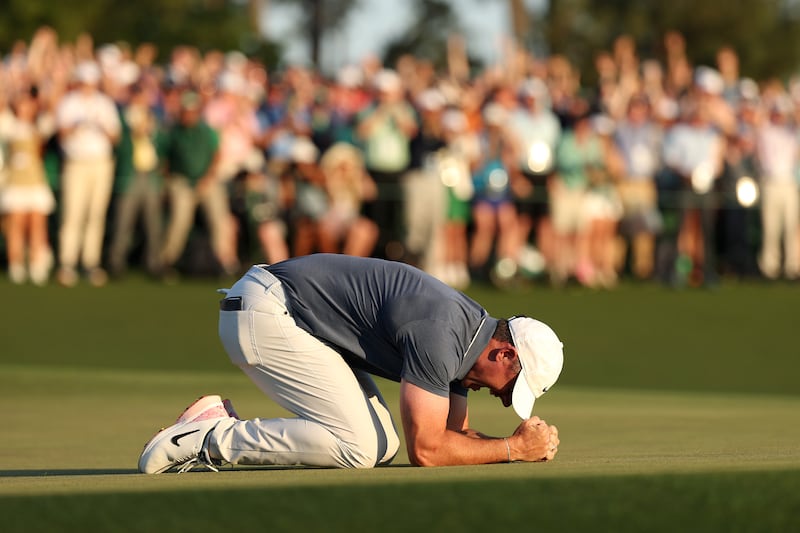 Rory McIlroy reacts to holing the putt that made him just one of six men to have completed golf’s Grand Slam. Photograph: Richard Heathcote/Getty Images Rory McIlroy masters his destiny
The Masters, April 13th
The emotions ran high that Sunday evening in April at Augusta National Golf Club, as the green jacket was – finally – slipped on to Rory McIlroy’s shoulders by Scottie Scheffler. A moment in time that elevated the Northern Irishman, the newest Masters champion, into an elite club of just six men to complete the career Grand Slam.
Tears ran freely, understandably enough, given his journey to that point of deliverance; not just for all the years it had taken McIlroy to reach his destiny, but also for the days and final hours of this 89th edition of the Masters on hallowed golfing terrain.
I attended my first Masters back in 1991, when Ian Woosnam won, and Ronan Rafferty – competing in his second and last Masters – was the only Irish player in the field. He missed the cut. In truth, back then, the prospect of an Irish winner of the great tournament was not even entertained and there followed many years where there were not even Irish players in the field.
Yet, the past two decades have seen a golden generation of Major champions from Ireland: Pádraig Harrington, Graeme McDowell, Darren Clarke, Shane Lowry … and, more than anyone, McIlroy.
McIlroy’s win at the Masters made it 11 Major title wins by Irish players in a run started by Harrington’s claret jug win of 2007.
What made that Sunday at Augusta so special was that McIlroy’s playoff win over Justin Rose, with a birdie at the first hole of sudden death, completed his career Grand Slam to join the legends of Gene Sarazen, Ben Hogan, Gary Player, Jack Nicklaus and Tiger Woods in that elite club, as five became six.
“You know, there were points in my career where I didn’t know if I would have this nice garment over my shoulders, but I didn’t make it easy today. I certainly didn’t make it easy. I was nervous. It was one of the toughest days I’ve ever had on the golf course,” said McIlroy. – Philip Reid
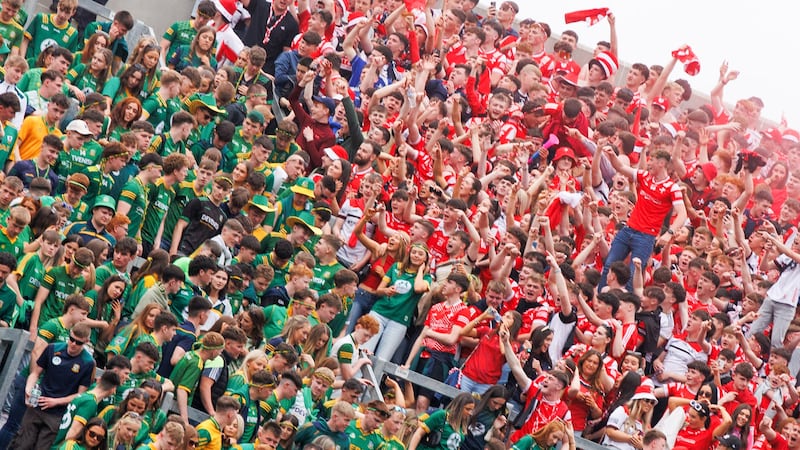
There’s nothing in sport like the end of a famine. This is especially true in the GAA where you can, in the space of 70 minutes, completely change the way a whole county sees itself. The way it has seen itself for decades.
Louth hadn’t won a Leinster title since De Valera was taoiseach. Think of all the generations of Louth people, dead and alive, who only ever imagined provincial titles as the kind of thing that happened elsewhere. Of the kids who grew to be adults and the adults who grew to be grandparents and how none of them ever knew how a day like this could feel.
Add in the fact that Dublin’s hold on the Leinster Championship had become the one immutable law of Irish sport. Imagine back in January you had to say what was most likely to happen in 2025 – an Irish winner of the Masters, Ireland beating Portugal and Hungary in the space of four days, an Irish heptathlon medal at the world championships or Dublin losing their Leinster crown? You would have ranked the Dubs fourth on that list 100 times out of 100.
But once Meath beat the Dubs in Portlaoise, all doors were suddenly open. Louth overcame Kildare on the other side and the scene was set for a Leinster final that was going to tell an epic tale, regardless of the outcome.
Meath were the better team in the first half but Louth stayed in touch by raining goals. Sam Mulroy missed his first four shots at the start of the second half and then didn’t miss again, putting in one of the most virtuoso half-hours of the whole championship. Meath scored just once in the closing 25 minutes but that one score was a goal that sent Croke Park into paroxysms.
In the end though, Louth were the ones left standing. Cue the red smoke swirling down from the Hill and nearly three-quarters of a century’s ghosts laid to rest. – Malachy Clerkin
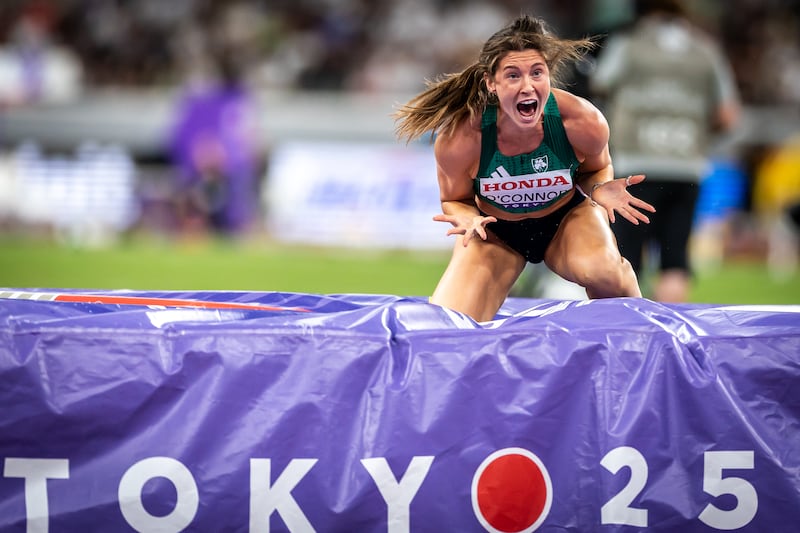 Kate O’Connor after jumping a new lifetime best height on the way to a historic silver medal at the World Athletics Championships. Photograph: Morgan Treacy/Inpho Kate O’Connor’s silver success
World Athletics Championships, Tokyo, September 20th
News had spread fast by the time Kate O’Connor stepped back into the arena for her final event in the heptathlon. Two laps of Japan’s National Stadium stood between her and the World Championships medal podium, and another multi-event first for an Irish athlete.
Two laps of the track that O’Connor could run around in her sleep. But then we heard that after six events already, her medal chances were possibly hanging by a loose ligament. Or worse still, a strained tendon that could snap at any moment.
Maybe O’Connor had asked a little too much of herself. All season she’d been raising the bar, starting with the five-event indoor pentathlon back in March when, just 12 days apart, she won bronze in the European Indoor Championships and then upgraded to silver on the World Indoor stage.
The 24-year-old then won gold in the seven-event heptathlon at the World University Games, completing her perfect set of medals.
The first two hot days and nights in Tokyo had gone beyond expectations. After setting personal bests in 100m hurdles, high jump, 200m and javelin, O’Connor appeared safe in second, with only the 800m to come. The problem was she’d twisted her right knee in the long jump, and suddenly it might all amount to nothing.
With her right knee taped up in blue, O’Connor appeared calm, glancing one last time at her father and coach Michael, sitting in the lower stand just beyond the finish line.
But there was no stopping her: O’Connor ran another personal best of 2:09.56 to win silver and complete another Irish heptathlon record of 6,714 points – becoming just the sixth Irish athlete to win a World Championship medal outdoors.
“I was never going to just settle for a bronze medal either,” she said. “I was always going to fight 100 per cent to the line, sore knee or not.” – Ian O’Riordan
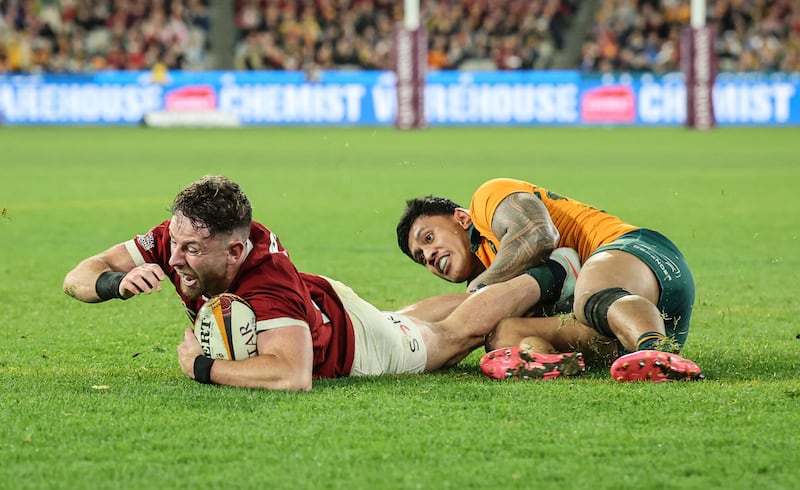 Hugo Keenan celebrates crossing the Australian line to score a try and write himself into British and Irish Lions history. Photograph: Dan Sheridan/Inpho Hugo Keenan’s instantly iconic tryAustralia 26 British & Irish Lions 29, Second Test, July 26th
Once every four years the British and Irish Lions embark on a tour to one of the southern hemisphere’s big three, and hence once every dozen years South Africa, New Zealand or Australia are the hosts. And once in a blue moon the Test series and the tour is distilled into one iconic moment.
Think Jeremy Guscott’s drop goal in 1997 or Justin Harrison’s lineout steal in 2009 or, sadly, speargate. To the list can now be added Hugo Keenan at the Melbourne Cricket Ground in 2025.
Given how well the Lions had played in the first 45 minutes in Lang Park a week previously, few pundits gave the Wallabies a chance of taking the Test series to a decider when they met at the MCG.
But in front of an enthralled 90,307 crowd, the biggest ever for a Lions Test, the Wallabies roared into a 23-5 lead. Tries by Tom Curry and Huw Jones cut that deficit by half-time and a Tadhg Beirne score, converted by Finn Russell, brought the Lions’ back to 26-24 down on the hour.
Maro Itoje was inspired, winning vital turnovers, as the Lions patiently built waves of attacks that the Wallabies kept repelling. But then came one last red wave.
Just when it seemed Russell had been isolated, James Ryan showed up for a vital carry. From the recycle Jamison Gibson-Park hit Keenan. Time seemed to stand still but as Jack Conan held his width and occupied Max Jorgensen, Keenan did a mini goose-step and took Len Ikitau on his outside to score.
Keenan had to re-enact his finish for the players when they congregated on the centre of the pitch afterwards. He’ll be dining out on it for ever. And to think that some pundits had been suggesting the Lions should never tour Australia again. – Gerry Thornley
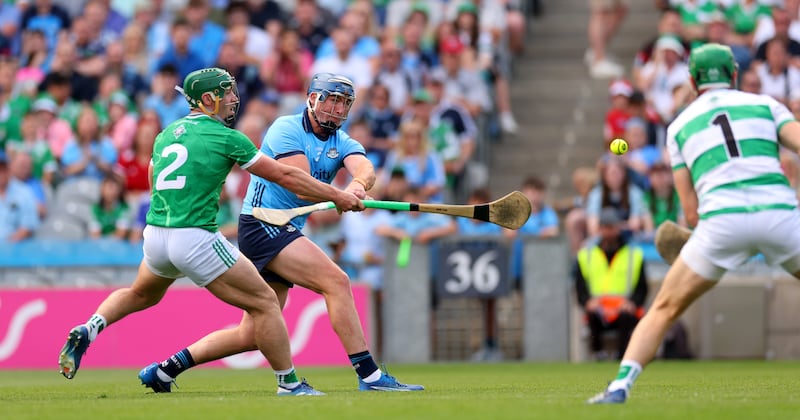 John Hetherton scores one of the goals that helped Dublin topple Limerick in June. Photograph: James Crombie/Inpho Dublin defy the odds to shock Limerick All-Ireland SHC quarter-final: Dublin 2-24, Limerick 0-28, June 21st
There had been suggestions that Limerick might have been guilty of complacency by so readily agreeing to travel to Croke Park to play on the same double bill as the Dublin-Cork football match.
For most, there was little jeopardy in the arrangement, one that allowed John Kiely’s men a run-out at headquarters that would be useful in advance of the semi-final against Tipperary.
After all, of their seven previous All-Ireland quarter-finals, Dublin had lost six.
Paradoxically, things started to go wrong for Limerick when Dublin’s Chris Crummey was red-carded in the 16th minute. An in-form hurler with the physique to take on Limerick, he was about the last one they might have chosen to lose.
Yet Dublin raised their game to compensate – a brave response but surely futile in the face of the modern game’s orthodoxy that no team could survive the loss of a player for more than about five minutes. Earlier in the championship, in Ennis, Cork couldn’t protect a nine-point lead after Shane Barrett was sent off in the 57th minute.
But Dublin did more than survive. Half-time replacement John Hetherton rampaged up front, muscling in for a cracking finish just after Limerick had taken the lead in the 51st minute. Within 34 seconds, the same player occupied three defenders as Cian O’Sullivan thundered through for a second goal.
Limerick, seemingly perennial champions, had no telling response. Seán Brennan in the Dublin goal spectacularly saved from Aaron Gillane in the 60th minute and the early football arrivals brought voluble support. The underdogs believed.
It didn’t last until the next match. Cork firmly contextualised the shock victory by putting seven goals into the Dublin net.
It left Limerick all the more incredulous, as they surveyed the wreckage of a season in which wreckage they lost the Munster title lost on penalties and became the fall guys in one of the game’s least explicable upsets. – Seán Moran
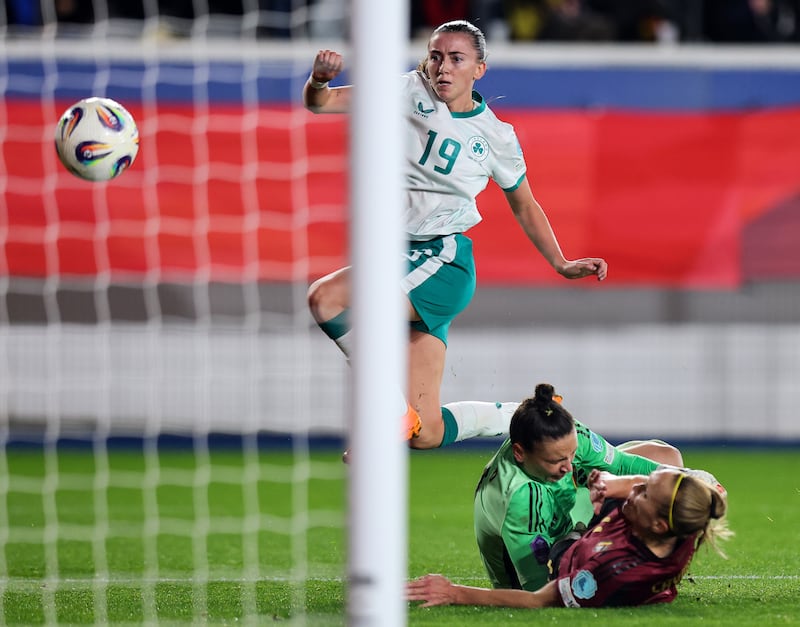 Abbie Larkin keeps her cool to dink the ball over the goalkeeper for a decisive goal for Ireland against Belgium. Photograph: Ryan Byrne/Inpho Abbie Larkin’s magical finish Belgium 2 Rep of Ireland 1, October 28th
The instructions were quite clear on the choosing of the most memorable sporting moment from 2025: “TROY PARROTT IS TAKEN!”. He had, no doubt, won an overall majority, too, so for fear of a lack of variety, the powers-that-be suggested we cast our nets further.
They didn’t have to go too far, though, because Abbie Larkin had produced a moment for the women’s national team just three weeks previously that was greeted with much the same frenzied celebrations among her team-mates as the ones Parrott would kick-start in Budapest.
It’s been a bumpy old trip for this Irish team since the highs of their qualification for the 2023 World Cup. Vera Pauw, Eileen Gleeson, Carla Ward – three managers in less than 18 months. And a whole heap of off-the-field problems too. Not least the controversy surrounding the manner in which the FAI handled Colin Healy’s departure, and Gleeson taking a discrimination case against the association.
On the field, the results under Ward were fine, apart from that calamitous 4-0 defeat away to Slovenia, but the performances were underwhelming. So, confidence wasn’t exactly roof-high when they took on the higher-ranked Belgium over two legs in their Nations League play-off.
Katie McCabe was exceptional in both legs, scoring twice in the first, winning her 100th cap in the second. But it was all heading for extra-time in Leuven with the sides 4-4 on aggregate when Larkin produced a dollop of magic.
With 90 minutes on the clock, she spun past her marker after the ball fell to her in the box, and then dinked it over the Belgian goalkeeper. Cue mayhem.
It was this team’s finest moment since that Amber Barrett goal in Glasgow, a whole three years before, qualified them for the World Cup. It earned them promotion to the A division of the Nations League and a guaranteed play-off for the 2027 World Cup. – Mary Hannigan
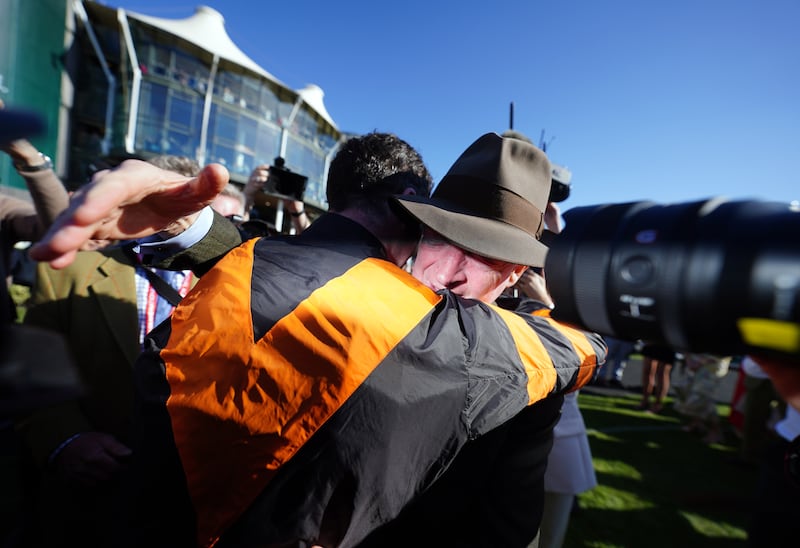 Jockey Patrick Mullins with his father and winning trainer Willie Mullins after winning the Grand National at Aintree in April. Photograph: David Davies for The Jockey Club/PA Wire Willie Mullins’s Disney endings
Aintree Grand National, April 5th/Breeders Cup, October 31st
Having long since redefined the parameters of success in National Hunt racing, in 2025 Willie Mullins managed not just one defining moment in his 37-year training career, but two.
Victory for his son Patrick on board Nick Rockett in April’s Aintree Grand National reduced the normally unflappable Mullins to tears.
Nick Rockett led home a Mullins 1-2-3 in the world’s most famous steeplechase that propelled the Irishman to successfully defend his British trainers’ title later that month. Wider ramifications were lost, though, in a deluge of family emotion.
“This is the summit for me, I don’t think it can get any better than this. It’s just huge. It’s like something out of a Disney film,” he said.
“I don’t know if I gave him a cheer, I was just speechless. I just broke down completely. I did for about 20 minutes after. I just couldn’t help it, I just completely lost it,” Mullins added.
About seven months later, and 9,600km away in California, the emotion was of happy amazement as Ethical Diamond, Mullins’s first runner at the Breeders Cup, stunned flat racing’s global elite with the unlikeliest of victories in the $5 million Turf.
The 28/1 outsider, who’d previously won a single race in seven starts over hurdles, and had competed in handicaps on the flat, swept past some of the world’s best to win in style under jockey Dylan Browne McMonagle.
His trainer had freely admitted he thought fifth would be the best his horse could hope for. Mullins even feared Ethical Diamond might be tailed off and make “a holy show” of everyone. Little wonder his immediate reaction appeared to be an entirely understandable “what the f**k!”.
It was a sentiment probably shared by flat racing’s aristocracy, who’re entitled to feel grateful that jump racing continues to be the focus of Mullins’s attention. – Brian O’Connor
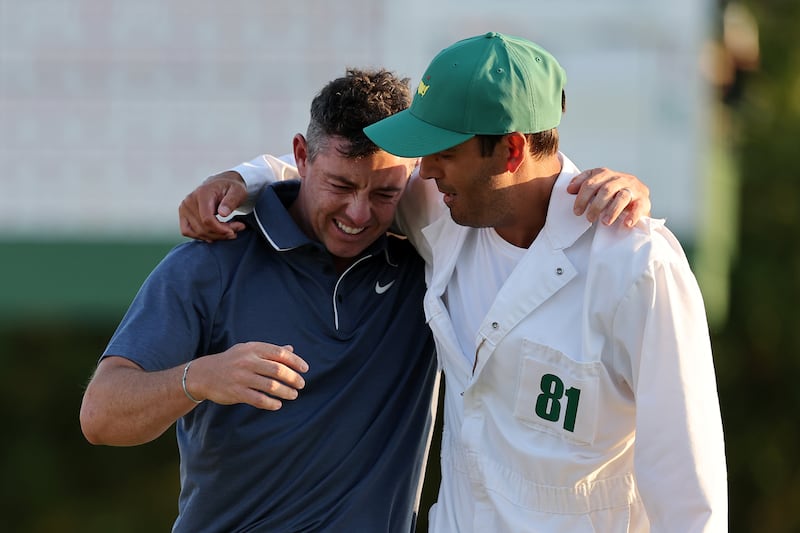 Rory McIlroy with caddie Harry Diamond after winning 2025 Masters at Augusta in April. Photograph: Michael Reaves/Getty Images History and poetry with Rory McIlroy
The Masters, April 13th
I felt like the nation literally held its breath for four days. After more than a decade of near-misses, Sunday scars and the constant, nagging question that followed him everywhere he went – “will he ever?” – at Augusta National, on golf’s biggest stage, McIlroy finally answered it.
By slipping into the green jacket and claiming that elusive fifth major, he completed the career Grand Slam and closed a chapter that had long defined him as much by heartbreak as brilliance.
It would take something very special to keep me up past bedtime on a school night, never mind getting white-wine drunk and emotional in the name of golf on a Sunday, but Rory’s Masters exploits were exactly that.
It felt like history unfolding in real time and it felt like the whole country was brought along for the ride. Every shot felt weighted with the disappointments of the past: the collapses, the close calls, the years where Augusta just thought it would be funny to taunt him, and us. And yet, he stayed. He fought. He endured.
What made it even more compelling was the backdrop. A year of intense scrutiny around his personal life only added to the drama. To summon that level of focus, and then to push it to a play-off hole for good measure, felt almost cruel; until it became historic, poetic even.
There are parallels with Troy’s hat-trick, two moments that reminded us why we love sport. Stories of redemption, resilience and the joy of finally seeing someone get what they never stopped chasing. – Karen Duggan
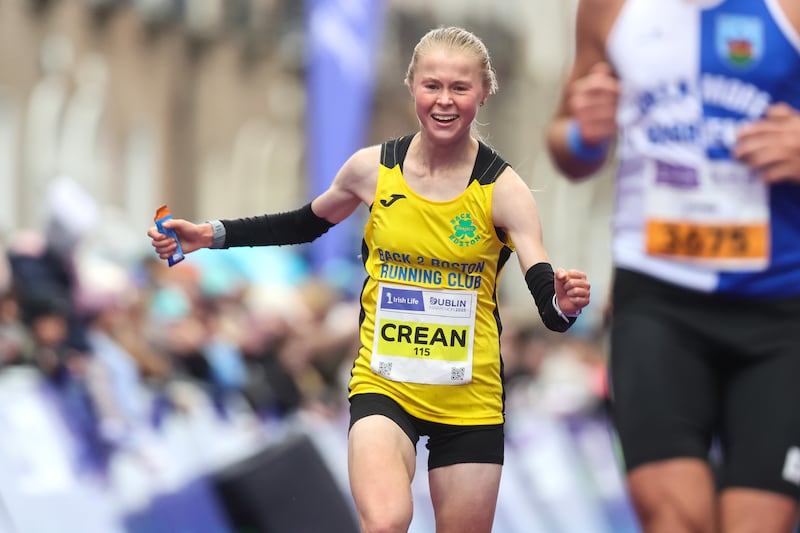 Ava Crean crosses the line to to win the women’s national title at Dublin Marathon. Photograph: Bryan Keane/Inpho Ava Crean redefines what can be done
Dublin Marathon, October 26th
Somewhere between Bethpage and Budapest, the streets of Dublin provided the stage for one of the most unexpected Irish breakthrough stories of the year.
At 19 years young, in late October Ava Crean smashed her personal best by more than nine minutes to become the youngest ever winner of the women’s national title at the Dublin Marathon.
The Limerick native, who had only run her first marathon six months earlier, defied a long-held coaching belief that the distance is no place for young athletes. The 26.2 miles challenge has always been viewed as the domain of the more robust, durable and road-tested runners.
But Crean finished sixth overall in Dublin and came home in 2:34.12 to claim the national title. Extraordinary.
Speaking in the media tent just moments after her historic win, Crean – a talented underage basketball player – described how she had taken to running during Covid but at the outset would stop after 500m to catch her breath.
The Back 2 Boston Running Club member described how, due to a self-perceived lack of ability, she would initially only run inside on a treadmill because of embarrassment.
But after shocking herself with a 2:49.26 in Manchester in April – an event she approached with the ambition to simply complete a first ever marathon – it was evident Crean was built for distance.
The following weekend she posted a 2:43.26 in her home marathon in Limerick. Manchester had been no fluke. If she was starting to cause ripples in running circles then, by October she was primed to make waves at national level.
Her only structured coaching came in the weeks after Limerick and before the Dublin Marathon when she worked with John Kinsella, so the potential for further progress seems limitless.
Crean beat three-in-row-seeking Ann-Marie McGlynn to the national title in Dublin. Afterwards, McGlynn remarked: “There are some people who have it, and that girl has it.”
Few athletes in any sport ever genuinely challenge established perceptions within their sport or alter conversations around what is possible, but teenager Crean achieved that on the streets of Dublin in October. – Gordon Manning
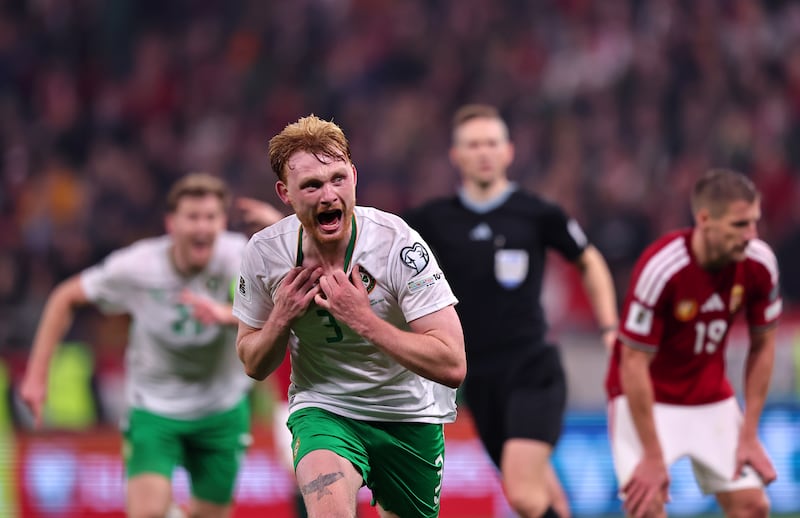 Liam Scales after Troy Parrott got on the end of his knock-down to prod Ireland to victory in Hungary. Photograph: David Balogh/Getty Images One giant leap by Scales for Ireland
World Cup qualifier: Hungary 2 Republic of Ireland 3, November 16th
If Ferenc Puskás himself could have handpicked two current Hungarians to clear the ball in the 96th minute of any game, it might well have been Barnabás Varga and Willi Orbán.
Both men jumped for the ball on that fateful night in November, but an Irishman climbed over them and headed it down for Troy Parrott, who ghosted between the red shirts, took a belt from Attila Mocsi and still managed to stud-rake the ball into the net for the winner.
Inside the Puskás Arena, pandemonium met deathly silence.
“Who headed it down?” someone wondered aloud.
Liam Scales, a Collingwood Cup winner with UCD in 2018, passed over by Manchester City and Bristol Rovers until his performances for Shamrock Rovers earned a move to Celtic aged 23. Sent off at Wembley in November 2024, and only in the Republic of Ireland team because Heimir Hallgrímsson ran out of left backs, went and produced a carbon copy of Niall Quinn’s flick for Robbie Keane in Ibaraki in 2002.
Rovers manager Stephen Bradley has long referred to “the Liam Scales mentality” – “Someone who you could ask to play up front and he’d say, ‘no problem, I’ll do it.’ That’s the kind of character he is.”
That’s the kind of character Ireland needed in Budapest on November 16th.
The five minutes of added time were up when Orbán beat Nathan Collins to a bouncing ball in the Hungary box. Under pressure from Johnny Kenny, the Hungarian defender cleared it down the right sideline.
The stadium clock ticked past 95 minutes. Caoimhín Kelleher, from an angle on halfway, lofted a back-spinning seven-iron on to a clump of bodies.
Normally, Ireland games and goals merge into a green blur.
After Parrott’s second against Portugal three days earlier, after that 2-0 victory in Dublin, the fans, the media and the FAI might have been sated.
The hilarious sight of Cristiano Ronaldo trying to cod the referee before he was sent off for elbowing Dara O’Shea was a bonus. Add in the resurrection of Séamus Coleman’s international career, plus Chiedozie Ogbene rising from the ashes of a ruptured Achilles, and the calamitous September loss to Armenia was easily memory-holed.
Pride restored.
But the players were not satisfied. And Scales strained every sinew as he leapt over Orbán and Varga to reignite dormant dreams of Ireland at the World Cup. – Gavin Cummiskey
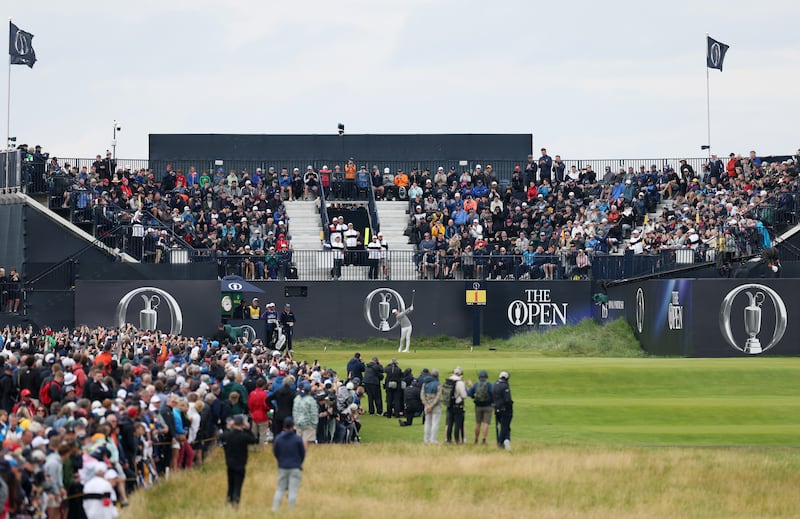 Rory McIlroy tees off on the first hole of the Open at Royal Portrush Golf Club in July. Photograph: Richard Heathcote/Getty Images Rory McIlroy’s settles serenely on homecoming
Open Championship at Royal Portrush, July 17th
Funnelled around the tee box, in some places 10 people deep, kids were on shoulders and parents strained to catch a glimpse.
When he appeared, it was first as a shape. An outline, but unmistakably Rory McIlroy sauntering across the footbridge leading from the putting green to the first tee.
At the top of the stand wrapped around the 18th green to the left, people had turned in their seats to peer over the back, while the rope down the right side of the hole strained as fans flooded to the fairway and pushed to see.
A ripple of concern, hope and goodwill thrummed through the crowd with the memory of McIlroy’s opening quadruple bogey at the 2019 Open still felt acutely.
It was a first hole from which even he could not recover, when his iron off the tee arched high left and out of bounds.
Six years on, and sensing the drama, the Sky Sports cameras camped just yards in front of the players interviewing Graeme McDowell on the first tee box.
Ignoring them, McIlroy elegantly swished his club in preparation. An opening shot freighted with history – his partners, Justin Thomas and Tommy Fleetwood, playing just bit parts.
As a 16-year-old, McIlroy had shot 61 around the links for the course record, but this time most minds were on his Portrush calamity.
Fallibility is a strange kind of baggage, but this time McIlroy’s strike was clean. The ball rose with a sweet fizzing sound towards Dunluce Castle to safely settle just off the fairway.
A collective exhaling broke the silence. Then a giddy chatter. – Johnny Watterson