
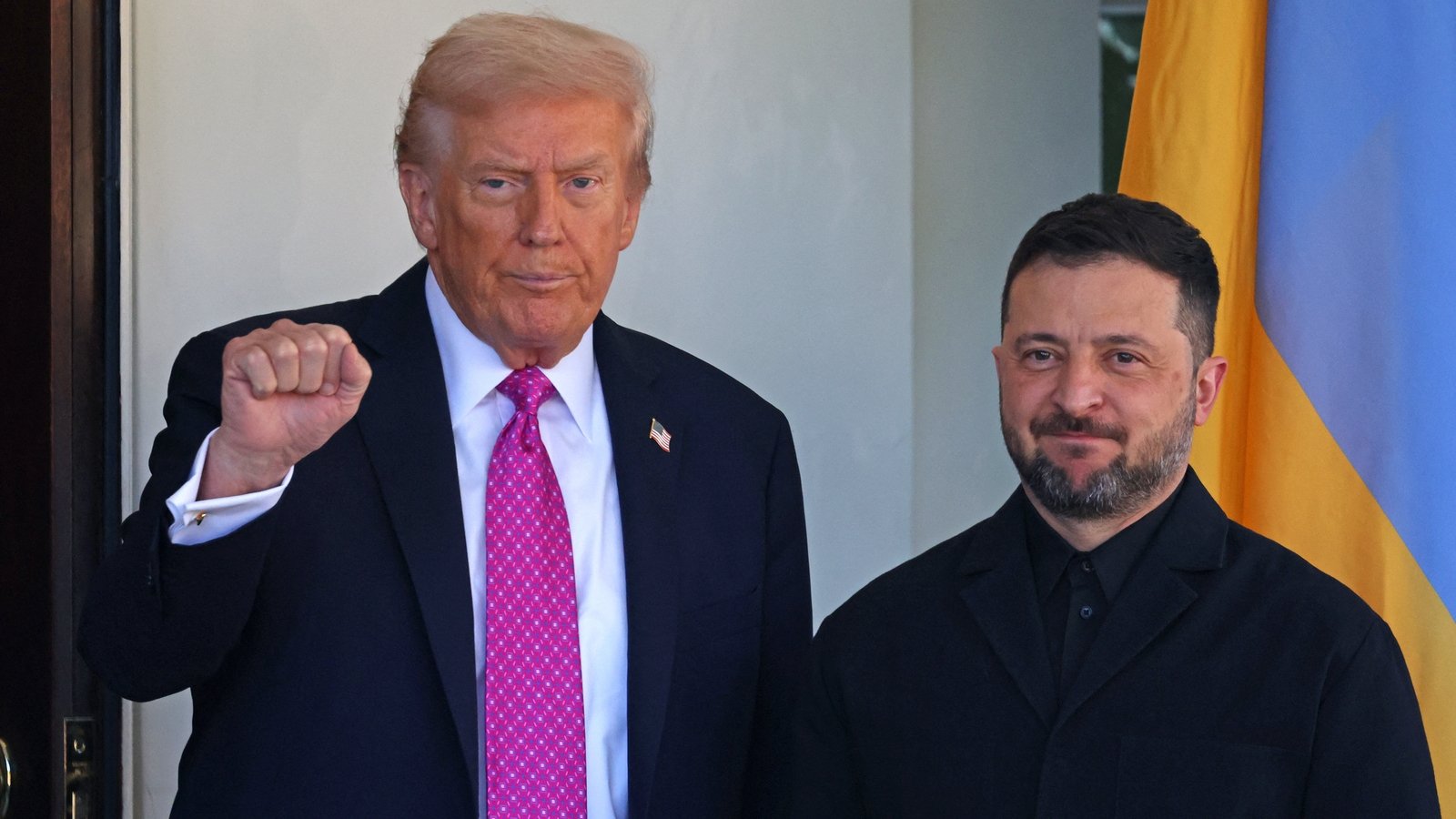
US President Donald Trump has said he had “productive” talks with Russian leader Vladimir Putin hours before he meets Ukrainian President Volodymyr Zelensky, in a year-end sprint to seal a deal to end the war.
Mr Trump’s renewed upbeat tone comes despite wide scepticism in Europe about Mr Putin’s intentions after Russia carried out another massive bombardment of the Ukrainian capital Ukraine just as Mr Zelensky was heading to Florida.
“I just had a very good and productive telephone call with President Putin of Russia,” Mr Trump announced on his Truth Social platform.
Donald Trump is set to meet Volodymyr Zelensky at 6pm Irish time in the dining room of his Mar-a-Lago estate, where he frequently brings both foreign guests and domestic supporters.
Watch: Volodymyr Zelensky and his delegation arrive in Miami
Mr Trump has made ending the Ukraine war a centerpiece of his second term as a self-proclaimed “president of peace,” and he has repeatedly blamed both Ukraine and Russia for the failure to secure a ceasefire.
Mr Zelensky, who has faced verbal attacks from Mr Trump, has sought to show willingness to work with the contours of the US leader’s plans, but Mr Putin has offered no sign that he will accept it.
The meeting will be President Trump’s first in-person encounter with Mr Zelensky since October, when the US leader refused to grant his request for long-range Tomahawk missiles.
And the Ukrainian leader could face another hard sell this time around, with Mr Trump insisting that he “doesn’t have anything until I approve it”.
The talks are expected to last an hour, after which the two presidents are scheduled to hold a joint call with the leaders of key European allies.
Polish Prime Minister Donald Tusk, who will join the call, wrote on X that the Russian attacks on Ukraine were “contrary to President Trump’s expectations and despite the readiness to make compromises” by Mr Zelensky.
The revised peace plan, which emerged from weeks of intense US-Ukraine negotiations, would stop the war along its current front lines and could require Ukraine to pull troops back from the east, allowing the creation of demilitarized buffer zones.
As such, it contains Ukraine’s most explicit acknowledgement yet of possible territorial concessions.
It does not, however, envisage Ukraine withdrawing from the 20% of the eastern Donetsk region that it still controls, Russia’s main territorial demand.
Read More:
The 20-point peace proposal Zelensky will discuss with Trump
Latest Ukraine stories
The Ukrainian leader said he hoped the talks in Florida would be “very constructive” but stressed that President Putin had shown his hand with a deadly drone and missile assault on Ukraine that temporarily knocked out power and heating to hundreds of thousands of residents during freezing temperatures.
“This attack is again Russia’s answer on our peace efforts. And this really showed that Putin doesn’t want peace,” he said as he visited Canada.
He also told reporters that he would press Mr Trump on the importance of providing security guarantees that would prevent any renewed Russian aggression if a ceasefire were secured.
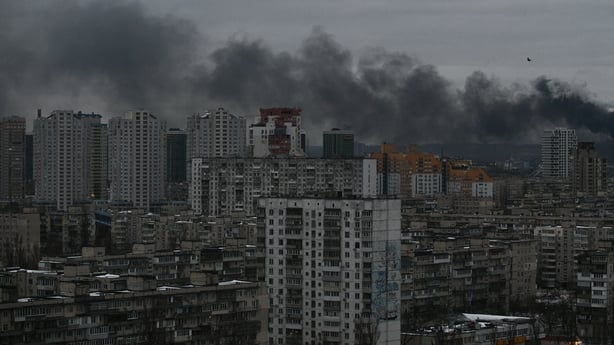
Yesterday’s attack on Kyiv killed one person and left dozens of others injured
“We need strong security guarantees. We will discuss this and we will discuss the terms,” he said.
Ukraine insists it needs more European and US funding and weapons, especially drones.
Russia has accused Ukraine and its European backers of trying to “torpedo” a previous US-brokered plan to stop the fighting, and recent battlefield gains, Russia announced yesterday it had captured two more towns in eastern Ukraine, are seen as strengthening Russia’s hand when it comes to peace talks.
“If the authorities in Kyiv don’t want to settle this business peacefully, we’ll resolve all the problems before us by military means,” Mr Putin said.
Russian Foreign Minister Sergei Lavrov told state news agency TASS that Russia would continue its engagement with US negotiators but criticised European governments as the “main obstacle” to peace.
“They are making no secret of their plans to prepare for war with Russia,” Lavrov said, adding that the ambitions of European politicians are “literally blinding them.”