
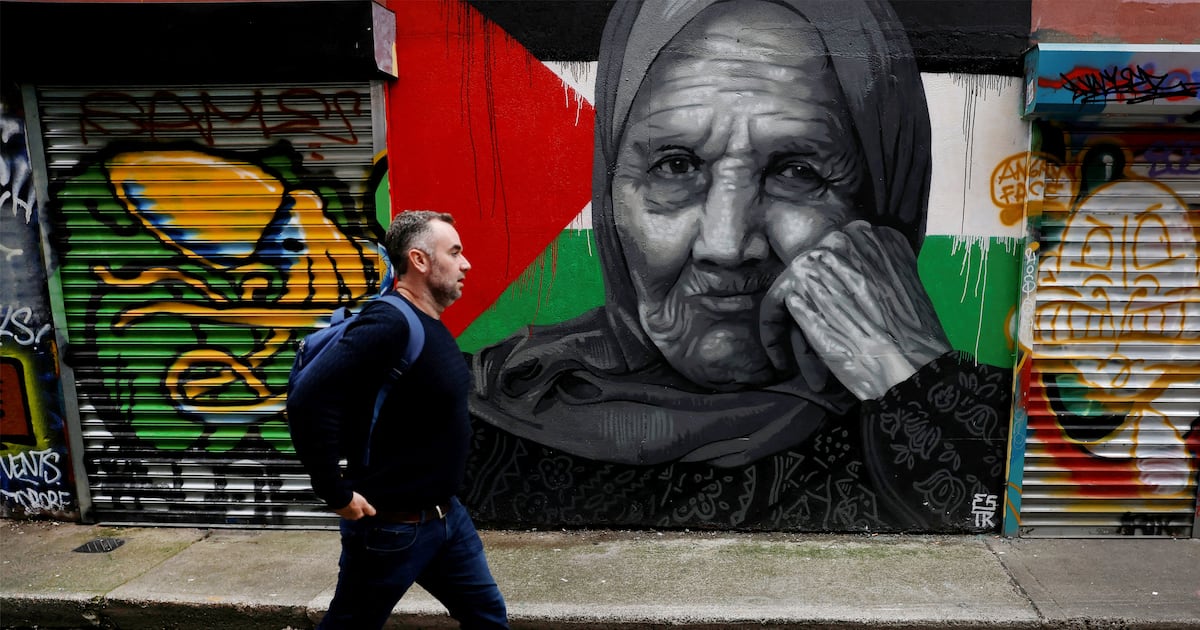
Last week, just before Christmas, Irish television viewers soaked up a beautiful rendition of Gaza on Christmas Eve by the Daughters of Jerusalem, a choir founded by the Edward Said National Conservatory of Music. The rendition was broadcast live from the ornate Royal Hospital Kilmainham in Dublin and the performers, mostly young Palestinian women, were warmly received.
Irish singer Imelda May performed just before the choir. Wearing a tatreez dress that she commissioned from a London designer two years ago in solidarity with the people of Gaza, May told the programme: “I thought I’d wear it a couple of times and it would all be over, but here we are.”
I mention this prominent performance because it shows the spirit that has been stirred in Ireland since the conflict in Gaza ignited. The bitter events shown on television screens only serves to intensify this solidarity with every week that passes.
Ireland’s presidential election in October was something of a comment on the war. The candidate with an overtly pro-Palestinian campaigning record stretching back decades stormed to victory in a vote powered by identity politics. Although she is a ceremonial president whose powers match that of the monarch in the UK, Catherine Connolly joined government leaders who are also strident pro-Palestine advocates.
Taoiseach Micheal Martin, for example, arrived at December’s final EU summit of the year determined to highlight the Palestinian issue. A meeting dedicated to the thorny issue of sequestering frozen funds for the Ukraine war at least heard some of the latest developments regarding the Gaza ceasefire and aid blockages, topics that otherwise would have been squeezed out.
Ireland has been an important force at the European level for its even-handed policies regarding the humanitarian and political fallout from more than two years of war in Gaza. In May of last year, Mr Martin was declaring the Palestinian enclave “hell on earth” not long after his government announced its intention to formally join South Africa’s genocide case against Israel at the International Court of Justice.
Alongside Spain and other allies, Ireland has sought to ensure the EU has absorbed ICJ rulings. It has been at the heart of the discussions around the EU’s treaty relationship with Israel and of curbing the privileges these bring to the trading relationship. Dublin welcomed the European Commission’s proposal in September to suspend parts of the EU-Israel Association Agreement. That step has not been taken because it requires at least 15 member states representing 65 per cent of the EU population.
Here lies the rub. Ireland has been, in its own terms, a very strong advocate for the Palestinian cause. It has been more willing than most to risk a reach of its relationship with Israel in pursuit of its diplomacy. But less high-profile have been the instances in which Ireland has curtailed acts of solidarity. A proposed tour of the country by Palestinians who play Gaelic football in the West Bank was scrapped in July because of the failure of the Irish to issue visas.
Another tour associated with Edward Said National Conservatory of Music fell apart in similar circumstances. The youth of the Lajee Centre in Aida refugee camp, which lies on the outskirts of Bethlehem, were denied a trip to Ireland in the summer by bureaucrats. Irish figures for the year since October 2023 show about two in five applications were denied.
Campaigners for the Irish parliament’s Occupied Territories Bill pushed the legislation on the basis that it would ban all trade, including services, with Israeli businesses operating in the settlements. That measure has, until now, circulated in proposal form, somehow failing to come to its final stages.
Moreover, there is a significant faction in Ireland that would be willing to cut what it defines as dual-use business ties with Israel. This largely means that the Irish would sever business-to-business ties with Israel’s tech sector, something that had significant traction prior to the Hamas-led attacks on October 7, 2023.
A proposed tour of the country by Palestinians who play Gaelic football in the West Bank was scrapped in July because of the failure of the Irish to issue visas.
The broad, big-picture view of Ireland as champion of the Palestinian cause is well known. When it comes to the EU level, it is a leader in what is still a minority faction. Without a big shift in German politics, that is likely to remain the case.
In other words, Ireland is pursuing comfort-zone politics that reflect the fact it is a small country, albeit one with a canny diplomatic campaigning style. As it has done throughout, the Irish position is very good at masking its own contradictions. These are not just applicable to Ireland but are shared across the board.
As things stand, and as the situation appears likely to evolve, these contradictions will magnify, not contract in 2026. Ireland’s policy masters present a good prism to view just how difficult it is to translate principled stances in this situation.
Thus, it is not enough to view Irish policy as one dimensional, with a foot-dragging underside. The contradictions it has hit upon and to some extent created, are shared widely. Watching how Dublin handles the challenges of 2026 is not just a way to examine how progressive diplomacy can influence or bring pressure on the parties driving the conflict. Irish policy presents as a litmus test that is shared across international diplomatic community. As such it deserves the closest scrutiny into its own actions as well as how its positions fare when put to that test.
What are the influencer academy modules?
Mastery of audio-visual content creation.
Cinematography, shots and movement.
All aspects of post-production.
Emerging technologies and VFX with AI and CGI.
Understanding of marketing objectives and audience engagement.
Tourism industry knowledge.
Professional ethics.
%E2%80%98White%20Elephant%E2%80%99
%3Cp%3E%3Cstrong%3EDirector%3A%3C%2Fstrong%3E%20Jesse%20V%20Johnson%3Cbr%3E%3Cstrong%3EStars%3A%3C%2Fstrong%3E%20Michael%20Rooker%2C%20Bruce%20Willis%2C%20John%20Malkovich%2C%20Olga%20Kurylenko%3Cbr%3E%3Cstrong%3ERating%3A%3C%2Fstrong%3E%203%2F5%3C%2Fp%3E%0A