
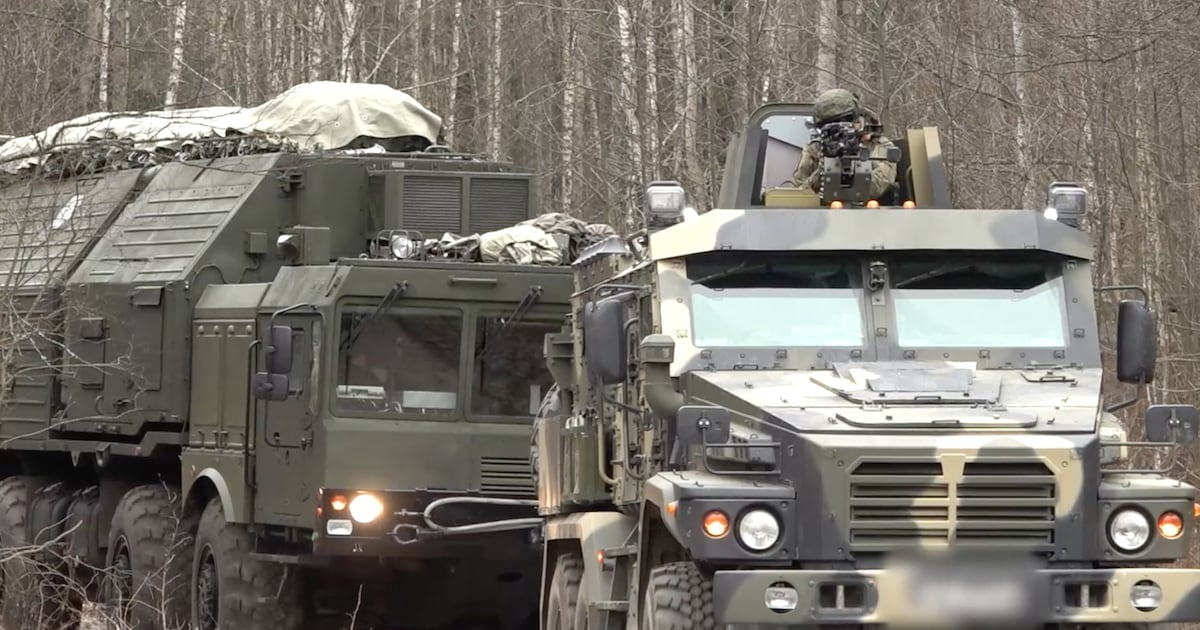
Russia has released a video of what it said was the deployment of its nuclear-capable hypersonic Oreshnik missile system in close ally Belarus, a move meant to boost Moscow’s ability to strike targets across Europe in the event of a war.
The state news agency Tass said it was the first time that the defence ministry had shown off the Oreshnik mobile missile systems, which Russian president Vladimir Putin has declared are “impossible” to intercept because of missile speeds reportedly more than 10 times the speed of sound.
The deployment, and Moscow’s announcement that the missiles have entered active service in a country that borders Ukraine and Nato members Poland, Lithuania and Latvia, comes at a time of heightened East-West tensions.
The move would allow Russian nuclear missiles to reach European targets slightly faster in any war.
Some western experts have said the development underlines the Kremlin’s growing reliance on the threat of nuclear weapons as it seeks to deter Nato members from supplying Ukraine with weapons that can strike deep inside Russia.
Two US researchers have said that, according to their study of satellite images, Moscow is probably stationing the missiles and their mobile launchers at a former airbase in eastern Belarus.
The video released by the Russian and Belarusian defence ministries on Tuesday did not disclose the location of the missile systems. But the footage showed mobile launchers and their crews driving along forest roads and specialist troops camouflaging the systems with netting.
A senior Russian officer was shown telling troops that the systems had officially been placed on combat duty and, as light snow fell in the background, speaking of regular training and reconnaissance routines for the missile crews.
Moscow tested a conventionally armed Oreshnik – Russian for hazel tree – against a target in Ukraine in November 2024.
Mr Putin has said the Oreshnik’s destructive power was comparable to that of a nuclear weapon, even when fitted with a conventional warhead. Intermediate missiles have a range of up to 5,500km , which would enable them to strike anywhere in Europe or the western United States from Russia.
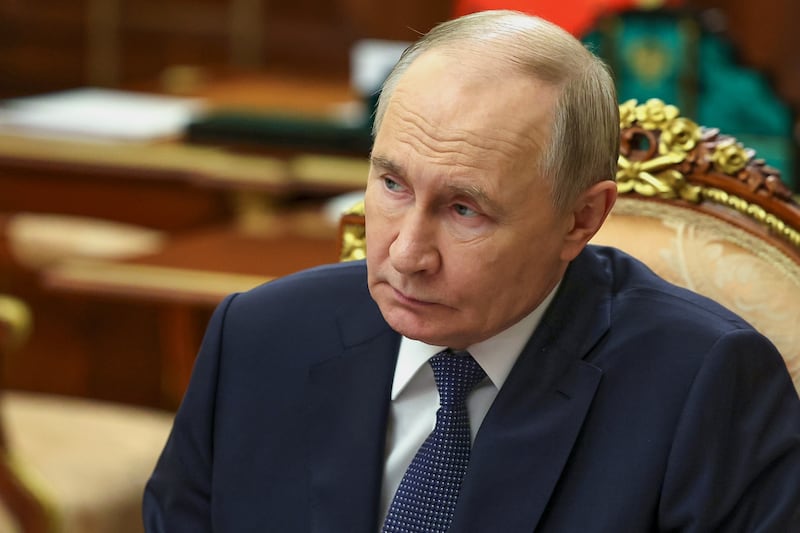 Russian president Vladimir said the Oreshnik mobile missile systems were ‘impossible’ to intercept. Photograph:Mikhail Metzel/ AP
Some Western officials have expressed scepticism about the Oreshnik’s capabilities. One US official said in December 2024 that the weapon was not seen as a game-changer on the battlefield.
Belarusian president Alexander Lukashenko, a staunch ally of Mr Putin who has also embarked on talks with the administration of US president Donald Trump, had already flagged the installation of the missiles.
He said that not more than a dozen “Oreshniks” would be deployed, a step his defence minister said was necessitated by what he called aggressive moves by Western opponents.
Mr Lukashenko allowed Russian troops to use his country to enter Ukraine in February 2022, but has not deployed Belarusian troops to fight alongside Moscow’s forces in Ukraine.
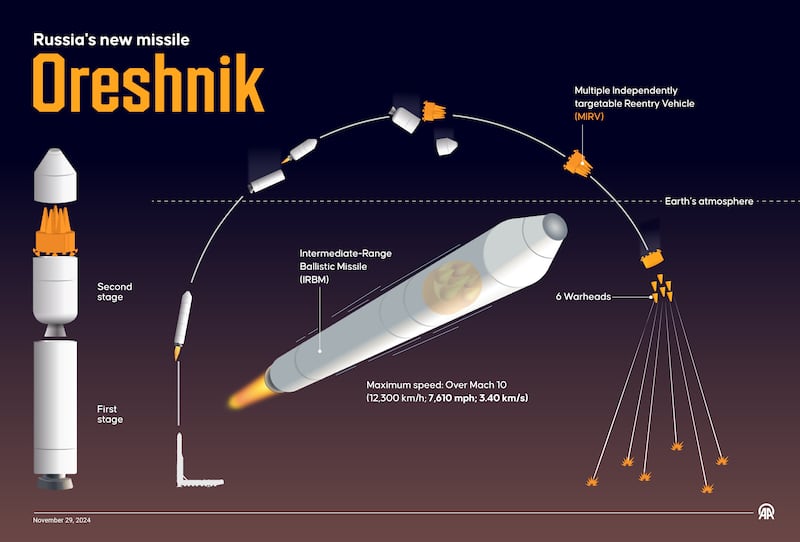 Moscow tested a conventionally armed Oreshnik – Russian for hazel tree – against a target in Ukraine in November 2024. Image: Omar Zaghloul/ Anadolu via Getty Images
The Kremlin said on Tuesday, meanwhile, that its position would toughen in talks on ending the war in Ukraine after accusing Kyiv of attacking a Russian presidential residence, an allegation that Kyiv said was baseless and intended to prolong the conflict.
Ukraine has said Russia’s accusations were “lies” aimed at justifying more attacks on Ukraine, and its foreign minister said on Tuesday that Russia had not provided any evidence “because there’s none”.
Russia said on Monday Kyiv had attacked a presidential residence in the Novgorod region with 91 long-range attack drones. It said it would retaliate and review its negotiating stance but would not quit talks on a possible peace deal.
“This terrorist action is aimed at collapsing the negotiation process,” Kremlin spokesman Dmitry Peskov told reporters on Tuesday. “The diplomatic consequence will be to toughen the negotiating position of the Russian Federation.”
He said the military knew when and how to respond.
A tougher negotiating stance would complicate efforts led by US president Donald Trump to end the deadliest war in Europe since the second World War.- Reuters