
LONDON, Dec 31 (Reuters) – This past year won’t soon be forgotten. In 2025, conventional thinking about economics and investor behavior was frequently challenged, as dramatic changes in technology, energy and geopolitics drove markets in often unexpected ways.
Here are 10 charts that help explain what happened in 2025 and what it might mean for next year.
Sign up here.
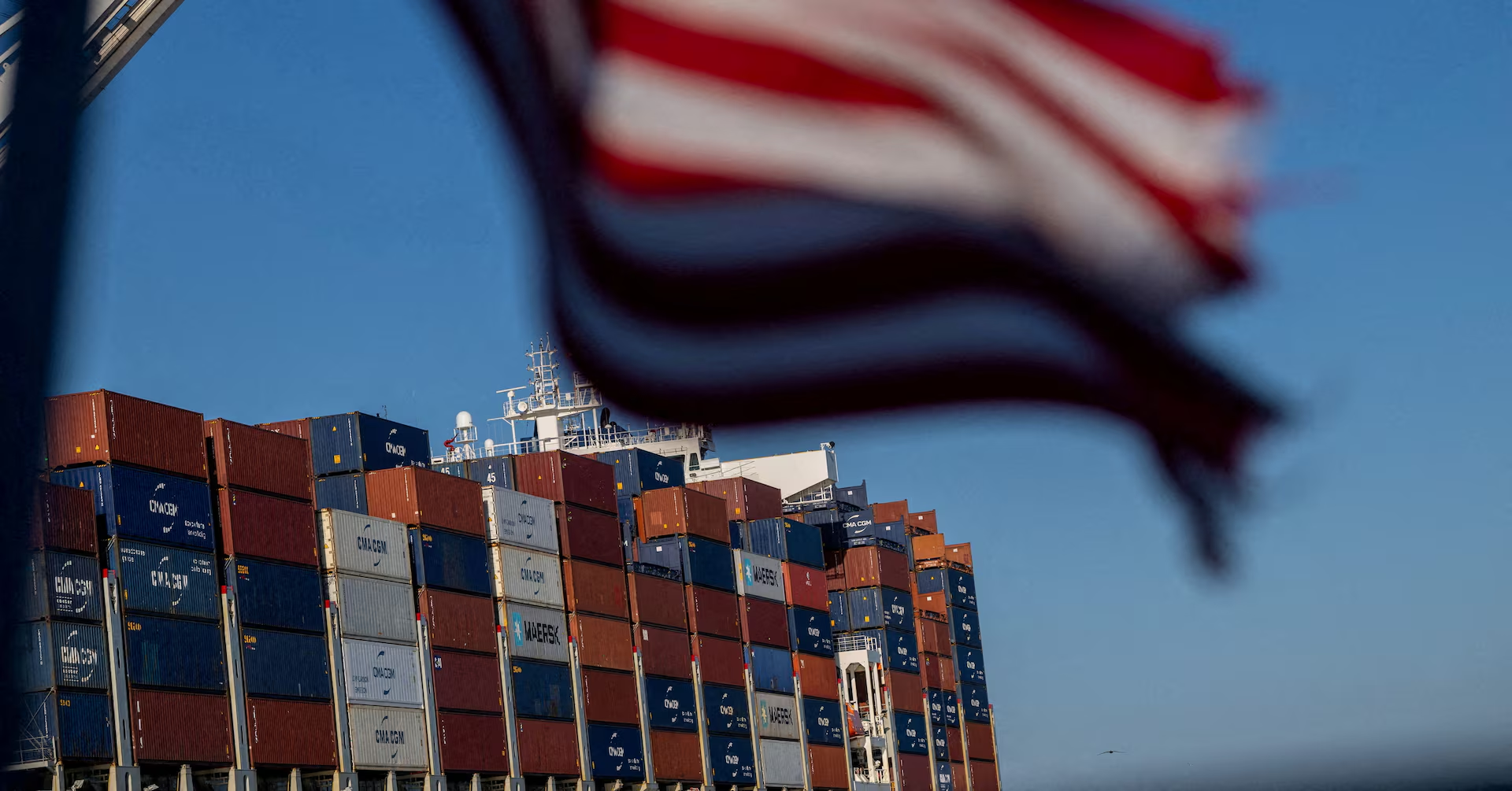
TRADE TANTRUMDonald Trump’s “America First” agenda proved to be a key market driver in 2025 – particularly in the first half of the year – as the U.S. president wasted no time delivering on his campaign promises to shift from free trade to “fair” trade.chartU.S. trade policy uncertainty – as measured by the Baker-Bloom-David model – hit an all-time high after Trump announced sweeping import tariffs on April 4, “Liberation Day.”
The index has since eased, but it remains in historically elevated territory, almost double the peaks of Trump’s first administration.
TARIFF THROWBACK
At this time last year, the average effective tariff rate on imports into the U.S. was around 2.5%. It is now almost 17%, the highest level since 1935. This represents the biggest U.S. tax increase as a share of GDP in more than 30 years.
Line chart showing US effective tariff rate from 1790-present.To the surprise of many, the U.S. economy and others around the world have coped remarkably well despite this massive change in America’s trade strategy. U.S. GDP grew at a healthy annualized rate of 4.3% in the third quarter. Will consumers and businesses be as resilient next year? That remains an open question.DOLLAR’S ANNUS HORRIBILISThe consensus among Wall Street analysts at the start of 2025 was that the dollar would strengthen as the “U.S. exceptionalism” narrative and Trump administration’s onshoring attracted waves of capital from around the world.chartInstead, the dollar has fallen around 10% against a basket of major currencies. By the end of June, it was down 12% – its worst first half of any calendar year since the era of free-floating exchange rates began over half a century ago.CONSULTING THE ORACLEThe “Magnificent Seven” U.S. technology stocks have dramatically outperformed in 2025, fuelled by the euphoria surrounding artificial intelligence, but as the year progressed, investor concerns grew regarding hyperscalers’ massive, increasingly debt-fuelled AI capex outlays.A line chart showing the percentage change of Walmart stock vs. the S&P 500 since Trump’s electionThe share price performance of Oracle (ORCL.N), opens new tab reflects this trajectory. The U.S. cloud computing giant’s stock rose 36% in a single day in September on positive revenue projections, then began to slide, dropping 15% in two days earlier this month – a magnitude of decline seen only during the COVID-19 pandemic, the 2008 global financial crisis and the 1990s dot‑com crash.
If Oracle is a bellwether of investors’ broader sentiment about AI, there could be a rocky road ahead for the tech-powered equity rally.
‘MY PRECIOUS’Gold and silver prices have soared in 2025, as safe-haven demand and bets on further U.S. interest rate cuts have fuelled a sharp rally in precious metals.Silver eclipsed $80 an ounce for the first time ever on December 29, driven by strong industrial demand, persistent supply shortfalls, and momentum-driven buying.Gold and silver on pace for biggest annual gains in decades as soft dollar, rate cut bets and safe-haven demand turbocharge fierce rally in precious metals. The yellow metal is up 72% in 2025 while the white metal has surged 178% in the year.While gold prices have fallen since hitting a record-high above $4,500 an ounce last week, the yellow metal looks set to deliver its biggest annual gain since 1979.
The risk now is that mean reversion will rear its ugly head in 2026, resulting in a sharp and painful pullback.
EUROPE RELOADSEuropean defense stocks have more than tripled in value since Russia’s invasion of Ukraine in 2022, a war now heading into its fourth year. The sector has gained more than 50% in 2025 alone, spurred by the announcement that Germany will spend up to a trillion euros on defense and infrastructure.Europe’s STOXX Aerospace and Defence Index has risen sharply since Russia’s invasion of Ukraine in 2022
This price move speaks to many of this year’s global themes, including increasing U.S. isolationism, rising geopolitical tensions and expectations for a European economic reboot.
And it also helps explain some other notable 2025 market moves, including the surge in the euro/dollar rate , the outperformance of European stocks versus Wall Street and rising long-dated German bond yields.
SUPPLY SHOCK ABSORBEROil prices jumped from $70 to $81 a barrel after Israel launched a bombing campaign in Iran on June 12, sparking fears that Tehran would block the all-important Strait of Hormuz. But the spike was short-lived as the so-called “12-day war” ended swiftly.Oil supply shocks
This speaks to a longer-term trend: geopolitical tensions still create volatility in energy prices, but price shifts only stick when supply is disrupted, not simply threatened. And even then, global energy markets are increasingly able to adapt, reducing the risk that a surprise event will cause a persistent imbalance between supply and demand.
POWER UPThe U.S. battery storage market has been the hottest segment of the American energy market in 2025, with capacity on track to jump by a record 12 gigawatts to a total of roughly 40 GW. Meanwhile, China’s exports of batteries and battery energy storage systems (BESS) hit a record in 2025, soaring by 24% from the year before over the first nine months of the year.US battery energy storage capacity
Utility-scale storage systems allow power firms to make better use of renewable power supplies by storing surplus solar output that can then be discharged during peak power demand periods. Battery storage will be a key trend to track in the coming year.
ASIA’S SOLAR FLAIRAsia has long been the primary driver of the global solar power industry, manufacturing the vast majority of solar components and accounting for over half of global solar farm installations.Solar generation by region
In 2025, Asia widened its lead, representing nearly 70% of the global rise in solar generation so far this year as well as a record 59% of all utility-supplied solar power.
Given the Trump administration’s pushback on renewables and Europe’s increasing focus on energy security, Asia’s solar dominance may deepen over the next 12 months.POWER DOWN
Spain and Portugal suffered an unprecedented power outage on April 28, the largest in Europe’s history. A combination of factors – including a solar plant failure and low system inertia – triggered a catastrophic chain reaction.
Spain powerThe blackout was resolved quickly, but it exposed the challenges modern power grids face. Policymakers are likely to zero in on such vulnerabilities moving forward as the AI-driven race for power heats up.(The opinions expressed here are those of the author, the Editor in Charge of Reuters Open Interest)Enjoying this column? Check out Reuters Open Interest (ROI),, opens new tab your essential new source for global financial commentary. ROI delivers thought-provoking, data-driven analysis of everything from swap rates to soybeans. Markets are moving faster than ever. ROI, opens new tab can help you keep up. Follow ROI on LinkedIn,, opens new tab and X., opens new tab
Writing by Anna Szymanski
Editing by Marguerita Choy
Our Standards: The Thomson Reuters Trust Principles., opens new tab
Opinions expressed are those of the author. They do not reflect the views of Reuters News, which, under the Trust Principles, is committed to integrity, independence, and freedom from bias.