
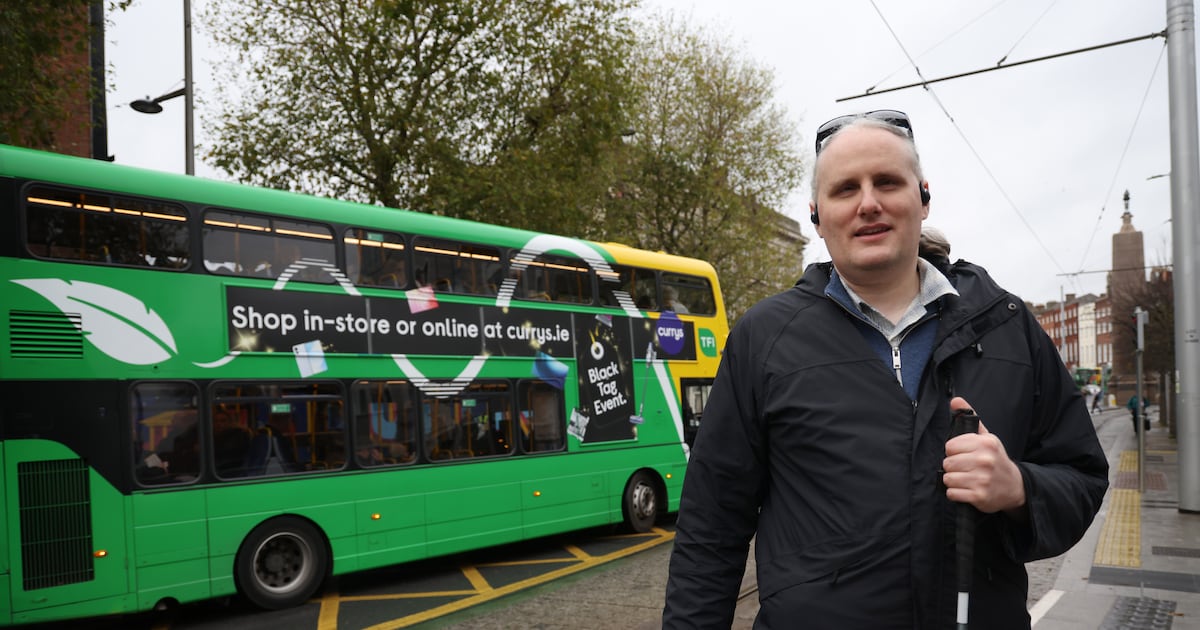
Declan Meenagh had just “wasted half the morning” trying in vain to apply online for a Revolut credit card and was feeling angry.
The 36-year-old, who is visually impaired, was unable to complete the identity-verification part of the process which required him to provide a video selfie.
Mr Meenagh was born with a rare genetic condition and has “about 5 per cent sight”. He is one of almost 300,000 people in Ireland with visual impairment or blindness – about six per cent of the population – according to the 2022 Census.
He can make out shapes and light but is almost fully blind. “It is like looking through a tiny straw,” he says. “It has remained stable and I am pretty lucky with it, but I could lose it all at any time.”
The Revolut ID verification which has so exasperated Mr Meenagh required him to move his face to various angles within an oval shape on his phone’s screen for the app to match it against the identification document he provided.
He could not see the oval shape, so he was unable to keep his face within it.
“There are text instructions as I am trying to video myself,” he says. “I am trying to position my face for the verification.”
During his struggle to do this, a message eventually appeared on his screen saying: “We couldn’t verify your selfie.”
“If someone with sight was doing this, they would have it done in minutes,” he says. “This, to me, is very inaccessible. Sighted people can get a credit card in minutes. I made about three attempts and then I contacted customer service.”
Under the European Accessibility Act, which came into force in June, 2025, all services including banking must be accessible to disabled people.
Later that day, Mr Meenagh made a formal complaint to Revolut. It was upheld. The company told him the “failure of our internal support system to immediately provide the human-led workaround pathway following the identification of an accessibility barrier constitutes a significant service failure”.
A Revolut spokesman said it was “dedicated to ensuring that our digital banking services are accessible to all customers, including individuals with disabilities and additional needs”.
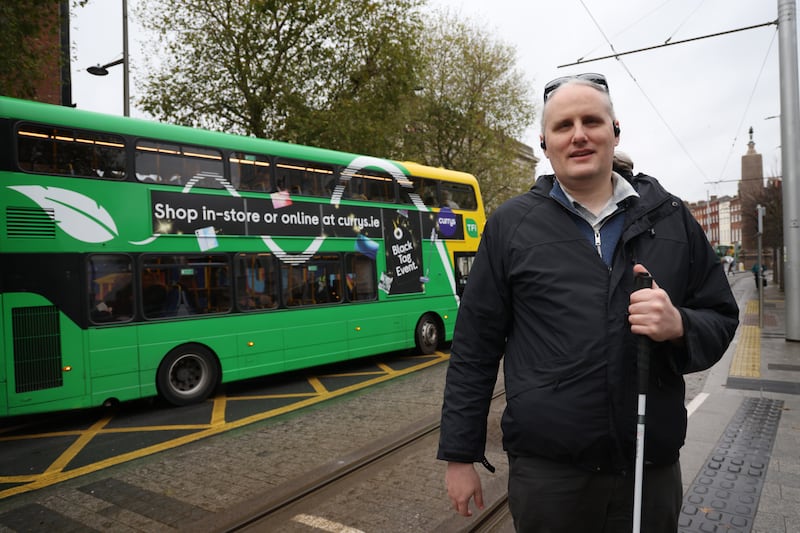 Declan Meenagh in Dublin City centre. Photograph: Bryan O’Brien / The Irish Times
On a Dublin street, Mr Meenagh walks from his workplace at a community centre in the north inner-city to O’Connell Steet. He uses a white stick in a back-and-forth sweeping motion on the ground in front of him.
“You are constantly on guard with the stick,” he says. “If your attention slips for a minute, you don’t sweep as much, you will miss something and you will walk into it. It could be a lamppost, bollards, a fence, bikes. You could fall on uneven paving. Then there’s dog poo and things the same consistency as poo. Maybe vomit.”
Turning on to Parnell Street, he almost walks through dog faeces. “I would have had no way of knowing that was there, could have walked straight on to it. That dog-owner had no respect for me, older people, wheelchair users. I could have been on the way to a medical appointment, a job interview.”
At the Luas stop at the bottom of O’Connell Street, he says he often wants to get the tram to Broombridge, as opposed to the one that stops well short of that, at Parnell.
“But there is no way for me to know which one is stopping here,” he says. “Sighted people get information by looking at a screen. We do by announcement.”
Luas stops do not have announcements informing commuters about where approaching trams are headed. Mr Meenagh says this is something that could easily be rectified and would make a big difference to visually-impaired people.
“If there are people [on the platform], I will ask – and people are very good.”
However, if there is no one around to ask, he must go to the front of the tram, hoping to get the driver’s attention to ask them. “This is a very inaccessible design from a mode of transport that is actually quite accessible.”
These may all “seem like small things”, he says. “But it’s all the small stuff that adds up to really disable people like me.”
Transdev is the Luas operator. When asked why there are no on-platform announcements, a spokeswoman for the company did not address this.
As part of a lengthy statement on accessibility, she said: “For customers who are visually impaired, have hearing loss, or have combined visual and hearing impairments, Luas provides a layered approach to information, including tactile platform layouts, high-contrast visual displays, audio announcements, on-board induction loops and staff support on request.”
Mr Meenagh describes Dublin Bus drivers as “on the ball”. “They call out their bus number as they pull into stops where a visually-impaired passenger is waiting,” he says. A company spokesman confirmed drivers were trained to do this.
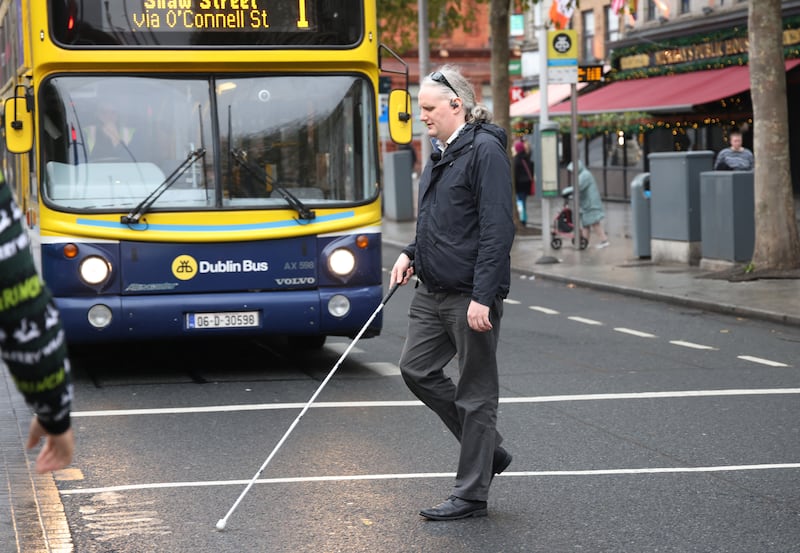 Declan Meenagh crossing Dublin’s O’Connell Street. Photograph: Bryan O’Brien / The Irish Times
Mr Meenagh, a computer science graduate, believes he is “behind” in his career because of attitudes from potential employers towards his disability. Technology used in many workplaces, for example, is not adapted to accommodate visually-impaired people. He believes he and many others are underestimated by employers.
He continues: “I genuinely believe people want to do the right thing, will go out of their way to help. But the head space in the workplace is, ‘how can he work if he can’t see around the office?’. There isn’t enough bias training that names the biases and shows the flaws in them.
“As a disabled person, you build up a lot of skills in terms of just dealing with problems, solving them. We are the most resilient, most talented people there are.”
This article is part of a series highlighting the barriers faced by disabled people in Ireland to realising their rights to participate fully in education, employment, housing, transport and society. Tomorrow: How accessible is public transport?