
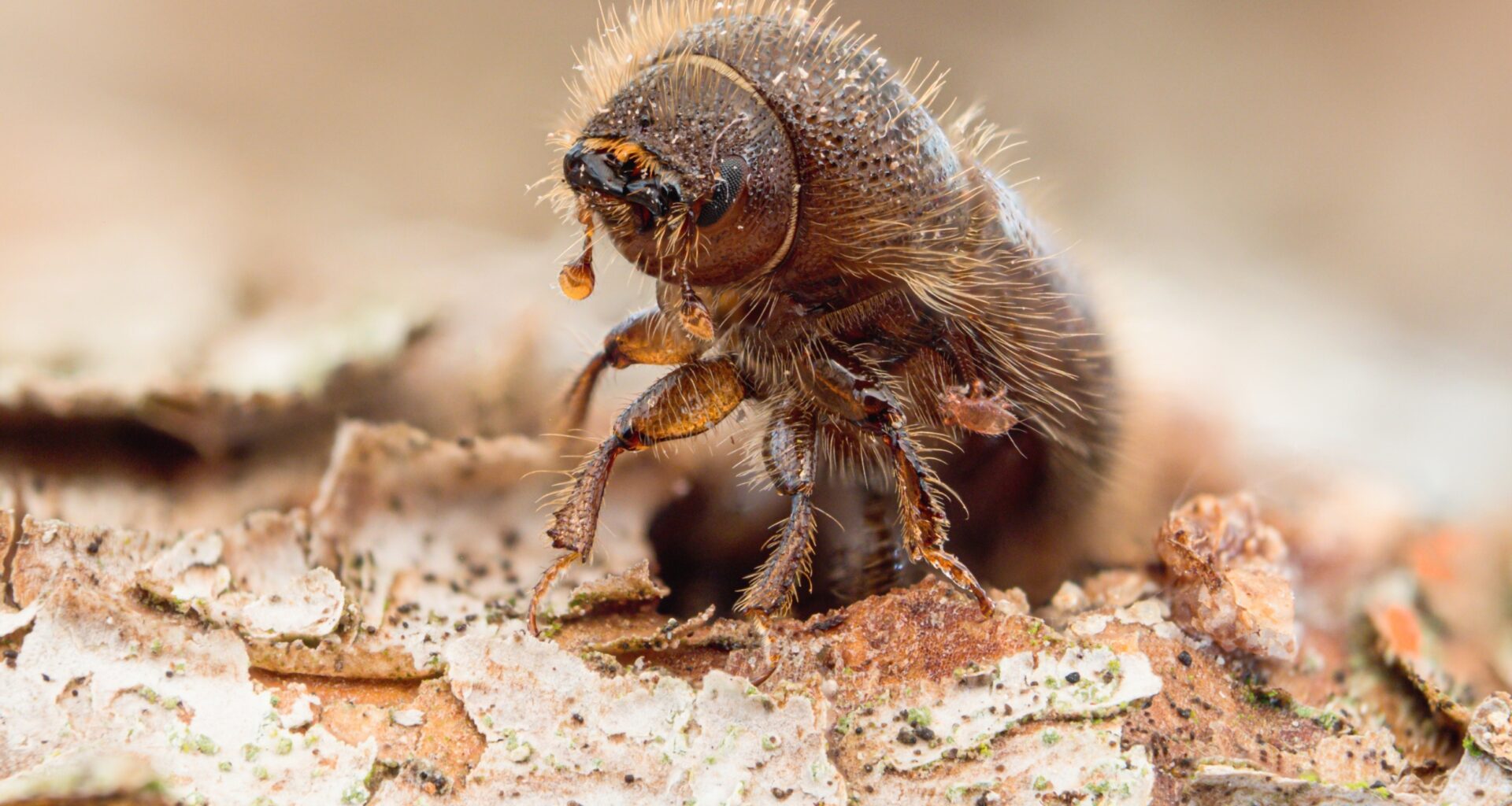
Spruce bark is packed with phenolic compounds that defend the tree against invading fungi. Those chemicals live in the phloem, the inner bark that beetles chew through as they tunnel.
A team at the Max Planck Institute for Chemical Ecology in Jena asked a sharp-edged question: when bark beetles swallow the tree’s chemical weaponry, can they repurpose it to protect themselves against their own pathogens?
Beetles upgrade plant toxins

Using high resolution mass spectrometry and nuclear magnetic resonance (NMR), the researchers mapped which defensive molecules spruce trees produce and what happens to them inside beetle bodies.
The surprise was not just that beetles tolerate these chemicals. It was that they chemically modified them into even stronger antimicrobials.
The insects cleave off the sugar groups, converting phenolic glycosides into their sugar-free “aglycone” forms.
The aglycones pack more antimicrobial punch and help the beetles fight off pathogenic fungi encountered in their galleries.
“We did not expect the beetles to be able to convert the spruce’s defenses into more toxic derivatives in such a targeted way,” said study lead author Ruo Sun.
Fungi slip past beetle defenses
The story doesn’t end with the beetles’ clever chemistry. The team turned to Beauveria bassiana, a well-known entomopathogenic fungus used in biocontrol, which has a mixed track record against bark beetles in the field.
“Although this fungus has not been effective in controlling bark beetles in the past, we found strains that had naturally infected and killed them. We therefore wanted to investigate more closely how they were able to successfully infect the beetles,” Sun explained.
The study revealed a two-step detoxification pathway that lets B. bassiana slip past the beetle’s upgraded defenses.
First, the fungus re-adds a sugar to the toxic aglycones (glycosylation). Then it caps that sugar with a methyl group (methylation). The result is a methylglycoside derivative that neutralizes toxicity.
This is safe for the fungus, and, crucially, resistant to the beetle enzymes that would normally snip sugars back off and restore the antimicrobial form.
Exploiting the beetle’s strategy
Even more striking, beetles that had gorged on phenolic-rich spruce tissue proved more susceptible once the fungus performed this methylglycosylation, suggesting the pathogen can exploit the beetle’s own chemical strategy.
To test causality, the team knocked out the genes in B. bassiana that drive methylglycosylation.
Mutant fungi without this pathway struggled to infect bark beetles, confirming that detox is not a side note. It’s central to the pathogen’s success.
The genetics, the enzyme biochemistry, and the infection outcomes all aligned: methylglycosylation is the key that unlocks the beetle’s chemical armor.
An evolutionary arms race
What emerges is a classic three-way arms race. The spruce tree outfits its bark with phenolics to block fungi.
The beetle co-opts those phenolics, converting them into more potent antifungals to protect itself and its brood. The fungus evolves a detox pipeline to neutralize those very compounds, reclaiming the upper hand.
“We have demonstrated that a bark beetle can co-opt a tree’s defensive compounds to make defenses against its own enemies,” said study co-author Jonathan Gershenzon.
“However, since one of the enemies, the fungus Beauveria bassiana, has developed the ability to detoxify these antimicrobial defenses, it can successfully infect the bark beetles and thus actually help the tree in its battle against bark beetles.”
Ecologically, that twist matters. If fungal pathogens can reliably infect beetles even when those beetles weaponize spruce chemistry, the tree gains an indirect ally.
In outbreak years – when Ips typographus can devastate spruce stands – knowing which fungal strains can slip past beetle defenses could tip management outcomes in the forest’s favor.
The practical implications are direct. “Now that we know which strains of the fungus tolerate the bark beetle’s antimicrobial phenolic compounds, we can use these strains to combat bark beetles more efficiently,” Sun said.
Biocontrol programs can screen B. bassiana collections for robust methylglycosylation capacity and deploy those strains where spruce phenolics run high.
Just as importantly, the study is a reminder to anticipate counter-adaptations: if a target pest can repurpose host chemistry, any biological pesticide should be vetted for resistance-busting traits before field release.
Probing the detox machinery
The team’s next steps focus on scope and synergy. They plan to survey how widespread the methylglycosylation pathway is across diverse B. bassiana strains and other beetle-killing fungi.
In addition, they’ll probe how this detox machinery interacts with additional pathogen traits – spore adhesion, cuticle penetration, growth rate – that shape infection success.
Mapping that landscape could yield a recipe for high efficacy biocontrol consortia tailored to spruce stands under attack.
This work highlights a broader principle in chemical ecology: defensive molecules are not static shields. They flow through food webs, get metabolized, intensified, and disarmed, and in the process, they steer evolution on all sides – host, herbivore, and pathogen.
Here, spruce phenolics spark a cascade of conversions – from glycosides to aglycones to methylglycosides – that decides who wins at the bark-beetle–fungus interface.
Understanding those exchanges opens the door to smarter, more reliable ways to help forests withstand one of their most relentless adversaries.
The study is published in the journal Proceedings of the National Academy of Sciences.
—–
Like what you read? Subscribe to our newsletter for engaging articles, exclusive content, and the latest updates.
Check us out on EarthSnap, a free app brought to you by Eric Ralls and Earth.com.
—–