
Stay informed with free updates
Simply sign up to the Artificial intelligence myFT Digest — delivered directly to your inbox.
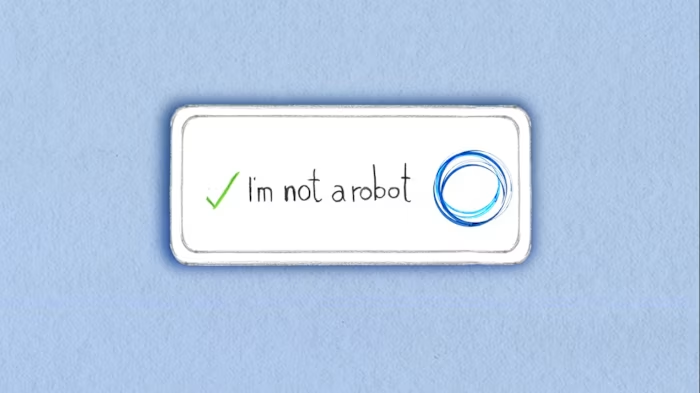
Three months into my new job as a host of the FT’s flagship News Briefing podcast, I was hit with an unusual problem: some of the listeners were convinced that my voice had been created by artificial intelligence.
Colleagues urged me not to read the comments on Spotify.
I did anyway.
“I’m unsubscribing, I’m not listening to an AI bot for my morning briefing,” one listener wrote, while another implored my employer to “Stop the AI!”
Funniest of all was the commenter who put my name in quotes: “Stop please, we heard ‘Victoria’ enough.”
Some listeners did defend me. “A little bit of digging shows that Victoria Craig is a real journalist, she used to work for BBC,” they wrote. “Don’t be so quick to jump to conclusions guys.”
I spent most of the past decade honing my presenting style at the BBC. And I’m proud of the way I speak on air. But some colleagues and friends have wondered whether that’s now working against me. The calm, smooth manner in which broadcasters are trained to speak has been replicated by computer-generated voices. Have they conditioned society to believe that this traditional broadcast style now belongs to AI voices rather than human ones?
The discourse about whether I am a robot highlights how, in the age of rapid AI expansion, distrust in the media is also accelerating. A fifth of respondents to a Reuters Institute survey this year said they thought journalists used generative AI to present stories.
“People see that these technologies can enable those tasks, and can help with them. And therefore expect journalists to use them for those very same tasks,” said Felix Simon, a research fellow in AI and digital news at the Reuters Institute for the Study of Journalism.
This alone is not a problem. But just a third of respondents believe journalists double check what AI has churned out before it is published, and only 19 per cent are comfortable with an AI-created presenter delivering the news.
To add another layer of complexity: AI-generated media is growing ever more prolific. Jeanine Wright, a former executive of the podcast production company Wondery, recently started her own platform called Inception Point AI. It has created a line-up of computer-generated podcast hosts focused on gardening, cooking and personal finance.
Nor is it just entertainment podcasts. In early December, both Yahoo and the Washington Post launched AI-curated news podcasts. Episodes will be tailored to each user’s news preferences based on the stories they interact with. Post users can even choose their presenter and length.
Customisation and lower costs are appealing. Yet research the Reuters Institute has done suggests that many media consumers still crave the authentic human connection that only a real person can deliver. The Post’s beta rollout was met with backlash from some listeners.
“People have flocked toward podcasts as a medium because it has this sort of personal attention,” explained Simon. “It’s a bit weird to take AI and say, ‘let’s do this because we can’.”
Is there anything that we can do to convince listeners that we are who we say we are?
More disclosures might help. We’ve added one to all FT podcast show notes to explain that none of our output is voiced by generative AI. And because listeners are clearly craving authenticity, I have leaned into that with a new weekly chat segment.
Clarity about exactly how AI is being used could be welcome too — though Simon thinks that audiences do not necessarily want to know the particulars of how the news sausage is made. They just want to be assured that a human had a final hand in the process.
“You’re using AI to transcribe this interview: As long as you check it before you use it in the article, that’s not necessarily something where people say, ‘We need to know that AI was in the mix,’ because it’s a bit like, at this point you using Excel to calculate some data . . . we don’t care, as long as the data we get to see in the article is correct.”
In the spirit of transparency, I did use AI to transcribe my interview with Simon. But I also double and triple checked that it got the conversation right. And, for the record, it did not. Human intervention was required.
So to close the loop on the comment-section quandary: I am, in fact, a human. Though, as another colleague said in jest when I told her about my predicament: You can’t spell Victoria Craig without A-I.