
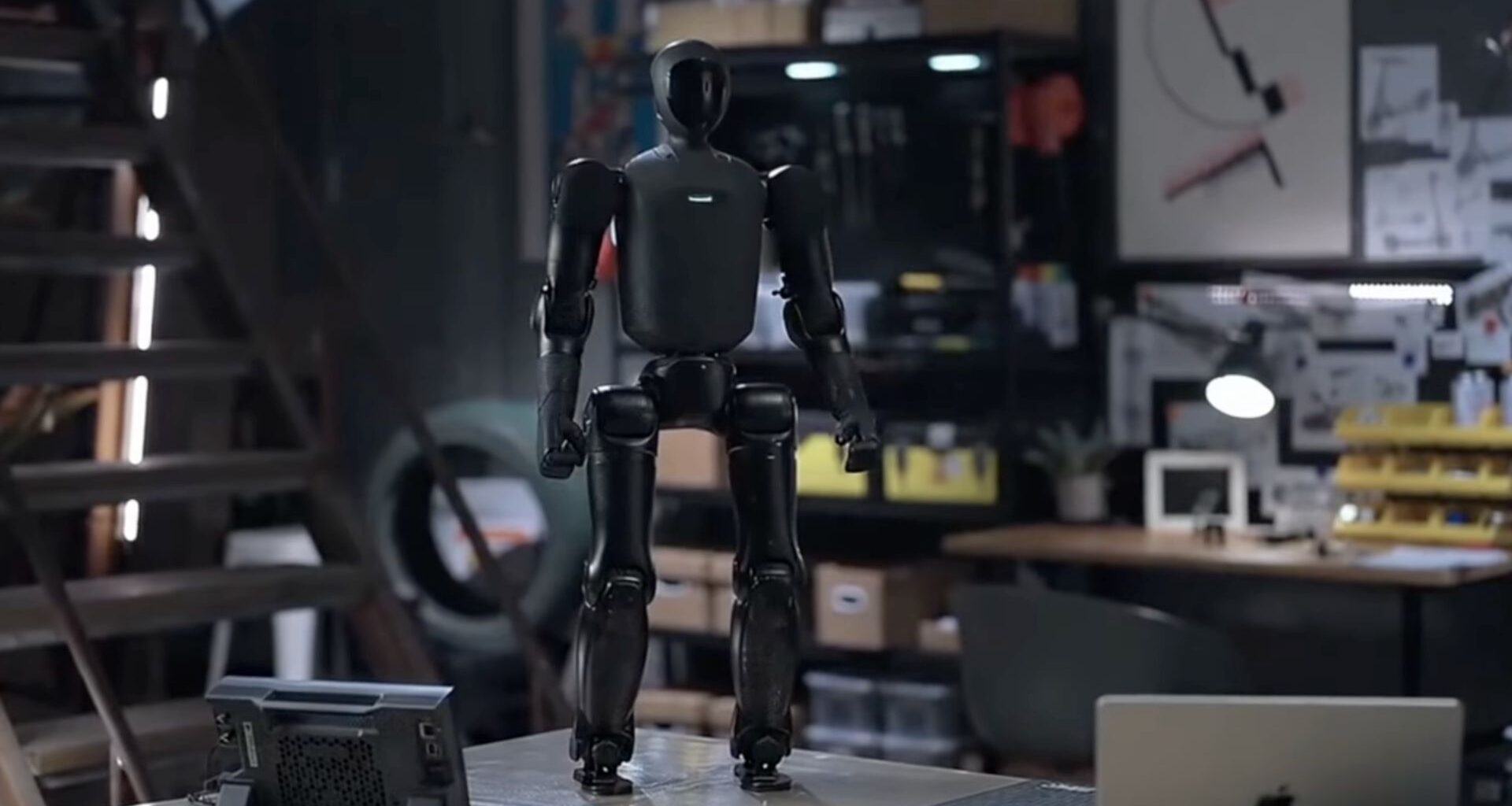
Chinese humanoid robotics startup Agibot has unveiled the Q1, an AI-powered personal companion small enough to fit in a backpack.
At just 80 cm (31 inches) tall and roughly one-eighth the weight of its full-size humanoids, the Q1 features full-body force control and crash-resistant Quasi-Direct Drive joints.
Its compact design makes experimentation safer, faster, and more affordable, bridging the gap between lab prototypes and personal devices. Agibot says the Q1 redefines humanoid accessibility, offering researchers, creators, and enthusiasts a capable platform for everyday interaction and innovation.
Last week, AgiBot launched Qingtian Rent, a platform renting humanoid robots for 16 events, including weddings, concerts, business meetings, and trade shows, offering versatile robotic assistance.
Humanoids go portable
Agibot has unveiled the Q1 as a compact AI-powered humanoid designed to bring personal robotics into everyday life.
At just 0.8 meters tall and small enough to fit inside a backpack, the Q1 redefines what a capable humanoid can be, bridging the gap between lab-bound prototypes and personal devices. The robot’s reduced size—roughly one-eighth the volume and weight of full-sized humanoids—makes it crash-resistant, safer for experimentation, and more cost-effective to iterate, reports Housebots.
Agibot reengineered its Quasi-Direct Drive joints, now smaller than an egg, to retain precise force control and fast dynamic response, enabling the Q1 to move intentionally. Its full-body force control allows developers to test algorithms physically, shortening development cycles from months to days.
Built as an open platform, the Q1 offers accessible SDK and HDK tools, an open-source exterior shell for 3D printing, and zero-code motion programming. Users can customize the robot’s appearance, program movements, and explore embodied AI without advanced robotics expertise. Out-of-the-box features include voice interaction, English tutoring, guided dance coaching, and onboard positioning, reports Mikekalil.
Positioned as both a “graduation” robot for labs and a first personal humanoid for creators, the Q1 embodies Agibot’s vision of a portable, customizable, and interactive platform, turning humanoid robotics into a personal lab you can carry in a backpack.
Humanoids reach mass
In December, AgiBot announced that it had produced its 5,000th robot, a major milestone for one of China’s fastest-growing humanoid robotics startups.
Founded in February 2023, the company achieved this milestone in less than 3 years, signaling rapid progress in the country’s expanding robotics sector. AgiBot’s mass-production strategy spans three distinct product lines, each targeting different commercial environments, demonstrating the startup’s versatility and commitment to meeting diverse customer needs.
The G-Series handles factories, while the X- and A-Series enable dynamic mobility. The Lingxi X-Series, its agile bipedal line, has manufactured 1,846 units, including the X2 model, which recently drew attention for performing a Webster flip that showcased advanced motion control.
The Expedition A-Series accounts for 1,742 units, featuring full-sized humanoids capable of broader tasks, including a 66-mile autonomous walk from Suzhou to Shanghai. The Genie G-Series comprises 1,412 units, with task-focused, often wheeled designs optimized for industrial and logistics applications requiring high efficiency. AgiBot’s robots operate in eight sectors, including manufacturing, logistics, reception, and performance.
The 5,000th milestone also positions the startup ahead of domestic rivals like UBTech, which aims to reach 5,000 units by 2026, underscoring AgiBot’s fast pace and balanced focus on AI development and hardware execution.