
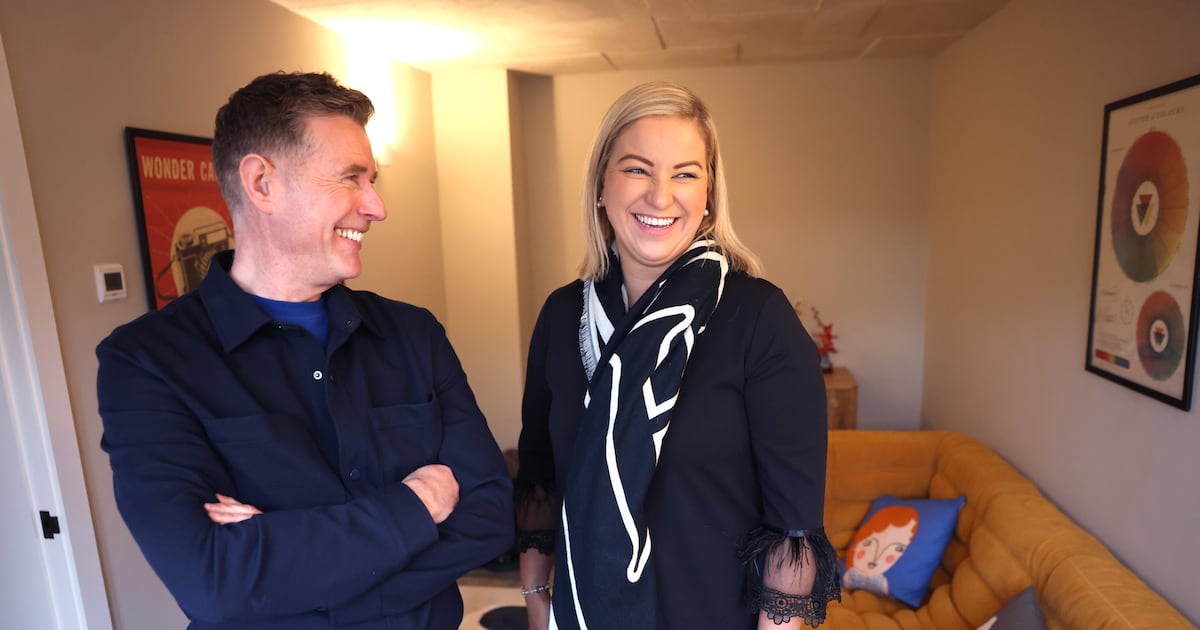
In a typically beautiful Bannonesque kitchen in Raheny, in north Dublin, the celebrity architect Dermot Bannon is tucking into sandwiches with Norita O’Donoghue, a teacher, and her husband, Louis, who works for the council.
The crew of the RTÉ show Room to Improve are bustling about, setting up their next shots of the renovation that Bannon has helped to create. Everyone but the people appearing on camera is wearing blue plastic slippers over their shoes, and everyone keeps trying to feed me sandwiches. “It’s a bit like the Kardashians here,” Bannon says.
They’re in the middle of filming the bit where Bannon gives the couple a tour of the finished house. Later they’ll film the bit where Norita and Louis are interviewed about the experience and later still the bit where all their friends and family come around for a party.
This will be the second house to appear in the 17th series, which begins this weekend. Linda Cullen of Coco Content, the production company that makes the programme for RTÉ, had the idea for the show almost 20 years ago, when the financial crash made a previous series, House Hunters, untenable.
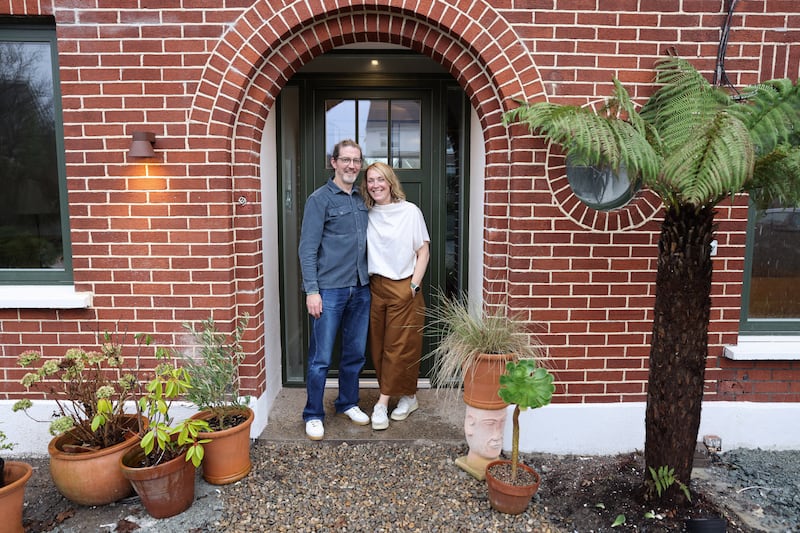 Homeowners Louis and Norita O’Donoghue. Photograph: Dara Mac Dónaill
Nobody was buying, she says, but many people had SSIAs, the government-backed savings accounts that featured a 25 per cent State top-up, so people were building extensions as their money was maturing after five years of being locked away. “I came up with the idea of renovating homes and extending.”
Norita and Louis moved into this 1950s three-bed semi in 2017 and had long been meaning to renovate. They’re very happy with the outcome.
Was there much arguing over the plans? People always ask that, Norita says – that and “How’s the budget?”
“There wasn’t a whole lot of clashing over design,” Louis says. “More on cost. I was the bad cop about the cost thing. Norita was brought on nice, fancy trips down to [other houses] while I was sitting looking at spreadsheets.”
Did Bannon keep pushing the budget up? “I think a lot of the budget is very client driven,” Norita says. “You’re inclined to go, ‘I might as well.’ You think of the lifetime you’ll be here.”
They’re whisked away to do a bit more filming for the home reveal. Bannon points at me accusingly: “He had four sandwiches!” He jokes that they have to be careful since RTÉ’s financial crisis.
Dermot is a very unusual character. He’s charming. He’s lovely. But, in terms of a programme, he actually allows you to show the flaws and faults
I watch with Jane Wardrop, the series producer, as they film on the stairs. “Wouldn’t you love to live in a house like this?” she says. She worked on the show for the first 10 years of its existence but then went away to work on another series, Home Rescue. She’s back this year, as is its director, Joanne McGrath. “The old team,” Wardrop says.
The show has changed over the years. It expanded from a half-hour to an hour, and the scale of the projects has grown. “I remember the first episode was €20,000 in Ballybrack – a flip-around, so the kitchen became the sittingroom and the sittingroom the kitchen,” Wardrop says. “And now this.”
Why does it work? “I’m not sure,” she says. Bannon has “always been passionate. He’s fixated on certain things, and he wants to get it right. He loves what he does. You can feel that. You get immersed in it yourself.” She adds, “Aren’t we all obsessed with houses? All of us. Such nosiness.”
“It’s popular because it’s relevant,” Claire Irwin, Room to Improve’s quantity surveyor, says. “There’s a lot of people around the country in a three-bed semi looking to expand, looking to upgrade their home. The show hasn’t lost the run of itself. We’re not spending €1.5 million on projects. The average person, this is their aspiration.”
Linda Cullen says, “Dermot is a very unusual character. He’s charming. He’s lovely. But, in terms of a programme, he actually allows you to show the flaws and faults and where he gets himself in trouble. I make loads of programmes, and I think that’s very unusual.”
[ Planning a home renovation? Here’s what you need to know before startingOpens in new window ]
Bannon and the couple rejoin us in the kitchen. How do the couple feel about being filmed?
“I was definitely a bit uncomfortable at the beginning,” Norita says. “These guys would ask a question and I’d give the same answer.”
“We film sometimes for 10 hours in a day. That’s 10 days – 100 hours of footage – for 52 minutes,” Bannon says. “There’s a lot of editing, a lot of storylines and stuff that never make it. That’s par for the course. A storyline on television takes two or three beats for it to be interesting for an audience to watch. I’ve learned that. You have to find a problem, deliberate and then the third bit is the resolution.”
“The filming process wouldn’t be for everyone,” Norita says. “I find it full-on. You’re doing a project and then you do the filming on top of it. You’re very exposed.”
Do they worry about people judging their decisions and their taste? Norita laughs. “I don’t mind that, because I do that myself when I watch.”
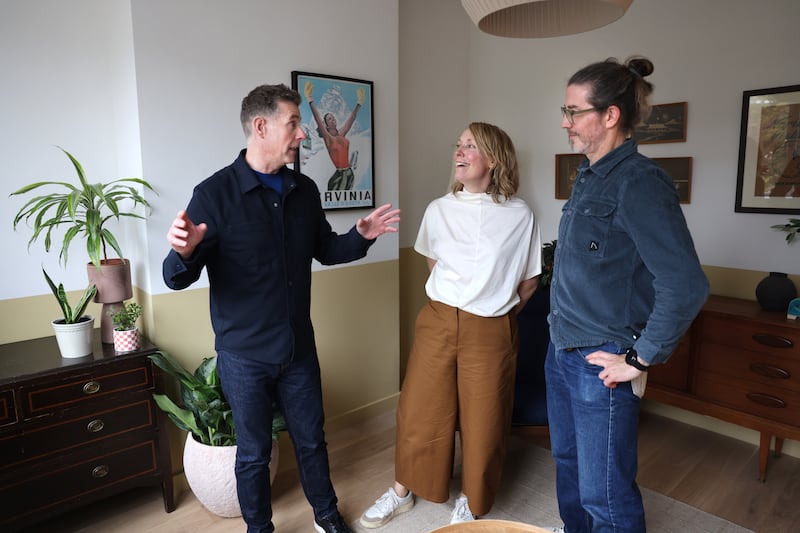 Dermot Bannon with homeowners Louis and Norita O’Donoghue during filming for Room to Improve at their home in Raheny, Dublin.
Photograph: Dara Mac Dónaill
The casting process is crucial, Cullen tells me later. “Obviously you’re looking for people who are not going to freeze, who are open, who might give Dermot a run for his money. We love a little argy-bargy – but not too much.”
“The first day you grilled us,” Louis says to Bannon. “When we left we thought, ‘That’s that gone’.”
“I was a bit abrasive with you at the beginning,” Bannon replies. “I need to know why this project is happening. If you don’t solve that you’re at nothing. Then it all unravels: there was something wrong with the feeling in the house.
“When you’re doing a job for the television you need to be able to tell a story. You need to be able to tell me, in a minute, what’s wrong with this house. It can be a bit like therapy that way.”
What was wrong with the house? “It was freezing,” Norita says. “And there was a deck out the back, but there was a massive disconnect between the deck and the rest of the house. We loved being outside there, but we couldn’t see it from the house.”
Bannon explains how they built the gorgeous, high-ceilinged, many-windowed kitchen pavilion into which you step down and look out into the garden.
“You can come right through the house and end here amongst all the plants,” he says. “My job is done better if I’m responding to what people actually need. A lot of people will tell you, ‘Oh, I saw this house,’ or, ‘We’d love it to look like this.’
[ Thinking of renovating or extending your home? Here’s your to-do listOpens in new window ]
“But what are your actual problems with the house? You have to get to the crux of what’s really irritating and annoying people about their home. For you,” he says to Norita, “it was literally that disconnect: ‘I hate living here because I can’t get to my garden, can’t see my garden’.”
“I felt you really wanted to get to know us,” Norita replies. “By doing that you realised what we are interested in and what we’re not interested in and what we need in terms of our lifestyle. It wasn’t just a build: it was very much something more intimate.”
The couple will be moving in tomorrow with their three daughters. “We have a dog as well,” Norita says. “So we’re trying to figure out where the dog’s going to sleep.”
“If she sees straight outside she’ll bark at everything,” Louis says.
“That’s the problem with the Bannon windows,” I say. “Irish people like sitting in the dark.”
“They just want misery,” Bannon says with a sigh.
Louis laughs. “People said, ‘You’ll get a glass box if you go with Dermot.’ I said, ‘If I built an extension I’d be a fool to have no windows in it.’”
“I haven’t done a glass box for years,” Bannon says. “It’s a pavilion.”
For the record, the pavilion does not look like a glass box, and Louis and Norita love it.
At one point Irwin whisks Bannon away to go through the final accounts. “I think quantitative surveying is a little bit like being Chandler from Friends: nobody knows what his actual profession was,” she says. “The show has explained to the nation what a quantity surveyor is.”
In the sittingroom the walls are painted in two distinct colours that meet around window level. It’s a very soothing room. “It’s like sitting in the sand dunes,” Bannon says.
Louis and Norita are in the pavilion now, doing their final interview for the show. For Bannon, architecture is less about buildings and more “about people and how they live. I always loved people-watching and watching different scenarios”.
“That’s why you want to put big windows in everything,” I suggest. “You want to park outside and look in.”
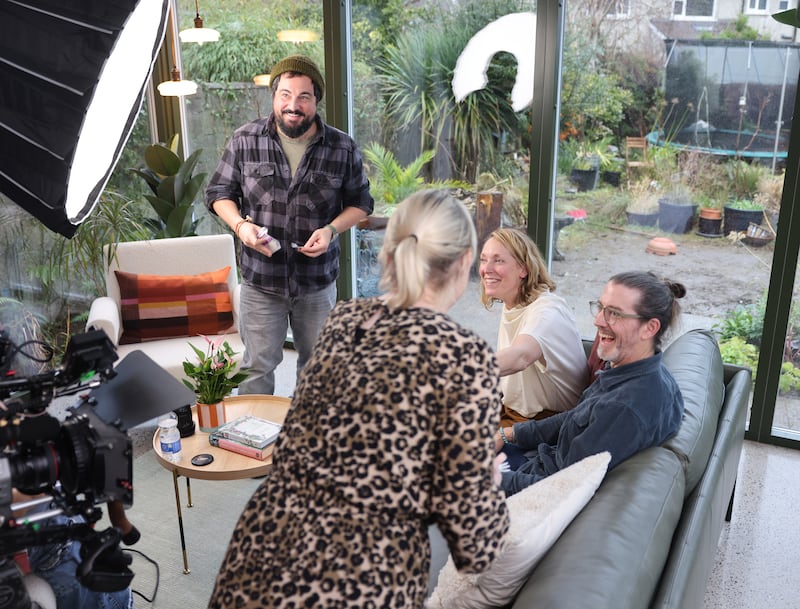 Behind the scenes in the O’Donoghue’s home. Photograph: Dara Mac Dónaill
He laughs patiently and continues: “As a youngster I used to work in Dublin Airport, and at my lunch break I would sit in the arrivals hall and watch people interacting. I would have grown up in a suburb of Dublin, but all my relations were from the country. And I spent a few years in Cairo [where his father worked as a horticulturalist]. It was all about people-watching.”
Bannon loves his work. Even when he reminisces about his college years in Hull, in northern England, he talks about the bustle of his student house during their final projects, all of them doing their architectural drawings with the music blaring.
“I never wanted to be a broadcaster. I wanted to be an architect,” he says. “I don’t go to bed at night and wonder will they offer me The Late Late Show.” He laughs. “I’m probably shooting myself in the foot now. They were probably about to ring and offer me The Late Late Show.”
Room to Improve has changed, but so has Bannon. In the summer of 2024 he had a pulmonary embolism. It was terrifying, he says. “I got really bad pains. We were at a water park [in Portugal]. I could barely walk … I went to the hospital that night – my first time ever bringing myself into hospital. They told me I had a lung infection …
“A week later the pains were back, much worse. I went to the Laya Healthcare clinic and they said, ‘You need to get into hospital right now.’ In the Mater they did blood tests and had me in a CT scanner within minutes. There were people literally crawling all over me, trying to find more clots and blockages …
“I lived in Cairo as a kid. We used to get injections all the time, vaccinations, and I hated them. There was one stage I said, ‘I’m not going back. I’m going to stay with Granny.’ I’m not great with hospitals.”
Bannon is on blood thinners now, and feeling good and healthy. The experience changed him, he says. “The whole Irish thing of delayed gratification, I was an expert at that. Work hard now and you’ll reap the rewards in the future. I’m trying to realign myself to enjoy what I’m doing right now …
“If I’m very stressed about something I think, ‘You could be doing something totally different. You have a choice. What can you do today to make this a bit more enjoyable?’ I’m really lucky and very, very, very privileged to do something I dreamed of as a child. I’m trying to get back to that wonderment.” He laughs. “I’m not good at it yet. I’m no guru. I’m struggling with it.”
The closest Bannon comes to Zen is when he’s ironing. It’s one of his favourite things, he says. “I put on headphones and I dance.”
The new series of Room to Improve begins on RTÉ One and RTÉ Player at 9.30pm on Sunday, January 4th