
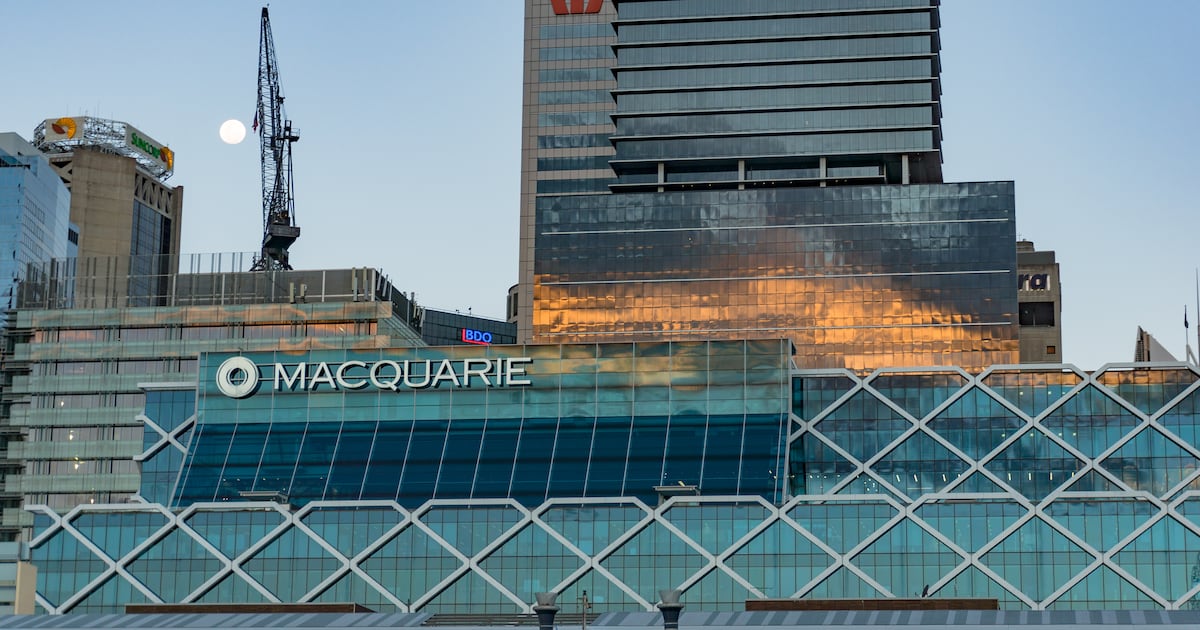
Australian financial services giant Macquarie is laying the groundwork to take as much as €510 million in special dividends from its European unit in Dublin to improve the financial efficiency in one of the most overcapitalised banks in the State.
Macquarie Bank Europe, based in Dublin 4, said in a recent filing with the Companies Registration Office (CRO) that it was planning to create €510 million of profits available for distribution.
This was technically to be done by reducing the nominal value of its 1.275 billion fully paid-up shares from €1 to 60 cent each, reducing its share capital to €765 million. A separate CRO filing showed that a special resolution on the matter had been passed on December 18th.
The directors of the bank declared in the original filing that it would have enough resources following the transaction to meet its debts and other liabilities for at least 12 months, a prerequisite under Irish law for a capital reduction to take place. PwC, as the bank’s auditor, issued an assurance that the directors’ declaration “is not unreasonable”, as is also required by law.
Macquarie Bank Europe estimated its total assets to be €5.53 billion following completion of the capital reduction, while it put its liabilities at €4.16 billion and net assets at almost €1.37 billion.
The bank had €1.32 billion of common equity Tier 1 (CET1) capital at the end of March 2025, according to its most recent capital disclosure document. That equated to more than 42 per cent of its so-called risk-weighted assets, making it one of the most overcapitalised banks in the Republic, relative to the size of its balance sheet.
The CET1 ratio was well in excess of the 17 per cent required by regulators to hold under its most recent supervisory review and evaluation process carried out by the European Central Bank and Central Bank of Ireland. The capital requirement is designed to help a bank absorb a shock loss.
Macquarie selected Dublin as home for its EU banking operations in 2018 in order to be able to continue to service customers in the European Economic Area in the wake of Brexit. It secured the necessary Irish banking licence the following year.
 Another huge corporate tax take to AI’s next phase: What’s in store for 2026?
Macquarie Bank Europe’s net profit dipped to €67 million in its financial year through March from €80.9 million for the previous year as a slump in net trading income more than offset an increase in net interest, fee, and commission income.
The wider Macquarie group has a number of high-profile interests in Ireland. These include the Beacon Hospital in Dublin, acquired from businessman Denis O’Brien in 2024, Beauparc Utilities, owner of the Panda and Greenstar waste firms in the Republic, and aircraft lessor Macquarie AirFinance.
However, the Australian group last year agreed to sell Broadstone Housing Investments, its Irish social housing and mortgage-to-rent business, to the unit’s chief executive. It marked a strategy U-turn, having failed to build up an Irish residential portfolio of scale.
It is understood that Macquarie remains interested in the Irish social housing development sector, but plans to focus on public-private partnerships (PPP).
The capital reduction carried out by Macquarie Bank Europe is not the only method used to extract trapped excess capital from the Irish unit of a foreign bank in recent months.
Italian banking giant Intesa Sanpaolo pushed its Irish subsidiary into its Luxembourg unit in November, resulting in the dissolution of a banking licence that had been in existence from the establishment of the IFSC in Dublin in 1987. The intragroup merger was also designed to improve the general efficiency of the Italian group.