
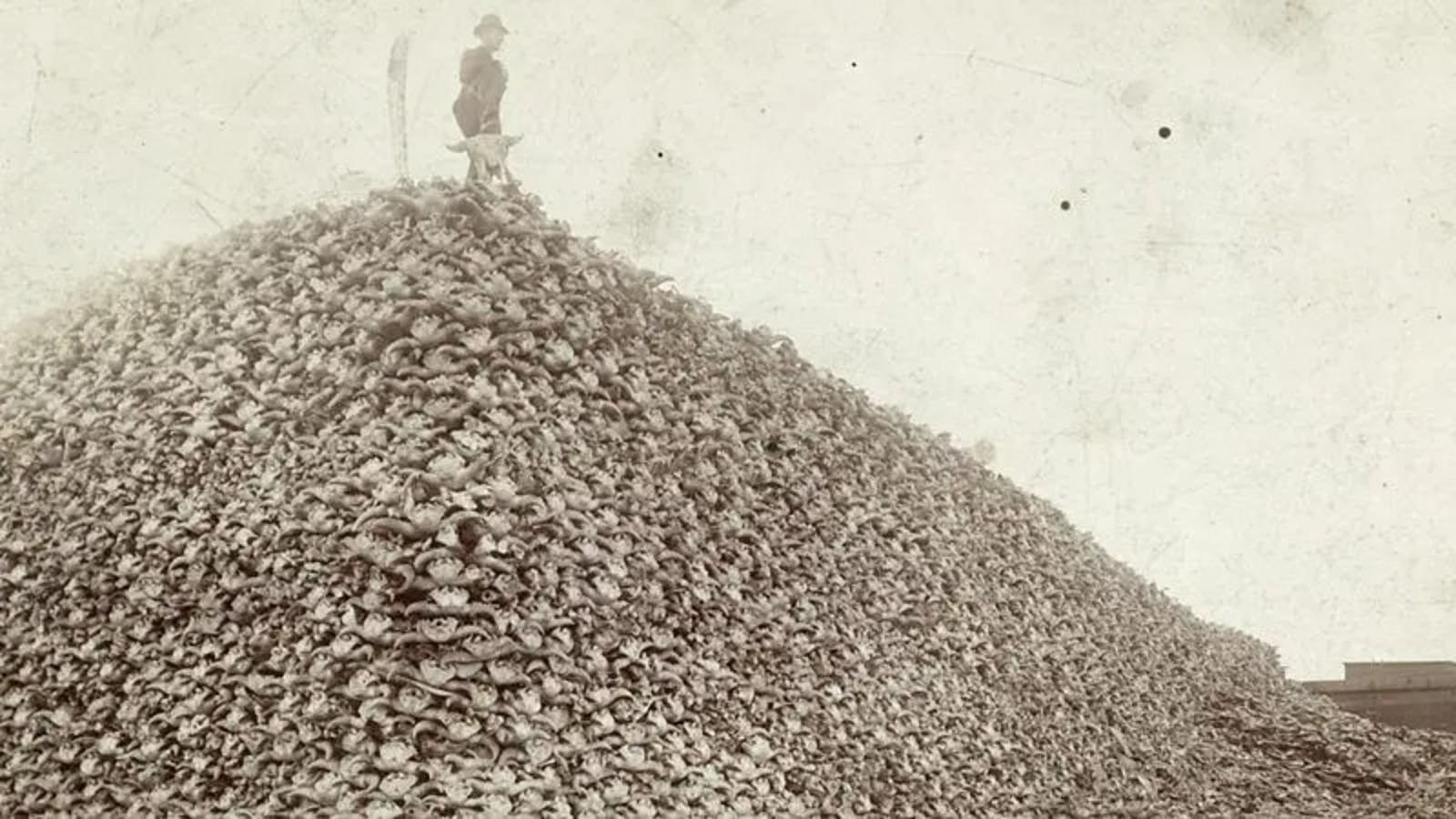
Image taken at an American refinery in the 19th century reveals a bison extermination campaign, orchestrated by economic and military interests to weaken indigenous peoples and facilitate the colonization of the West.
In the 19th century, a photograph taken at an American refinery exposed piles of bison skulls and revealed a deliberate strategy of exterminating the animal, used to weaken indigenous peoples, facilitate the colonization of the West, and produce social, economic, and environmental effects that persist to this day.
The image that reveals a colonial strategy.
Two men in black suits and bowler hats pose atop a mountain of bison skulls, stacked in order, creating a disturbing scene recorded in the 19th century.
The photograph, macabre at first glance, does not merely represent excessive enthusiasm for hunting in the United States, nor does it depict ordinary hunters responsible for the animal massacre.
— ARTICLE CONTINUES BELOW —
Are you in favor of US military intervention in Venezuela and the arrest of Nicolas Maduro?
— Click Oil and Gas (@clickpetroleoeg) January 3, 2026
Experts indicate that the skulls provide evidence of a calculated campaign to eradicate bison in North America, depriving indigenous peoples of a vital resource.
According to the filmmaker Tasha Hubbard, professor at the Faculty of Native Studies of Alberta UniversityThe image celebrates colonial destruction.
The bison as a strategic target for expansion.
Hubbard describes the extermination of the bison as a strategic part of colonial expansion, seen as necessary to subdue the territory and allow for white occupation.
The mass slaughter caused a permanent impact on the tribes dependent on the animal, altering their social and economic evolution in a measurable way.
Comparative studies indicate higher infant mortality rates among these nations, as well as lasting consequences that persist to this day.
Indigenous peoples hunted bison for centuries, integrating the animal into a largely nomadic culture spread across North America.
A vital resource for survival and culture.
For these communities, the bison provided meat, hides for clothing and shelter, as well as bones used in the production of essential tools.
Despite often being called a buffalo by colonists, the bison is a different animal, a distinction ignored by popular historical records.
Hubbard explains that removing this fundamental species allowed the use of hunger as a weapon against indigenous peoples, weakening them for territorial control.
Estimates indicate that native hunters killed fewer than 100 animals per year, an insignificant number compared to the existing population at the beginning of the 19th century.
From its peak to near extinction.
During that period, there were between 30 and 60 million bison roaming the plains of North America, sustaining entire ecosystems and societies.
On January 1, 1889, only 456 purebred bison remained in the United States, with 256 protected in captivity.
These animals survived in Yellowstone National Park and in a few other wildlife sanctuaries.
The drastic reduction did not occur by chance, but was accompanied by economic and political interests linked to territorial conquest.
Railroads, weapons, and lack of protection.
The construction of three railways crossing areas with a high concentration of bison increased the demand for the animals’ meat and hides.
Modern shotguns facilitated large-scale killings, while there were no laws capable of restricting or regulating predatory hunting.
Historians point out that the search for meat and leather was intrinsically linked to colonization and the transformation of nature into a commodity.
Second Bethany Hughes, teacher of University of MichiganThe desire for wealth and power guided this process.
The industry behind the skulls
In 1871, a tannery in Pennsylvania developed a method for transforming bison hides into commercial leather, accelerating the slaughter.
Hunters began decimating herds in the central plains with alarming speed, as described in later historical studies.
The famous photograph was taken at the refinery. Michigan Carbon Works, where bones were processed industrially.
The bones were turned into charcoal used in the sugar industry, as well as raw material for glue and fertilizer, increasing the profits of the enterprise.
Capitalism, colonialism and consumption
Hughes argues that the image documents a successful commercial venture built upon the debris of colonial expansion and dominant racial logic.
For her, colonialism and capitalism go hand in hand, transforming territorial violence into seemingly legitimate economic success.
The consumption of refined products, such as sugar purified with bone char, concealed the ethical conditions of their industrial production.
According to Hughes, the photograph exposes business practices that normalize human and environmental destruction behind everyday goods.
War, famine and forced displacement
The extermination of the bison was also part of military campaigns that used resource scarcity as a tactic for territorial domination.
Army officers sent soldiers to kill bison, aiming to deplete the livelihood of the indigenous peoples of the plains.
the historian Robert Wooster reports that the general Philip Sheridan He advocated for this strategy.
Sheridan believed that eliminating the bison would force the tribes to abandon nomadic habits and accept resettlement in controlled reserves.
Lasting physical and social consequences
Deprived of bison, indigenous communities were forced to migrate to reservations, becoming dependent on agriculture for survival.
The strategy worked militarily, resulting in the displacement of the Kiowa tribe to a reservation in Oklahoma.
In one generation, the average height of these populations dropped by more than 2,5 cm, indicating severe and prolonged nutritional impacts.
At the beginning of the 20th century, infant mortality was 16% higher and per capita income remained 25% lower in these nations.
Debates on the causes of the collapse
Researchers have questioned how millions of bison were exterminated in such a short time, raising hypotheses beyond intensive hunting.
A 2018 study suggested that epidemic diseases, such as anthrax and spotted fever, may have contributed significantly to the population collapse.
According to this analysis, such diseases would be deadly enough to eliminate tens of millions of animals in specific regions.
Regardless of the combined causes, bison populations never fully recovered over the following decades.
Restoration attempts and current legacy
Currently, the bison is still classified as near threatened, despite recent ecological restoration efforts in the Great Plains.
The 2023 Inflation Reduction Act allocated US$25 million, approximately R$149 million, for species recovery programs.
Initiatives include the return of 1 bison raised by The Nature Conservancy to their ancestral pastures.
Projects in Montana foresee the return of 5 animals, while tribes have returned 250 bison in partnership with the National Wildlife Federation.
A message that persists.
For Hughes, the significance of the mountain of skulls was diluted over time, reduced to a distant sadness over the colonial past.
She argues that the image should provoke reflection on how colonial and capitalist systems continue to shape current environments and societies.
More than just a historical record, the photograph symbolizes the role of consumption in sustaining these structures of persistent exploitation.
According to Hughes, turning living beings into resources reveals a lack of humanity that still defies contemporary understanding.
With information from BBC.