
 BBC
BBC

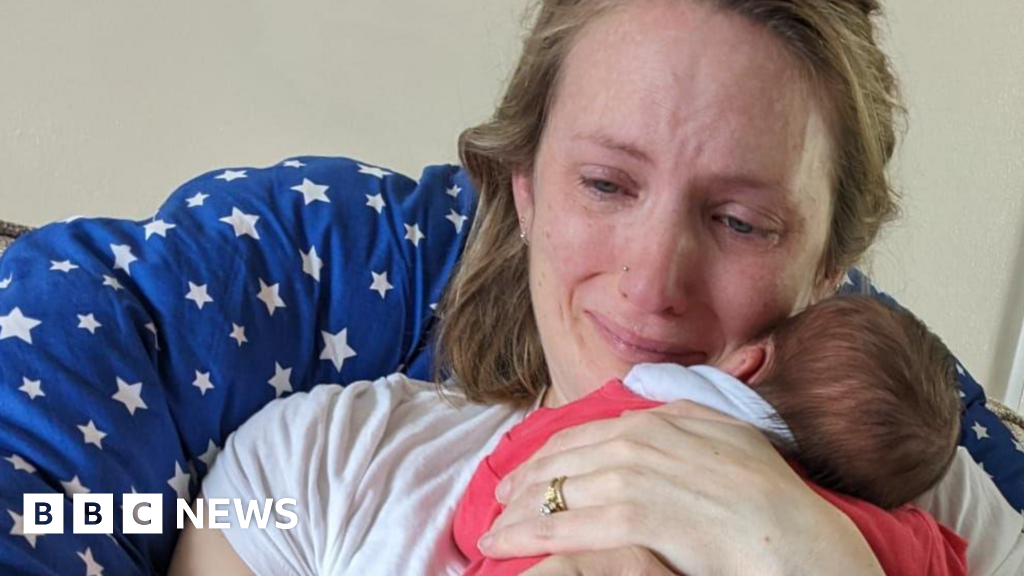
Louise is now able to feel compassion for herself and is helping other women with extreme morning sickness
When Louise was pregnant with her second daughter, she suffered from extreme sickness and struggled to get through each day.
Doctors said she would feel better as soon as her baby was born in June 2024, but her mental health declined and she was diagnosed with postnatal depression.
Louise, who lives near Chelmsford, has now recovered and is helping other women with hyperemesis gravidarum (HG) through their pregnancies.
Here, in her own words, she explains how she has learned to feel compassion for herself and look forward to the future.
‘We knew immediately something was wrong’
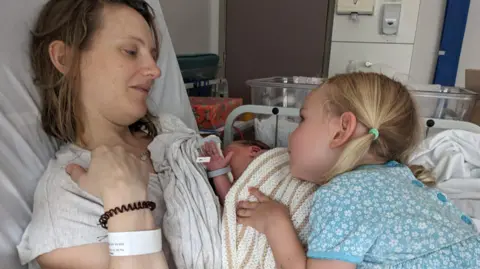
Louise was not able to care for her daughter Anouk while she was pregnant, due to hyperemesis gravidarum
Every minute of my second pregnancy was a struggle due to HG. This was made worse by vertigo from 33 weeks.
Every few days, with increasing frequency, I would be struck by extreme dizziness, causing me to vomit. It disabled me from caring for my first child, Anouk, who was three at the time.
It was impossible to drive or leave the house alone. I was wracked with anxiety over how I would care for my newborn.
I had been told by multiple consultants things would improve once my daughter was born, which I knew was likely from my first pregnancy, when I also suffered from HG.
I remember the relief I felt when my midwife let me know the consultant had agreed to deliver my baby early, as requested, due to my sickness. So, when Adeline was born and I still felt extremely unwell, I can only guess my brain couldn’t cope.
The birth in itself was traumatic. Something I have blocked out and numbed myself to until recently. When Adeline came out, there was no cry – we knew immediately something was wrong, though no-one communicated with me.
I now know she was unable to regulate her oxygen. She was taken to the neonatal ward and away from me, where I didn’t have contact with her again until the evening.
If you have been affected by the issues in this story, help and information is available through BBC Action Line
‘I felt like my brain was at war with me’
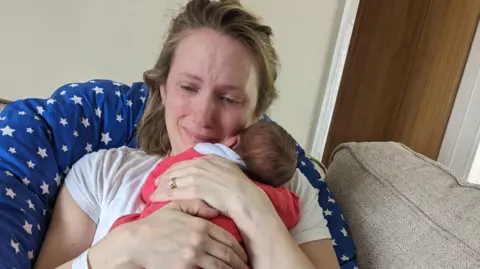
Louise expected to feel better when Adeline was born, but she fell into a deep depression
None of us can remember the exact moment I tipped over the edge into a deep depression and heightened anxiety.
My body and my brain had finally had enough. My brain has shut most of that time out because it’s too hard and too painful to remember. But there are parts I do remember.
I remember feeling like my brain was at war with me. I was in a constant state of battle with it, throwing increasingly extreme worries at me that I just could not control.
The apparent mess in the house would spiral to me envisaging myself homeless on the streets, on drugs and my children being removed from my care. The fears were real to me. The more people tried to convince me otherwise, the more I felt no-one was listening.
It was exhausting. And the pain, the intense physical pain of the depression. Every inch of my body ached. It hurt everywhere. And then the insomnia arrived.
Those months of interrupted sleep as a result of sickness now transformed into complete and utter insomnia.
I was desperate to close my eyes, rest and forget the pain. But I couldn’t. I had an intense fear that someone was going to hurt me or I was going to hurt someone – most likely my children. I felt like my brain was shutting down on me.
‘I could not see a future’
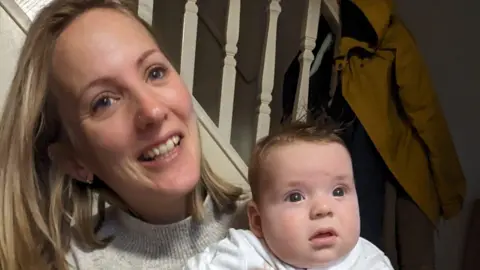
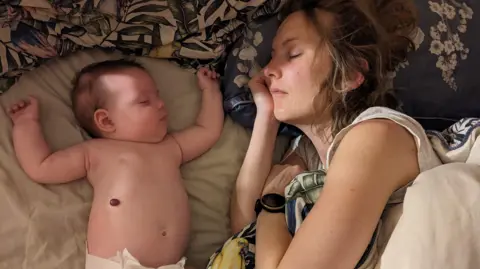
Louise could not feel joy after having Adeline but is feeling much better after therapy
I begged my sister and my husband, Pete, to get help. With my mental health in a rapid downward spiral, the NHS crisis team became involved. The shame and fear that came with this was intense. Shame of how I could let this happen to me. And the fear I would be locked up in a hospital indefinitely.
I was diagnosed with postnatal depression and the start of postpartum psychosis, which luckily the crisis team caught early.
A psychiatrist came to assess me and prescribed strong medication to halt the delusional beliefs and help me sleep, but my brain was still awake at night with anxieties swirling around. I would wake up unrefreshed, exhausted. It was difficult to get out of bed. It felt like my legs were weighed down with lead.
I couldn’t tell you the exact point at which the suicidal thoughts came. But they came. Sometimes they came and went. But then they began to linger. I didn’t want to be alive anymore. I could not see a future. I could not understand why anyone wanted or needed me around.
It was also incredibly painful to feel no joy. I am someone who has always had a level of anxiety, but I have always been happy and not feeling joy is a pain that is indescribable. It broke my heart when Anouk told me she felt angry when I cried because I didn’t look like mummy.
I desperately sought answers on the internet on how to end my life. But every method I considered, I feared would not be successful and that thought was even more painful than the thought of not being here. But finally, I settled on a method and told my husband.
I suppose now, looking back, that was a cry for help. And so now with a real fear that I would hurt myself, hospital admission was on the table.
I was very rapidly offered a bed at a mother-and-baby unit. But the place was far from home. I was intensely scared and unsure I would be able to cope alone with my baby – my husband had been the primary carer up until now. I was also worried about the impact on Anouk.
Imagine knowing all the pain you’re causing, being desperate to be out of the pain and turmoil but having to pit it against splitting up the family. But also knowing that it was a very real possibility that, if I stayed at home, I would take my own life. Eventually, I declined this place and was placed on the waiting list for a local bed.
‘I’m grateful for having survived’
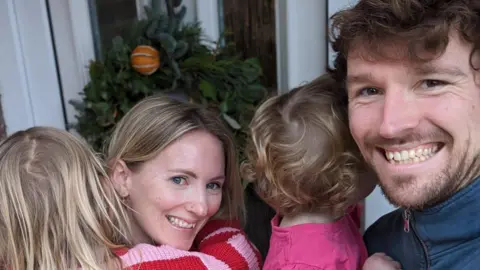
Louise and Pete are now looking to the future, with their two daughters
Just as becoming unwell had been a blur, so is much of my recovery. Whether it was time and hormones settling, whether it was medication finally kicking in, whether it was me using cognitive behavioural therapy to push myself into uncomfortable scenarios and challenge my brain or a combination of all three, I gradually began to feel better.
I feel lucky to have had eye movement desensitisation and reprocessing therapy through an amazing NHS perinatal mental health team. This helped me to process the trauma of two very difficult pregnancies and being unwell, as well as other historical issues such as significant eating disorders. I am also now able to feel compassion for my unwell self, though this is not easy.
My daughter turned one in June and I am very fortunate to now be through the other side. I am so grateful for having survived this. I am grateful for a family who supported me – especially my husband, Pete.
Our relationship is stronger than ever, but I don’t underestimate the impact it had upon him being a carer for a newborn, a toddler and me. I am fortunate to be married to such a wonderful man and father. And I am trying to show myself compassion and not feel shame, knowing I did not choose this.
I currently volunteer for the charity Pregnancy Sickness Support, supporting other women suffering from HG, and ran a half marathon in March to raise money for PANDAS, a perinatal mental illness charity.
I want to give back and help people know they are not alone. I am looking forward to the future that once felt so unimaginable. And I want others to know, who may be in the depths of it, that there is hope.