

Chevy Chase is many things: an unparalleled physical comedian, a once-powerful leading man, an integral member of the original cast of Saturday Night Live (SNL). He is also, according to many who have worked with him, a jerk – although they often use a more colourful noun.
Few in Hollywood want to collaborate with him. John Carpenter has said that his experience directing Chase made him want to quit the business. In February, Chase was left off the performance roster of the SNL 50th anniversary special, even though he was the show’s first Weekend Update anchor. He hasn’t been in a hit since 2014, when he was written off the NBC comedy Community.
In an honest but empathetic new documentary, I’m Chevy Chase and You’re Not, Chase is shown as a complex man, one who is loved by fans and intimates regardless – even if, as he tells the film’s director, Marina Zenovich, she is “not bright enough” to grasp that complexity. (The film premiered on CNN on Thursday night and was on its streaming platforms the next day.)
Zenovich was no stranger to handling prickly subjects. She has a history of excavating the lives of complicated men – Roman Polanski, Lance Armstrong and Robin Williams among them – and was intrigued by the contradictory opinions of Chase. She wanted to understand him better.
Chase, in contrast, appeared at once confused that he had created such a reputation and dismissive of the criticism. His wife of 43 years and his three daughters love him. People still clamour to get a glimpse. He still receives a healthy amount of fan mail. “I feel fulfilled,” he says in the documentary.
By the time Zenovich joined Chase at CNN’s New York offices to talk about the film last month, the director seemed well attuned to Chase’s often caustic manner but also to the fuller, more sensitive person behind it. He didn’t excuse his rougher behaviour. But it was clear that his childhood, during which he was physically abused by his mother and stepfather, contributed to many of the choices he has made in his career.
Chase, who was battling a bad cold that later turned into pneumonia, had just returned from a trip through Nebraska, Iowa and South Dakota as part of an annual holiday tour, in which he hosts screenings of Christmas Vacation with Q&A sessions. (Although he seems to enjoy the adoration, he also couldn’t help but disparage some attendees as “Maga horses**t people.”)
The lively discussion segued from absurd to thoughtful, from funny to painful. These are edited excerpts from the conversation.
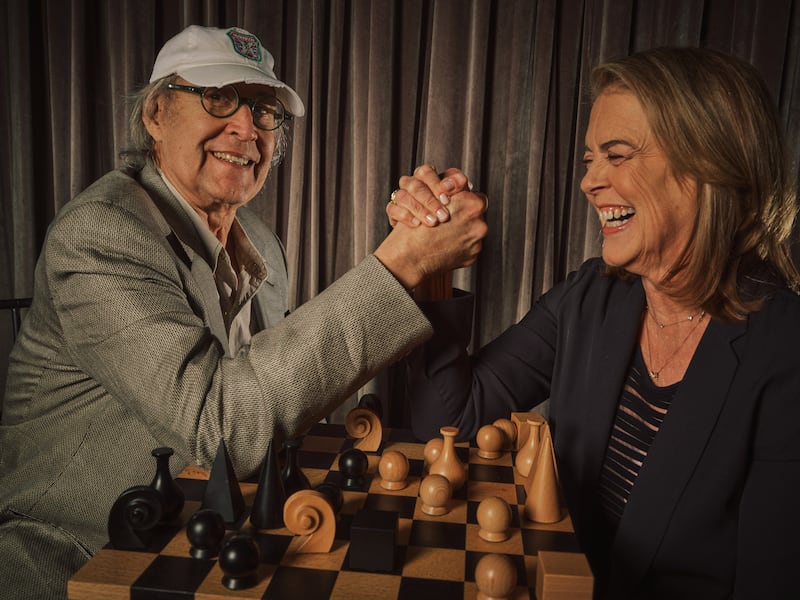 Chevy Chase with Marina Zenovich in New York. Photograph: Blaise Cepis/New York Times Q: Why did you want to participate in this film?
Chevy Chase: I really like it. I didn’t know if I wanted one or not. I just knew that I’d seen the one with Armstrong. I thought it was very good. All I could think of when we were doing mine was: What’s my problem? What have I cheated on? I thought about my life a little bit, which I tend to do, unlike others. I just thought: “I’ve not really done anything bad that’s worth filming.”
Q: Marina, why did you want to make this?
Marina Zenovich: When the idea was brought to me, I thought, ooh, Chevy Chase – that could be really interesting. I was a fan. But what was interesting was that when I would tell people that I was working on it, they wouldn’t really have nice things to say about him. That was kind of consistent.
Chase: Really?
Zenovich: Yes
Chase: I didn’t realise.
Zenovich: So that was intriguing to me, because, why do people not like you?
Chase: Maybe they thought I was full of myself, or, you know, that I thought too much of myself. I don’t think people really like a tall, handsome, funny Jew guy who’s not a Jew, but he’s Jewish. [Chase is not Jewish.] I didn’t mean to interrupt you. I’d like to hear more from you.
Zenovich: Would you?
Chase: Yeah, I’m sorry.
Zenovich: I just couldn’t believe how consistent the hate was. Not hate, just – come on, they thought you were an a**hole. And then I realised, as I was making it, that there were three levels. Chevy is so loved and protected by his family and friends. So that’s level one. Level two is Hollywood, where he has a reputation. He’s misunderstood. The third tier are the fans who don’t care about the reputation. They love him so much, and I really saw that when we went out on the road with him in 2023.
But then the more research I did, the more I learned about Chevy’s background and what he went through as a kid. It’s not an excuse, but it puts things into perspective.
Q: Did you participate in this documentary as a way of correcting the record, or providing an explanation for why you act a certain way?
Chase: I don’t have any need to do that. The whole issue of them thinking I’m an [expletive], it’s all junk. I don’t care much about it. I have a great, great life, a wonderful family.
Q: Were you surprised by anything in the doc?
Chase: I don’t think so.
Zenovich: You didn’t like the Terry Sweeney part.
In the mid-1980s, Chevy Chase met Terry Sweeney, the first openly gay cast member of SNL, during a hosting stint. According to Sweeney’s account in Live From New York, an oral history of SNL, Chase approached Sweeney and said: “Oh, you’re the gay guy, right? I’ve got an idea for a sketch for you. How about we say you have Aids and we weigh you every week?” (In the documentary, an obviously upset Chase offers a qualified denial when asked about it.)
Chase: Oh, that did surprise me because I don’t remember doing it. It’s not natural for me to do that, but one can always be an [expletive] on occasion. I felt bad for Terry Sweeney when I heard that. Is he dead?
Q: He isn’t dead.
Zenovich: You could write him a note.
Chase: Why would I write him a note?
Zenovich: Because it would mean so much.
Chase: Why would he care about me? I was a [expletive] to him.
Zenovich: Because it’s healing.
Chase: Okay, I’ll do it. [Laughs.]
In 1992, Chase starred in and produced the John Carpenter movie Memoirs of an Invisible Man, an experience which, as heard in a previously recorded podcast interview included in the documentary, was a difficult one for Carpenter.
Q: What about the part where John Carpenter said you made him want to quit the business?
Chase: I don’t know what that’s all about, but he’s a crazy guy anyway.
Q: So that’s about his behaviour, not yours?
Chase: Did he say I was an [expletive]?
Q: He said you made him want to quit the business?
Chase: Oh, that’s even better. If you look at those movies, they come from a guy who’s frightened, who’s unsure. I think that he mistreated other people, and that’s not good. And I try not to mistreat other people, particularly having a fame quality, because it makes them feel bad. [Carpenter declined to comment.]
Chase was on the NBC comedy “Community” for four seasons. It was a turbulent experience during which he frequently clashed with showrunner Dan Harmon. During production of season four, Chase became frustrated with his character’s increasing bigotry, in particular with a storyline in which the character does a bit with a blackface hand puppet. The documentary recounts allegations that Chase, in frustration, asked whether his character would next be made to use a racial slur, and reportedly uttered that slur in reference. He abruptly exited the show.
Q: How do you feel about how Marina depicted the situation on “Community”?
Chase: They hated me, too?
Zenovich: Pretty much.
Chase: [Laughs.] Can’t I get anybody to like me?
Q: I think your family likes you.
Chase: They do.
Q: Why is it so different how your family feels versus the rest of the world?
Chase: I partially explained it as the tall and handsome thing.
Q: But there are other tall and handsome actors that aren’t depicted this way.
Chase: They aren’t as handsome. It’s like Jon Hamm, who played Fletch. I met him at an airport, and I felt it was incumbent upon me to say, “Did you do Fletch?” because he did. And I spoke with him, almost as a fan, because that’s what he needed, so I’m trying to be nice, basically. And by the end of our talk, he got up and left. [Laughs.] “I’ve got to get my plane.” No hug, no shaking hands. And, I’m thinking, “What have I done wrong in my life?” [Laughs.]
Q: Do you have anything to say about Community? Because you don’t address it in the documentary.
Chase: It wasn’t a bad experience. I just didn’t think it was that good, the show.
Q: But you really loved it, at the beginning.
Chase: Oh, shut up.
Q: Your daughter [Caley Chase] says in the documentary how much you loved the writing.
Chase: My daughter can go to hell. [Laughs.]
Q: How do you feel about how your role ended?
Chase: I thought it ended great.
Q: You did?
Chase: It was too great a misunderstanding of what I was saying and not saying. I thought that there was at least one person – and another who, for some ungodly reason, didn’t get me, didn’t know who I was, or didn’t realise for one second I’m not racist. They were too young to be aware of my work. Instead, there was some sort of visceral reaction from them.
 Marina Zenovich in New York. Photograph: Blaise Cepis/New York Times Q: Marina, what surprised you the most about making this?
Zenovich: I still want to psychoanalyse Chevy. Forgive me if I say anything that upsets you, but I feel that you had so much going for you, but because of your mother and your stepfather, they really did you a disservice.
Chase: I agree with that. Once you’re slapped with a yardstick on your bare ass and on the backs of your legs until they’re so bruised that somebody else notices, then that’s a different thing.
Zenovich: He was trying so hard. He had looks and talent, and he had a chance. He had a shot. And he made it as much as he could, but I think he turned to drugs and drinking to stop the pain.
Chase: Everybody does, to some degree – something to help us get through life. So it’s not such a bad thing. We don’t take drugs and drink because we want to hurt others. In fact, we want to be loved by them. I don’t look back on [the years of drugs and alcohol] as a bad time at all. We all smoked pot. Everybody took acid. I took it once. Cocaine ultimately put a hole in my septum.
Q: When did you finally quit?
Chase: Let’s see. When I married Jayni [in 1982], I was still taking cocaine.
Zenovich: How did you hide that from her?
Chase: It wasn’t too hard, really. I mean, I had a packet of cocaine in my pocket.
Zenovich: I think a lot of your behaviour that people don’t like is from when you were using and you don’t really remember that.
Chase: I wasn’t that great when I was drinking and using drugs?
Zenovich: Your personality wasn’t great. You were talented. Like anyone, you didn’t know how you were behaving. So a lot of the questions that came up for me during this were around: How do you sustain a career?
Chase: That’s a trick, isn’t it? I never thought about it, so I don’t know how to tell you how I did it.
Q: Do you think you sabotaged your career?
Chase: I don’t think I sabotaged my career. I think we go up and down and up and down, up and down. You make mistakes. You make mistakes. You don’t make so many mistakes. You learn more, and then you get to where I am now, where I don’t think any of that matters any more. All that matters is how I am with people throughout the rest of my life.
Q: Do you feel at peace now?
Chase: I can’t tell you how much.
Q: Really?
Chase: No! I still get anxiety attacks. I had one this morning, but that’s partly because I knew you were coming and people were coming. You have no idea how much nose blowing, how much Kleenex was used before I got here.
In 2025, Saturday Night Live celebrated the 50th anniversary of its premiere season – Chase’s only season in the cast. Chase was invited to the three-hour live anniversary special in February, and he appeared onstage for the group goodbye. But unlike the other living members of the original cast he was not invited to perform.
Bill Murray, who effectively replaced Chase in 1977 – and got into a backstage brawl with him when Chase hosted in 1978 – performed, too. He poked fun at Chase during a segment on Weekend Update, a franchise Chase helped create.
 Chevy Chase in New York. Photograph: Blaise Cepis/New York Times Q: Do you want to talk about the SNL 50th special?
Chase: Do they hate me there too?
Q: It’s clear in the doc that it was really upsetting to you how you were treated.
Chase: Lorne [Lorne Michaels, the show’s creator] never got back to me on that. I texted him a fairly long thing about how he hurt me. “How could you hurt me like that?” That’s what I felt. I never got an answer. I love that guy. I don’t think he means it, but it did hurt. I would have put me inasmuch as Bill Murray. Murray came in to replace me. But I’m not replaceable. He’s Bill Murray. He’s great. You can’t replace me.
Q: In the doc, you call yourself an angry child. Why are you angry?
Chase: I’m angry at what I was left with from my parents. I’m angry with the fact that I had to go through that and continue to go through it every day of my life, in some fashion.
Q: It doesn’t ever go away?
Chase: No, no, it doesn’t. I don’t think about the physicality of it, but it’s all just a mishmash of fear. Most comedians, I think, come from fear.
Q: Did you ever go through therapy?
Chase: Sure. It was pointless, really. I went to two that I thought were good, but not over a long period of time. After a while, it was like, “Okay, I’m done.”
Q: Marina, was there anyone you tried to get into the doc that wouldn’t talk?
Zenovich: A lot.
Chase: Well, the ones you got were precious to me. I mean, Goldie [Goldie Hawn, his costar in the 1978 film Foul Play].
Zenovich: No Christopher Guest. [Guest and Chase first worked together on the 1973 stage show National Lampoon: Lemmings, a spin-off of the humour magazine that also featured John Belushi.]
Chase: I don’t for a second hold that against Chris. It mostly is that he’s smart enough to stay out, and he’s got his own life, and he’s making his own movies.
I don’t talk to him much. But once in a while, I’ll call and I’ll just leave a message that’s kind of funny and that’s about it. He doesn’t do it back, by the way. – This article originally appeared in The New York Times