
Iran’s government is planning to provide financial relief to citizens in a bid to quell widespread protests sparked by a deepening economic crisis. It will pay around $7 (Rs 631) to 80 million (eight crore) Iranians to ease some of the pressure.
Iran has been witnessing demonstrations over the country’s economic crisis since December 28. The protests have reportedly spread to 27 of Iran’s 31 provinces now.
Let’s take a closer look.
Iran rocked by protests
Merchants and traders began protests in late December by shutting down marketplaces in the capital, Tehran, to express anger against the sharp plunge in the value of the
Iranian currency rial against the US dollar.
University students soon joined the demonstrations on campuses over the economic collapse.
STORY CONTINUES BELOW THIS AD
Official statistics show that inflation had reached 52.6 per cent in December.
The protests entered their ninth day on Monday (January 5), with videos shared online showing demonstrations in Tehran and the south-western city of Yasuj.
Protesters in several places have called for freedom and the ouster of the Islamic Republic’s Supreme Leader, Ayatollah Ali Khamenei.
Footage of a protest in the city of Yasuj, in Kohgiluyeh-Boyer Ahmad province, showed men and women chanting “Freedom, freedom, freedom”, reported BBC.
Similar slogans were heard during agitation on the Cheragh Barq street in Tehran.
As per videos obtained by BBC Persian on Sunday, several dozen protesters were seen marching down a street in the city of Sari, north of Tehran, chanting slogans such as “Death to the dictator”, a reference to Khamenei. They were also heard shouting, “Pahlavi is coming back” — a reference to Reza Pahlavi, the exiled son of the late shah of Iran.
Demonstrators also hit the streets in the districts of Ilam, Arak, Hamedan, Amol, Lahijan, Kermanshah, Malekshahi, Semnan and Noorabad on Sunday evening, reported BBC Persian.
Security services fired on protesters inside the Imam Khomeini hospital in Malekshahi, Ilam province.
According to Kurdish human rights group Hengaw, these protesters were among those shot when the Islamic Revolutionary Guard Corps opened fire on a demonstration outside a government compound in neighbouring Malekshahi county on Saturday.
STORY CONTINUES BELOW THIS AD
Four other people, including retired Revolutionary Guards brigadier-general Latif Karimi, were killed in the incident, BBC reported, citing Hengaw.
Azar Mansouri, a leader of the Reform Front, the movement linked to Iran’s president, Masoud Pezeshkian, described the incident as “a disaster”. She urged: “As soon as possible and with justice, address the tragedy that occurred in Malekshahi, Ilam. Identify the perpetrators, introduce them to the public, and bring them to justice so that this wound can heal a little.”
Police were also seen entering the University of Birjand in the south-east of Iran, arresting students inside, as per The Guardian.
A human rights group has claimed that the death toll in Iran has passed 35, with more than 1,200 arrested.
According to the US-based Human Rights Activists News Agency, which has been monitoring the ongoing protests in Iran, 29 protesters, four children and two members of the country’s security forces have been killed.
The semiofficial Fars news agency reported late Monday that some 250 police officers and 45 members of the Guard’s Basij force were injured in the demonstrations.
STORY CONTINUES BELOW THIS AD
United States President Donald Trump has vowed that Iran would be “hit very hard” if more protesters died.
“If they start killing people like they have in the past, I think they’re going to get hit very hard by the United States,” he said.
On Monday, Esmail Baghaei, the spokesman for Iran’s Ministry of Foreign Affairs, described Trump’s remarks as “psychological warfare and media propaganda against the country” and “part of their strategy to exert pressure on Iran.”
Iran to pay citizens $7
The Iranian government has decided to offer most citizens a payment equivalent to about $7 per month.
The government spokeswoman, Fatameh Mohajerani, said the plan aims at “preserving households’ purchasing power, controlling inflation, and ensuring food security.”
Last week,
Iran reformed its currency exchange policy. Earlier, the subsidies were provided to those importing products from abroad through exchange rate subsidies.
Iranian President Pezeshkian said that the exchange rate had been exploited by some sectors without slashing prices.
Speaking about the reforms, Pezeshkian explained: “We are not removing subsidies, we are delivering them to the final consumers.”
Fatemeh Mohajerani, his spokesperson, said on Monday, “It is evident that by ending or reducing subsidised and preferential official foreign currency exchange rates, the prices of some items will rise.”
STORY CONTINUES BELOW THIS AD
There is an expected short-term rise in food prices due to the foreign exchange subsidies being replaced with the new system of direct subsidies to consumers, as per The Guardian.
Mohajerani said in her statement that the $10 billion once spent every year to subsidise some imports would instead be used to pay Iranian citizens directly.
Announcing an “economic relief” plan on Sunday, Iranian authorities promised to transfer 10 million rial (Rs 21,395) in voucher form to 80 million people over four months, reported The Telegraph.
The payment is equivalent to the average daily salary of an Iranian worker.
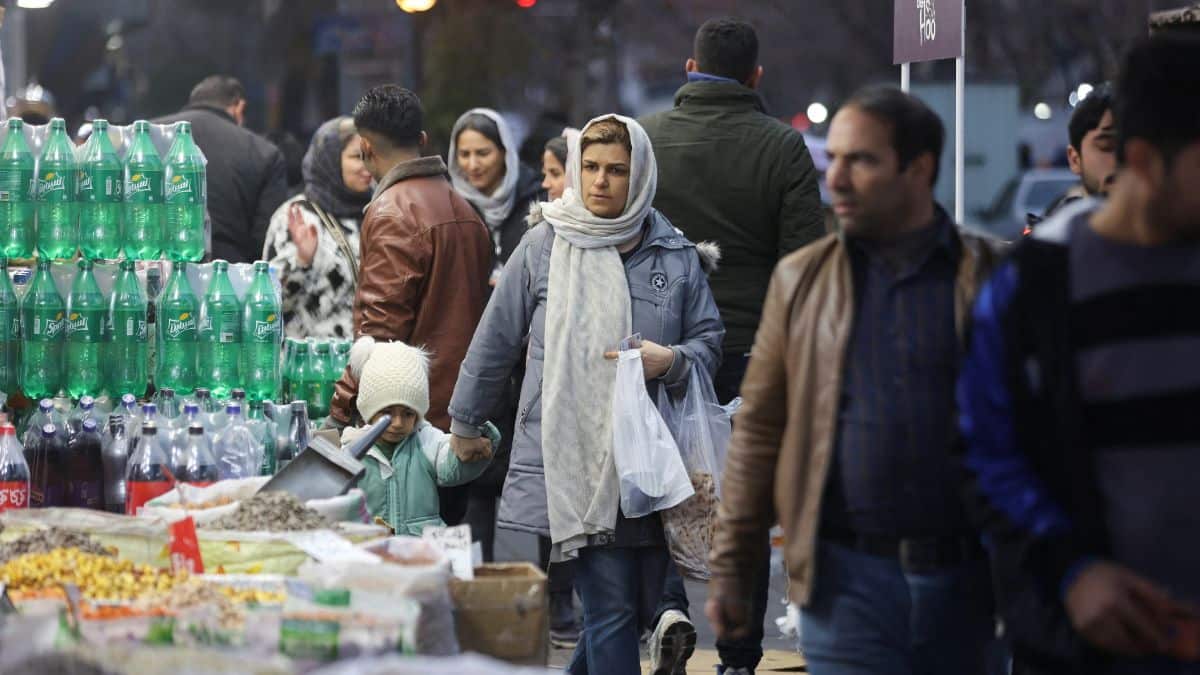
An Iranian woman shops in a local market in Tehran amid protests over Iran’s economic crisis, January 5, 2026. Reuters
Pezeshkian unveiled the plan at a high-level meeting with Cabinet members and provincial governors.
He pledged that any potential price surge would be fully covered to protect household purchasing power.
Pezeshkian said, “Any problems or shortcomings in society are a direct result of actions – therefore, it is essential that stakeholders and implementers are involved in all aspects of decision-making.
STORY CONTINUES BELOW THIS AD
He added, “Undoubtedly, direct interaction with the people – listening to their concerns, demands, and criticisms and working to persuade public opinion – plays a key role in reducing psychological and social pressures.”
The Iranian president further said: “Society cannot be appeased or calmed through coercion or improper methods.”
The monthly payment would be equal to about 100 eggs, a kilogramme of red meat, or a few kilogrammes of rice or chicken at current prices in Iran, as per The New York Times (NYT). It will be provided in the form of credit to eligible Iranians for buying certain goods.
This is one of the most ambitious money distribution programmes in Iran, which is facing severe international sanctions and reduced oil sales.
Will the reforms ease Iran’s economic pressure?
The promised monthly payments are expected to bring relief to Iran’s poorest, but not much for the middle class battling high costs.
The Iranian authorities “may be hoping that policies aimed at appeasing both merchants and Iran’s poorest classes will be enough to deflate the main grievances driving protests”, Esfandyar Batmanghelidj, a founder of the Bourse & Bazaar Foundation, an economic think tank based in Britain, told NYT.
STORY CONTINUES BELOW THIS AD
However, the financial assistance is unlikely to change Iranians’ broader sense of despair over the economy and their future, he said.
“It’s a small amount for the middle class and will not meaningfully improve their standard of living, but it will definitely improve the situation for the poorest quintile,” Batmanghelidj said.
“The government clearly thinks it can afford to do this,” he added. “But what they can afford is not enough to alleviate the pressures most Iranians are facing.”
In a rare move, Supreme Leader Khamenei admitted protesters had valid grievances.
“Protest is justified, but protest is different from rioting,” Khamenei said last week. “We talk with protesters, but talking with rioters is useless. Rioters must be put in their place.”
As per The Telegraph, the dual approach of monetary help and dialogue suggests the Iranian regime sees the protests as a serious threat following several setbacks last year.
With inputs from agencies
HomeExplainersCan Iran’s $7 monthly payment to citizens help end protests over economic crisis?End of Article