
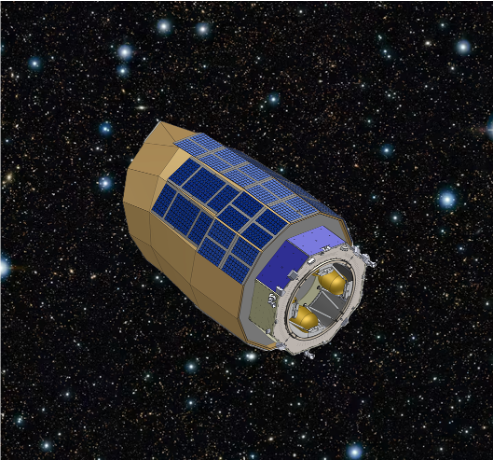
Lazuli will be the largest privately funded space telescope ever built — larger than the Hubble Space Telescope. Credit: Schmidt Sciences
Schmidt Sciences has announced the “Eric and Wendy Schmidt Observatory System,” an ambitious initiative comprising a privately funded space telescope and three innovative ground-based observatories.
The system features Lazuli, a 3-meter space telescope equipped with a coronagraph for exoplanet characterization and rapid transient detection; the Argus Array, an optical facility for continuous northern sky monitoring; the Large Fiber Array Spectroscopic Telescope (LFAST) for faint object spectroscopy; and the Deep Synoptic Array (DSA), a radio array designed for real-time imaging.
These facilities are slated to be operational by 2029, with an emphasis on rapid development cycles to integrate current technologies and undertake calculated risks, thereby complementing existing government-funded astronomical endeavors.
Operationally, the observatories will adhere to an open data model, offering merit-based access to the global astrophysical community with no reserved observing time, and will utilize shared backend infrastructure for data processing and archiving.
On Wednesday, Schmidt Sciences — an organization funded by former Google CEO Eric Schmidt and his wife, Wendy Schmidt — announced an ambitious initiative to build a space telescope larger than Hubble and fund the construction of three innovative ground-based observatories.
Together, the four facilities are called the Eric and Wendy Schmidt Observatory System and cover optical imaging, spectroscopy, and radio astronomy. Officials say they are aiming to have all four facilities operational and doing science by 2029, and some even earlier. And once these facilities are built, they will consider building more.
The announcement came Wednesday in a jam-packed conference room at the annual winter meeting of the American Astronomical Society (AAS), being held in Phoenix.
The initiative marks a major expansion of the Schmidts’ philanthropic efforts in astronomy through the Schmidt Sciences organization. The couple has previously funded the Schmidt Ocean Institute, run by Wendy Schmidt, which operates marine research vessels.
The new investment in astronomy is “a very large, purely charitable gift from Eric and Wendy Schmidt as basically a gift in new platforms and systems for the global astrophysical community,” said Stuart Feldman, the noted computer scientist and president of Schmidt Sciences, at the AAS session.
“For 20 years, Eric and I have pursued philanthropy to seek new frontiers, whether in the deep sea or in the profound connections that link people and our planet, committing our resources to novel research that reaches beyond what might be funded by governments or the private sector,” said Wendy Schmidt in a statement. “With the Schmidt Observatory System, we’re enabling multiple approaches to understanding the vast universe where we find ourselves stewards of a living planet.”
Wide-ranging capabilities
Philanthropy has long played a significant role in funding the construction of U.S. ground-based observatories from Mount Wilson to Keck, although the total amount of private investment is much less than public funding.
But a privately funded space telescope of this scale is unprecedented: The observatory, named Lazuli, will feature a 3-meter mirror and a powerful coronagraph — an instrument to block out the glare of stars, allowing the telescope to observe exoplanets. It will have instruments to both image those planets and study their atmospheres with spectra. It will also be designed to rapidly slew across the sky to catch cosmic explosions as they occur.
Lazuli’s capabilities will “approach Hubble” but “for a ridiculously low price,” said Pete Klupar, executive director of Schmidt Sciences, at the AAS session. Klupar is leading the engineering team building the Lazuli spacecraft. The mission was first proposed by a team led by Saul Perlmutter, the astrophysicist who shared the 2011 Nobel Prize for discovering the acceleration of the universe’s expansion. “He realized that we could build a groundbreaking mission for pennies” compared to NASA flagship observatories, said Klupar.
The telescope’s design and capabilities were publicly outlined for the first time in a paper that was posted to the arXiv preprint server on Tuesday. The authors wrote that its science portfolio will include studying supernovae, objects that generate gravitational waves, and cosmology.
Each of the ground-based facilities greenlit by the Schmidts are arrays with innovative designs — two of them optical and one radio — that were previously in development by existing teams at academic institutions.
The Argus Array, led by the University of North Carolina, will combine more than 1,000 small telescopes to form a telescope with roughly the collecting area of an 8-meter mirror, rivaling some of the largest ground-based observatories. The array will continuously observe the northern sky, making its mission something of a Northern Hemisphere complement to the Vera C. Rubin Observatory in Chile.
However, it will have a very different operating strategy; instead of taking deep imagery that covers the sky every few days like Rubin, Argus will observe the entire sky continuously, making more of a real-time movie. Some regions of the sky will be imaged every second. It will generate up to 7.8 petabytes of data per night, which will be processed with graphics processing units (GPUs).
The array will quickly find light emitted by events that create gravitational waves, like mergers of neutron stars. It should be able to discover thousands of supernovae “within minutes of the explosion,” said Nicholas Law, the leader of the Argus Team, at the AAS meeting session.
Telescopes for this array have been in production by Observable Space since the summer of 2025. The Argus team expects to be on sky with the full array of telescopes in 2027, said Law. They have not yet announced the site location.
The Large Fiber Array Spectroscopic Telescope (LFAST) will be a large array of small telescopes, but one designed to enable spectroscopy of faint objects. This will let it search exoplanet atmospheres for biosignatures and studying supernovae in detail.
The array will use fiber optics to feed light from each mirror to a spectrograph. The mirrors will be organized in subarrays of twenty 30-inch telescopes on a single structure. Team leader Chad Bender of the University of Arizona said the number of the subarrays has not been determined, as the concept is meant to be scalable. But he noted that one such structure has the collecting area of a 3-meter telescope, while 10 of them is equivalent to one of the 10-meter Keck observatories. But they are aiming for more — enough to have collecting area equivalent to a 30-meter-class telescope. Bender said their preferred site is Kitt Peak, with Mount Lemmon and Mount Hopkins as backup sites.
The Deep Synoptic Array (DSA) is a radio array of 1,650 dishes that will be built in remote Spring Valley, Nevada, with Caltech as the lead institution. The array makes use of a new design of astronomical radio receivers developed at Caltech that don’t need complex cooling systems. They have already been tested in precursor arrays in work funded by the National Science Foundation.
In addition, the massive number of receivers allows DSA to form a more complete combined beam than existing radio arrays. For instance, the Very Large Array in New Mexico consists of dozens of antennas arrayed in three spokes, a configuration that Caltech’s Gregg Hallinan, leader of the DSA team, compared to observing “with a broken mirror.” Having 1,650 antennas forms a fuller beam, reducing the intensive data processing that is typically necessary to form an image of radio emission and allowing it to capture images in real time — what the team calls a “radio camera.”
‘These are going to be real’
The Schmidt system plans to operate the observatories on an open data model, with no reserved time for particular institutions, research groups, or nationalities, including on Lazuli. “It’s completely merit-based,” said Aprita Roy, director of the Astrophysics and Space Institute at Schmidt Sciences, in an interview. “Time will be open and everybody will propose for it,” including the researchers who are building the instruments, she said.
The observatories will share some of their back-end infrastructure for data processing and archiving — “as much infrastructure as makes sense,” said Roy. Researchers will be able to apply for time to the system as a whole, she added, allowing them to use multiple facilities for a single project.
Schmidt Sciences did not release budget figures, but Roy told Astronomy that the space telescope, named Lazuli, will cost in the “hundreds of millions” of dollars. The combined budget for the three ground-based facilities are less than that, but “not small, either,” she said.
Roy said that Schmidt Sciences’ original plan was to fund “the riskiest early stage development” of the projects. Once the projects were “de-risked,” they hoped that some or all of them might then be more competitive for public funding.
But, said Roy, the plan to go back onto the “traditional funding path didn’t really work out.”
“Over the last year actually we’ve been trying to decide and discuss with our founders — if we really thought these technologies are so promising, does it make sense to build out the full-scale observatories?” said Roy. “Now, that’s a lot of both investment of time and technology and people — and then you have to operate them.”
With Wednesday’s announcement, all three (plus Lazuli) are officially going ahead with construction, with Schmidt funding or co-funding them; British financial trader Alex Gerko is funding half of the cost of the Argus Array. “These are going to be real, they’re approved, they’re happening, they’re already starting to build,” said Roy.
A different approach
Schmidt leaders say they hope to show that it is possible to build missions that embrace increased risk to launch quickly for less money. Having a sole shareholder — the Schmidts — “eliminates analysis paralysis” and “allows us to take credible, calculated risks that others just can’t do,” said Klupar at the AAS session.
Shortening the design cycle doesn’t just reduce costs; it also enables more current technology to be deployed.
By contrast, NASA flagship missions, with so much riding on them — like the James Webb Space Telescope (JWST) — often require so much development time to improve their reliability and reduce risk that the technology in the telescope’s instruments are no longer state-of-the-art by the time they fly, say researchers.
“The coronagraph technology in JWST was over 15 years old at launch,” said Ewan Douglas, of the University of Arizona, in an interview. Douglas is leading the team building Lazuli’s coronagraph and previously worked on the coronagraph on NASA’s upcoming Nancy Grace Roman Space Telescope set to launch later this year. Roman’s technologies were “frozen in the late [twenty-]teens,” said Douglas — a faster cycle, less than a decade.
For Lazuli, the team is aiming for a design cycle of just three years, with a launch in 2028. “So we figured out what the right coronagraph for the telescope we’re getting is, and we’re getting it out the door,” said Douglas. Like other Schmidt projects, the coronagraph will make use of GPUs — in its case, a multiteraflop Nvidia Orin cluster that was deployed on the International Space Station late last month by the commercial firm Neutralino Space Ventures.
Schmidt leaders are careful to emphasize they do not see the foundation as replacing NASA missions or the National Science Foundation, which funds most U.S. ground-based astronomy. The projects are “meant to be complementary and additive,” said Roy.
Part of the drive to launch Lazuli so quickly is so that it can work together with NASA’s Roman and the Vera C. Rubin Observatory in Chile, which was funded and built by NSF and the Department of Energy.
And unlike a flagship NASA mission, Lazuli is not taking the time to develop new technology, its builders say. “I think of the NASA path as this slow trajectory that lifts the whole field up because they build all this non-existent technology along the way,” said Roy. “We are leveraging that development to fly things quickly.”
Like Roman, Lazuli’s coronagraph will allow for direct observations of Jupiter-sized planets. But it will be also able to look closer to their host stars than Roman will, closer to the theoretical habitable zone where temperatures support liquid water. While gas giants wouldn’t support life, studying them will help us better understand these systems, said Douglas, and also serve as a precursor for work that will be done by NASA’s future Habitable Worlds Observatory, which is hoped to launch in the 2040s.
Funding paths
The Schmidts’ investments come after a year in which the Trump administration proposed slashing U.S. public funding of astronomy — cuts that were mostly rejected by Congress.
Roy says that unlike NASA and NSF, Schmidt Sciences is not intending to be a general funding agency. While Schmidt will accept proposals for observations by anyone, they don’t intend to award grants for researchers to fund their analysis of the data beyond initial, first-light datasets. But Schmidt will be offering funding for early career researchers to establish research groups.
After the session, many astronomers were still processing the plans — especially Lazuli, which had been long rumored during development but never outlined in detail. But many astronomers said they were excited about what they had seen. “I think it’s fantastic,” said Joe Shields, director of the Large Binocular Telescope Observatory in Arizona. “It complements but really extends the whole ecosystem of observational capabilities in a dramatic way.” And, he added, “I think it’s pushing us to do our business in different ways that can be very impactful.”
“Right now, it’s clear that we need a combination of private and public funding for science because they do different things and move at different speeds,” said Melodie Kao, a radio astronomer at the University of California, Santa Cruz.
Schmidt Sciences’ commitment to open data was also “very admirable,” Kao added. “One of the criticisms of private money is that you pick the winners and the losers. And so I commend them — I really admire them — for putting in the ground rules that the data will be public for everyone so that the whole community can benefit.”
But Kao also hopes that the ground-based facilities will be funded for more than their announced lifespans of three to five years. In response to a question from Kao during the session, Roy said, “We think that we should operate these experiments for defined useful lifetimes and then move on to the next exciting thing.”
But, Kao noted later in an interview, “Some discoveries take a long time to come to fruition” — for instance, discovering planets with multi-year orbits. “Pairing these observatories with the public assets built by NSF and NASA will be extraordinarily powerful,” she said. “And also I hope that they’ll be around for a while.”