
Market positioning will prevent significant dollar drop, Natixis saysData and concerns over Greenland weigh on euroSupreme Court decision on Trump’s tariffs could hurt the dollarJapan-China tensions under the spotlight
Jan 8 (Reuters) – The dollar was poised for its third straight daily rise on Thursday, though mixed U.S. economic data left markets cautious ahead of Friday’s nonfarm payrolls report.
Data on Thursday showed the U.S. labour market appeared stuck in a “no hire, no fire” state, with job openings falling more than expected in November while hiring eased.
Sign up here.
However, services sector activity unexpectedly picked up in December, suggesting the economy ended 2025 on a solid footing.
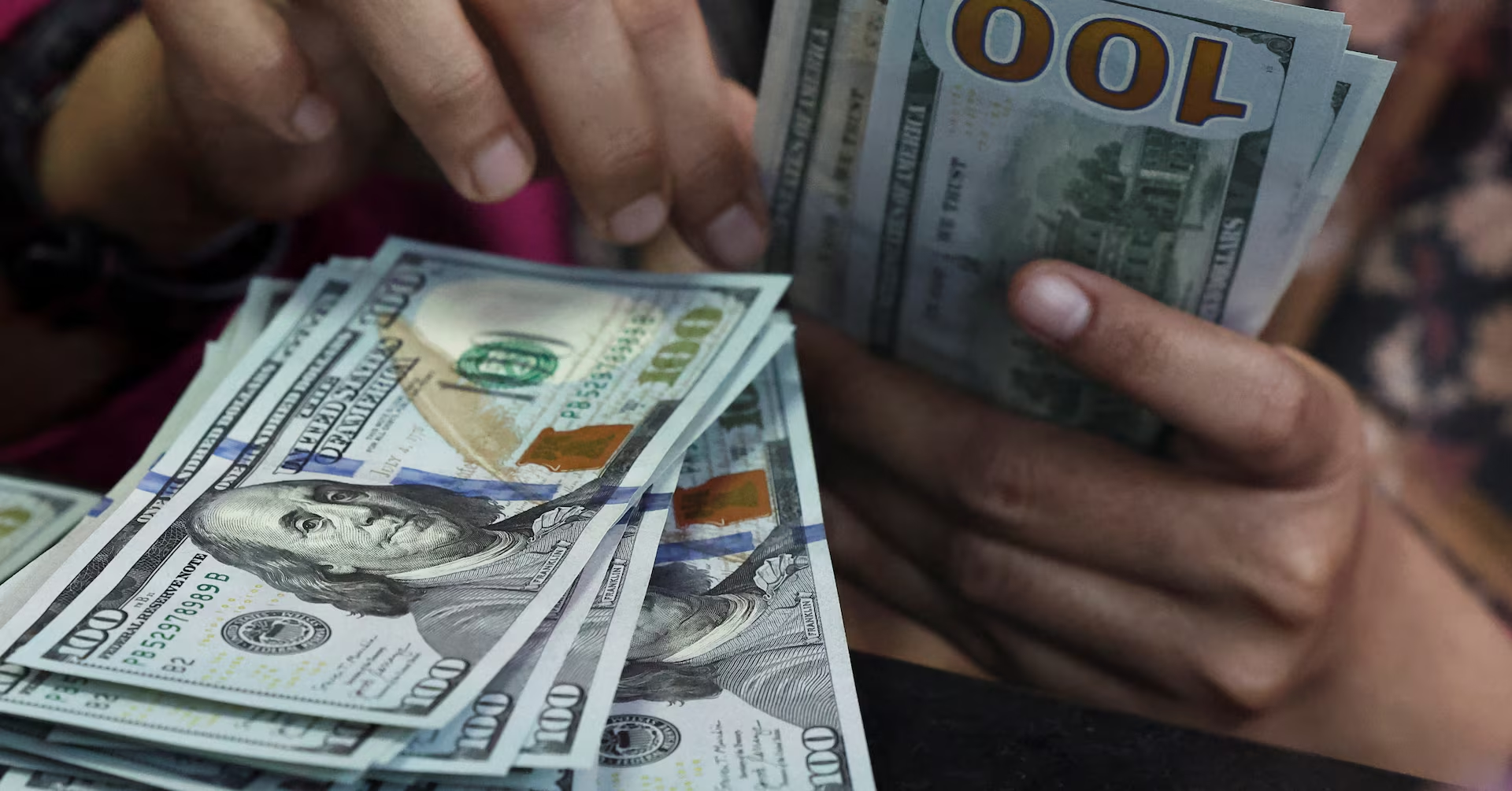
The dollar index , which measures the U.S. currency against six rivals, was up 0.06% at 98.793. The dollar is coming off its worst annual performance since 2017, with analysts predicting another year of decline.
“The U.S. economy still looks pretty good. A lot of the positioning in short U.S. dollar has already been done, and I think that’s going to prevent the dollar from getting significantly weaker going forward,” said Jack Janasiewicz, lead portfolio strategist at Natixis.
“I think the winners could be some emerging market currencies more than the euro or the yen,” he added.
Traders are pricing in at least two rate cuts from the Federal Reserve this year, although a divided central bank indicated in December there would be only one cut in 2026. The Fed is expected to keep rates steady at its meeting this month.
Markets have kept geopolitical concerns in the background, focusing on economic data instead.
However, risks that President Donald Trump’s administration could be forced to refund more than to importers if the U.S. Supreme Court this week declares his duties unlawful could resurface to hurt the dollar.
Trump said on Wednesday the 2027 U.S. military budget should be $1.5 trillion, stoking some concerns about rising debt and a higher risk premium on U.S. assets.EURO ZONE DATA AND GREENLAND IN FOCUS
On the euro front, recent inflation figures drove the currency lower and German Bund yields to a one-month low.
The euro was down 0.05% at $1.1669 on Thursday, after dropping by 0.45% in the last two sessions.
“Soft European inflation reinforces dovish sentiment, while the Greenland crisis underscores Europe’s relative vulnerability, potentially triggering further euro selling,” said Olivier Korber, foreign exchange strategist at Societe Generale.
U.S. Secretary of State Marco Rubio told reporters Trump retained the option to address his objective to take over Greenland by military means, while alarmed allies, including France and Germany, were working on a response.
Analysts flagged that the debate about changes in the European Central Bank policy shifted towards the possibility of a rate hike a year from now, while inflation is currently getting back to target with core edging lower.
The Japanese yen was roughly unchanged at 156.70 per U.S. dollar.
“For those hoping for a significant appreciation of the yen, the only option for now is to wait for the conflict with China to cool down again,” said Michael Pfister, foreign exchange strategist at Commerzbank.
“The Chinese government could further escalate the conflict with a complete export ban on rare earths, which would deal a significant blow to the yen,” he added.
Shares in Japanese chemical manufacturers fell on Thursday while those of their Chinese rivals jumped after China said it was launching an anti-dumping probe into imports of chemicals used in chipmaking.
The Australian dollar eased to $0.6704, just below the 15-month high it touched earlier this week.
Reporting by Stefano Rebaudo and Sophie Kiderlin; editing by Shri Navaratnam, Edwina Gibbs and Kate Mayberry
Our Standards: The Thomson Reuters Trust Principles., opens new tab