
NASA’s James Webb Space Telescope has discovered a bizarre population of “platypus galaxies” in the early universe, each exhibiting an unusual range of properties that are not typically found together.
The platypus is a highly unusual marsupial, featuring one of nature’s most distinctive combinations of traits, combining a ducklike bill and egg-laying with common mammalian characteristics. Now, according to a team at the University of Missouri led by researcher Haojing Yan, a series of galaxies with a similarly unusual combination of features has been identified using data from the James Webb Space Telescope.
“It seems that we’ve identified a population of galaxies that we can’t categorize, they are so odd,” Yan said in a recent statement. “On the one hand they are extremely tiny and compact, like a point source, yet we do not see the characteristics of a quasar, an active supermassive black hole, which is what most distant point sources are,” Yan added.
The team reported its findings in a new paper presented at the 247th meeting of the American Astronomical Society.
James Webb Space Telescope Observations
In data from the James Webb Space Telescope, Yan and his team discovered nine anomalous celestial features whose signals emanating from much earlier in the universe are only now reaching us from the early universe. Due to the high precision imagery offered by Webb from its position in space, which is not blocked by Earth’s atmosphere, the telescope can detect faint details even across tremendous astronomical distances.
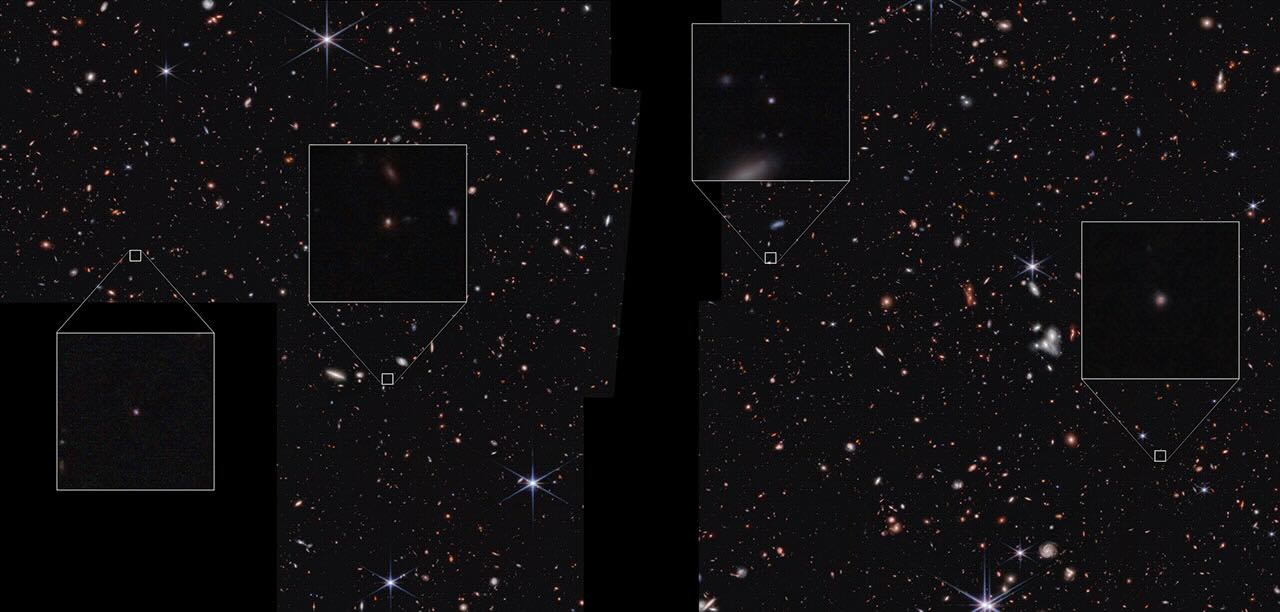 According to NASA, four of the nine galaxies identified in the new population of “Platypus galaxies” (shown above) were discovered in NASA’s James Webb Space Telescope’s Cosmic Evolution Early Release Science Survey (CEERS) (Image Credit: NASA, ESA, CSA, Steve Finkelstein (UT Austin); Image Processing: Alyssa Pagan (STScI)).
This allows researchers to gain new insights into how galaxies were created. Given the constant speed of light, these signals also serve as windows into the universe’s remote past, as light from distant objects takes a tremendous amount of time to cross the vast gulf of space.
Platypus Galaxies
The objects are unusual, since in some ways they resemble stars or quasars in that they are “point-like” objects. Yet in contrast with this, light spectroscopy data collected by Webb also revealed narrow emission lines rather than the broad ones astronomers expected to find, the likes of which are normally correlated with active star formation in galaxies.
“Each property on its own is familiar to us,” said Yan, a University of Missouri-Columbia astronomy professor and co-author of the recent study. “But when added together, they create something we’ve never seen before.”
 University of Missouri researcher Hoajing Yan, who led the research (Image Credit: Abbie Lankitus/University of Missouri).
“Our ongoing theory states that galaxies were formed by merging with other galaxies, often through violent collisions,” Yan said. “But these ‘platypus galaxies’ may have formed quietly, without such dramatic events. This suggests the early universe may have been more flexible and creative than we thought.”
James Webb Space Telescope Follow-Up
The team’s discovery is exciting in itself, but it only represents the beginning of an entirely new line of inquiry. Yan and his team plan to conduct additional research to investigate the nature of the anomalous objects observed by the James Webb Space Telescope.
Part of their follow-up work will involve collecting data on hundreds of other objects in the cosmos to determine whether this unusual combination of traits is reflected elsewhere. Spectroscopic data collected during the endeavor will enable researchers to analyze the light these galaxies produce across the entire spectrum, facilitating precise comparisons that can reveal a galaxy’s age, chemical composition, and star-formation processes.
“If these objects are really a new type of galaxy, it tells us we’ve been missing part of the story,” said co-author Bangzheng “Tom” Sun, a graduate student in Yan’s lab.
“And we’re just beginning to uncover it.”
The paper, “A New Population of Point-like, Narrow-line Objects revealed by the James Webb Space Telescope,” was presented at the 247th meeting of the American Astronomical Society.
Ryan Whalen covers science and technology for The Debrief. He holds an MA in History and a Master of Library and Information Science with a certificate in Data Science. He can be contacted at ryan@thedebrief.org, and follow him on Twitter @mdntwvlf.