
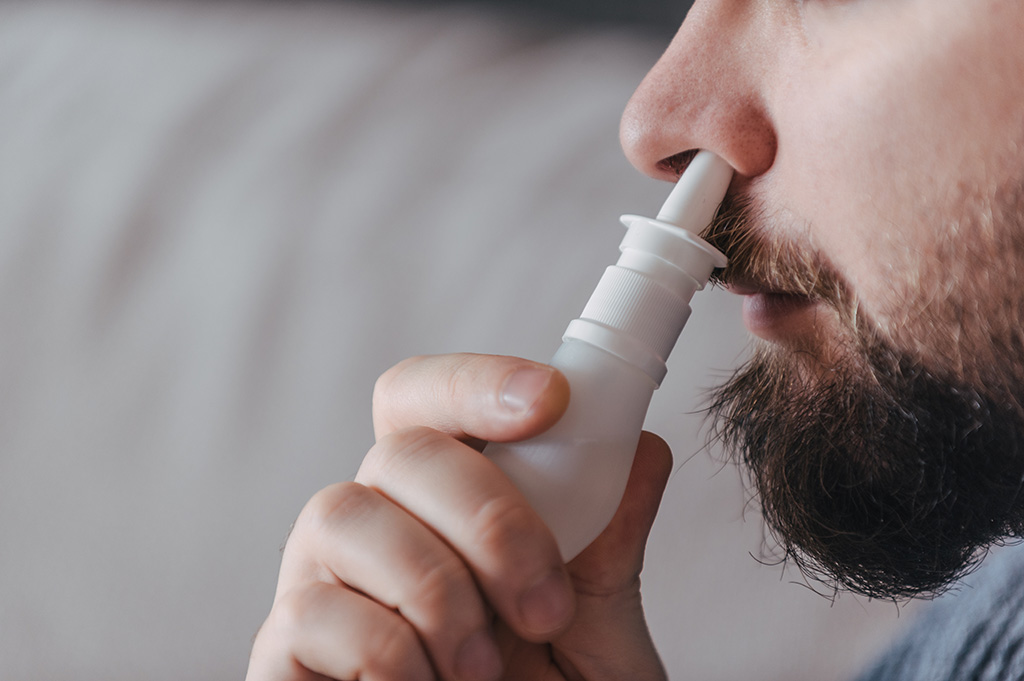
A report by the Royal Pharmaceutical Society (RPS) has warned that there needs to be better public awareness of the risks of nasal decongestant sprays.
Results of a survey of 309 community pharmacists, published by the Society on 8 January 2025, have revealed that almost two-thirds of pharmacists (63%) have intervened in cases of suspected over-use of nasal decongestant sprays — often by recommending an alternative or refusing a sale.
The Society has reiterated that nasal decongestant sprays containing xylometazoline or oxymetazoline should not be used for more than seven days in a row, in line with NHS and manufacturer advice.
Longer use can cause rhinitis medicamentosa (i.e. ‘rebound congestion’), which can result in people becoming dependent on the sprays to breathe more easily, the RPS warned.
According to the survey results, 59% of pharmacists thought that patients are unaware of the risk of rebound congestion, while nearly three-quarters (74%) reported that medication packaging could be clearer about the seven-day limit.
Amira Guirguis, chief scientist at the RPS, said: “Nasal decongestant sprays can be helpful for short-term relief, but using them for longer than seven days can make your congestion significantly worse. Our research shows that many people are unaware of this risk, which means they may continue using these sprays without realising they could be prolonging their symptoms.
“We’d like to see clearer warnings on the packaging, which you can’t miss, and greater awareness of the seven-day limit. If your congestion lasts more than a week, speak to your pharmacist. There are safe and effective alternative options to help you manage your symptoms.”
An accompanying blog written by Guirguis, also published on 8 January 2026, offers advice on how to safely use nasal decongestant sprays.
Olivier Picard, chair of the National Pharmacy Association, commented: “As [the RPS] report rightly says, overusing nasal decongestant sprays increases the risk of side effects, which is why pharmacists may refuse to supply them in circumstances where they judge there to be a risk of misuse or abuse of the product.
“We are concerned that when a patient buys medication off the shelf in places, such as a supermarket or a petrol station, they may be unaware of the potential side effects of what they are taking or how to safely take the medicine.
“Pharmacists are experts in medicines and are always the best people to speak to if you have any concerns about a medication you are taking.”
Read more: ‘How to counsel patients on the administration of nasal sprays, drops and ointments and performing nasal irrigation’