
It’s not inaccurate to think of the heavens as a clockwork apparatus above our head. We use our planet’s spin to mark a day and its orbit around the sun to mark a year. That annual orbital reckoning also means the same constellations appear in the same part of the sky on the same calendar dates, providing a sense of regularity. It’s comforting, in its way.
Many astronomical events, such as meteor showers, run by calendrical timings as well. But our moon and the other planets move with the cogs of different celestial gears. So every year, we get a new assortment of fun events to look forward to; 2026 is no exception.
Some are familiar, such as the dozen—or baker’s dozen—of full moons in any given year. Others are unique—or at least obscure to those who don’t pay close attention to the night sky. All are lovely, and worth watching. Below you’ll find the ones that I, in particular, am most looking forward to observing in 2026. I’ll note that this list is, by needs, U.S.-centric. If you want a more complete list of everything going on in the sky over the next 50 or so weeks, take a look at In-The-Sky.org, a website that offers details for events that are visible from across the world (you can enter your location to get local info as well).
January 10: The king of the solar system, the giant planet Jupiter, will reach opposition. That means it will be located opposite to the sun in the sky, with the planet rising at sunset and being visible all night. Because Earth will be almost directly between the sun and Jupiter, the latter planet will be at its closest to us—about 633 million kilometers—so it will appear at its biggest and brightest. Go out after dark and look east to see it gleaming like a jewel near the bright stars Castor and Pollux in the constellation Gemini. Through binoculars, you might catch one or more of Jupiter’s four large moons aligned right next to it. A telescope will reveal the planet’s broad atmospheric stripes and bands as well. It’s one of my favorite objects in the sky to observe, and I’ve withstood many a freezing night to catch a glimpse. And while this day will be the best time to see Jupiter, any time over the next few months will be fine as well.
February 2: In the early evening (shortly before 9 P.M. EST), the waning gibbous moon will pass directly in front of the bright star Regulus in the constellation of Leo. This rare “occultation,” in which the star will suddenly blink out behind the moon, will be visible for most of the eastern U.S. north of Florida. The occultation will last less than an hour, after which Regulus will reappear on the other side of the moon. The exact timing will depend on your location, so see In-The-Sky.org for your local details.
March 3: Very early risers in the U.S. will get a rare treat: a total lunar eclipse, which occurs when the moon passes into Earth’s shadow as it orbits our planet. I wrote about the mechanics of lunar eclipses in my March 7, 2025, The Universe column. But for this eclipse, the show will really begin at 4:50 A.M. EST, when the dark, most noticeable part of Earth’s shadow will slip onto the moon. Totality—when our planet’s shadow will fully engulf the moon—will begin at 6:04 A.M. and continue for just under an hour, ending when a tiny, sunlit sliver of the lunar surface will reappears at 7:02 A.M. The show will be over at 8:17 A.M., well after the sun will be up, making the last part of the eclipse invisible for East Coasters—but if you’re west of the Rockies, you will be able to watch the whole event. When viewing a lunar eclipse, it’s fun to go outside every few minutes to see how the moon changes. And perusing it with binoculars during totality is an amazing sight; the surface can appear brownish or even bloodred, depending on your local atmospheric conditions.
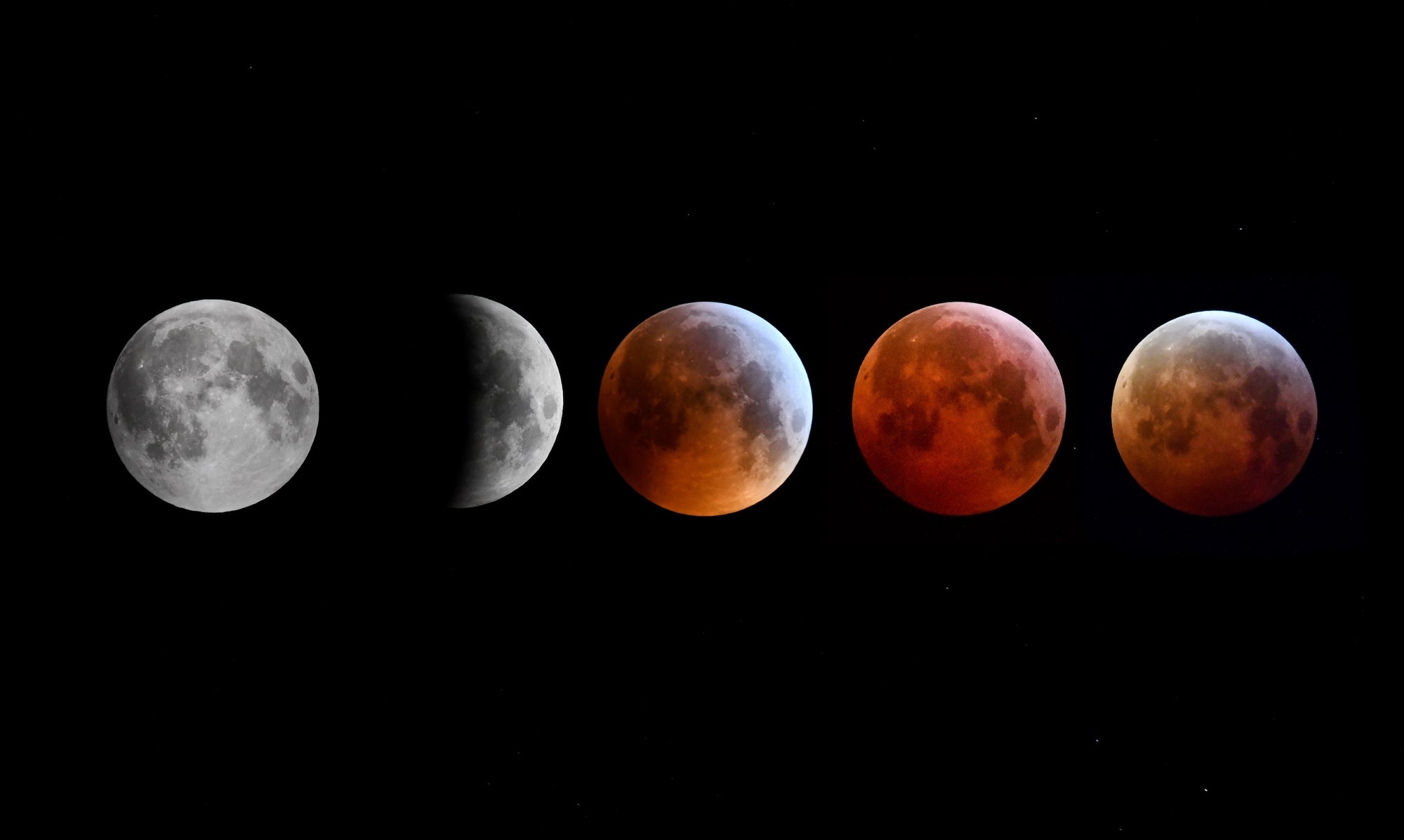
This composite image shows the progression of a total lunar eclipse.
April 25: The moon will occult Regulus again at approximately 8:30 P.M. (depending on your location), though this time it will be best viewed from sites east of the Mississippi, where the pair will be higher in the sky.
May 18: After sunset, the moon will pass less than three degrees from Venus, which is always a beautiful sight! Venus will be an impossible-to-miss beacon to the west in a clear sky, while the moon will be a very thin crescent, possibly more difficult to spot than Venus! The view will be best through binoculars. So if you have a pair, break them out. You won’t regret it.
June 5: Brilliant Venus will reach its highest point in the western sky after sunset on this date, making this the best time to spot it in 2026. As a bonus, Venus and Jupiter will be just 1.5 degrees apart in the sky on June 9, though they’ll be a striking pair for many days before and after. As a second bonus, elusive Mercury will be between them and the horizon; fainter and faster-moving than Venus, it never gets far above the horizon, so even many astronomers have never seen it! Scanning the sky with binoculars after sunset will help you spot it.
June 17: On this date, the moon will occult Venus! This event will be visible across the entire U.S., so you might think it’ll be easy to see. But it will occur at approximately 3:45 P.M. EDT (though you should check your local timing) during broad daylight. Careful use of binoculars should reveal the spectacle. Warning: you never want to look at the sun through binoculars, which would cause catastrophic damage to your retinas. I like to stay on the shady side of a big tree and scan the sky well away from the sun to see Venus during the day; it will be about 38 degrees east (to the left) of the sun at the time. It might be easier to spot than the very thin crescent moon, too. Unlike a star, Venus won’t just blink out; the planet has a visible disk, so it will take a couple of seconds for the moon to slide all the way across it and block it out. The event will last for about 90 minutes before the planet will reappear on the other side of the moon.
July 4: If you’ve never seen the distant planet Uranus, this will be your chance: in the early morning, before sunrise, the bright planet Mars and much fainter Uranus will be extremely close in the sky, less than a tenth of a degree apart! Such an event is called an appulse, though the term “conjunction” is more commonly used. Through binoculars, Uranus will look like a pale bluish star above the much redder Mars, which will be about 60 times brighter than the more distant planet. I’d recommend a telescope here, if you have one.
August 12: The grandest event of the year is a total solar eclipse, when the moon passes in front of the sun and turns day into night. This can only be seen along a narrow ground path that runs from Greenland, over Iceland and finally to Spain. If, however, you live in the extremely northeastern region of the U.S., you’ll still see a partial eclipse, with a small section of the sun blocked. For example, in Maine about 25 percent of our star will be eclipsed, while at my location in central Virginia, only about 1.5 percent of it will be, barely noticeable. As always, never look at the sun without proper optical aid! You can also get eclipse glasses for safe viewing; the American Astronomical Society keeps a list of vendors.
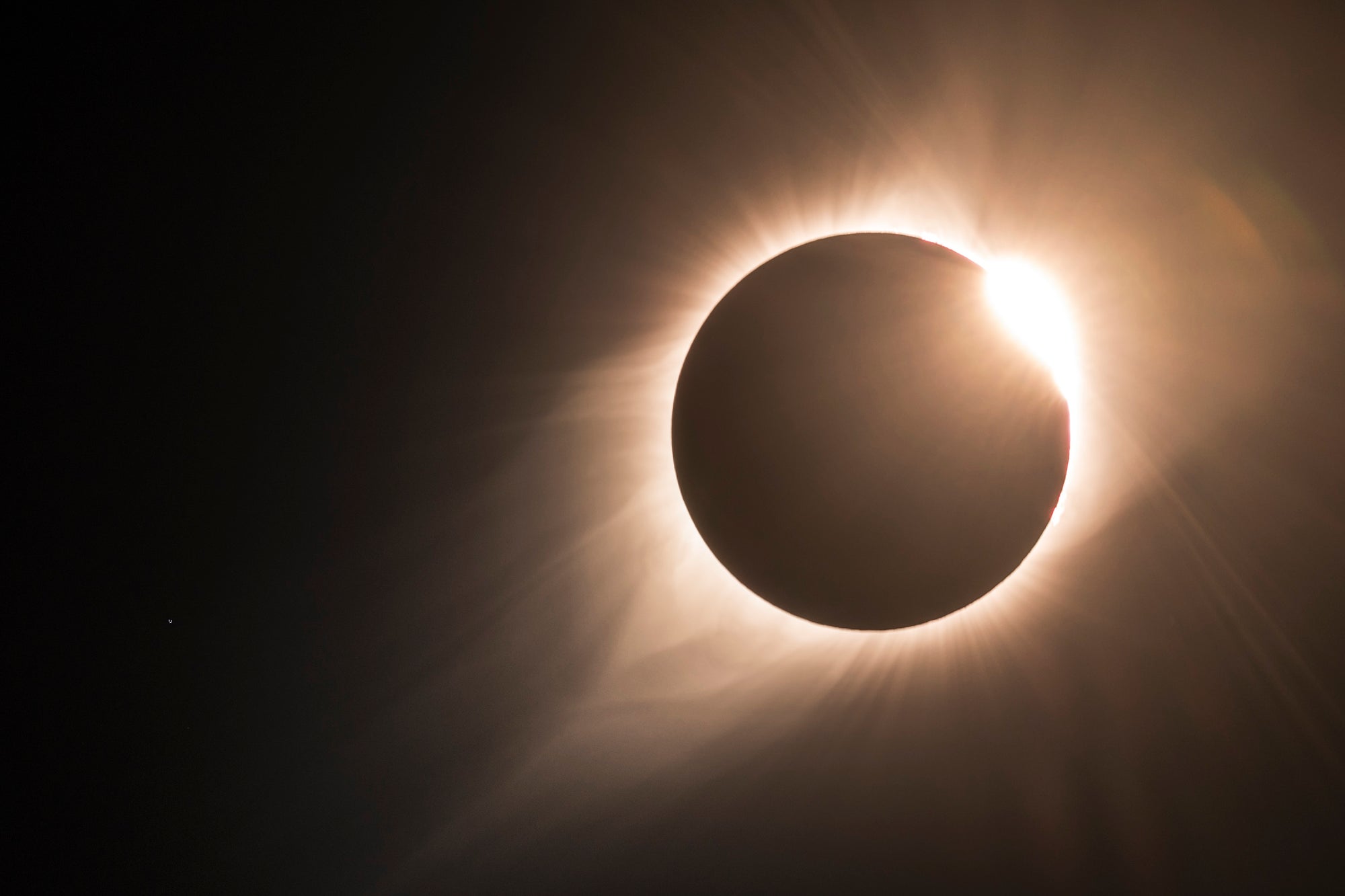
A view of a solar eclipse near totality, revealing the sun’s wispy corona and the “diamond ring” effect as sunlight beams through lunar valleys. The bright star Regulus is also visible (lower left).
john finney photography/Getty Images
August 27–28: We will be blessed with a second lunar eclipse on this night, but it won’t quite be total: at maximum, a little more than 90 percent of the moon will fall into Earth’s shadow. The event will start at 10:35 P.M. EDT, and the maximum eclipse will occur just after midnight. It won’t be as cool as the March eclipse, but the timing will be a lot more copacetic.
October 6: This time the moon will occult Jupiter in the early morning, around 4:15 A.M. EDT (as usual, check your local timing). This event will be visible to the eastern half of the U.S. and will last for slightly more than an hour. You should watch a bit early, though, because Jupiter’s largest moons will join in the fun as well! First, Europa will be blocked, followed by Io and Callisto, very close to each other, then Jupiter itself and finally Ganymede. The moon will be a waning crescent, so its brightness may not overwhelm the fainter moons, but you’ll need a good pair of binoculars or a telescope to see all the action.
November 16: For night owls, Mars and Jupiter will be a mere 1.1 degrees apart on this night. Yellowish Jupiter will be about 3.5 times brighter than the orange Mars, so this will be a lovely pairing. They won’t rise until around midnight, but it’ll be worth staying up to see.
Of course, there will also be meteor showers this year. On the night of August 12, the same day of the solar eclipse, the Perseids will be at their best. And on December 14 the Geminids, my favorite shower of the year, will hits their stride. These two are usually excellent showers, with as many as 100 and even 150 meteors per hour, respectively (though, honestly, usually fewer). You can read general info about the Perseids and the Geminids in Scientific American articles published last year.
There are also many other lunar occultations this year if you want to try your hand at seeing them. And I always recommend going out to see the moon whenever you can. Most people enjoy the full moon, but I prefer it when it’s a crescent, especially if the “dark” part is lit by earthshine, the reflected light from Earth. It’s one of my favorite things to see in the sky and stirs poetry in my soul.
But my advice every year, every day, every night, is always the same: if you’re able, look up. There’s a whole universe ticking away above our heads, and if you don’t take a peek at it every now and again, you might miss something amazing.