
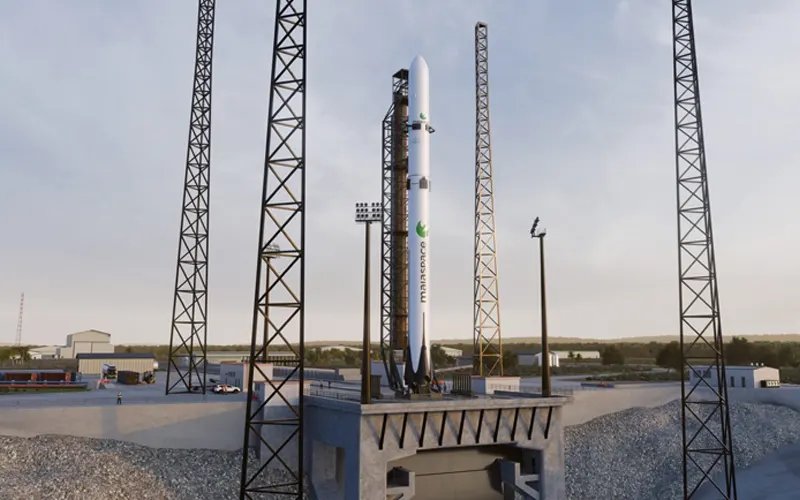
 Credit: MaiaSpace
French small launch services provider MaiaSpace has explained that an initial flight of its Maia rocket in 2026 will represent the deployment of a “minimum viable product.”
MaiaSpace was founded in 2022 as a wholly-owned subsidiary of ArianeGroup. The company is developing a partially reusable two-stage rocket called Maia that is designed to be capable of delivering payloads of up to 1,500 kilograms to low Earth orbit. It is also developing an optional kick stage that will increase the launch vehicle’s payload performance by as much as 1,000 kilograms.
As the company works toward the commencement of commercial operations in 2027, it is planning to launch an initial suborbital demonstration flight in late 2026 to validate key elements of the Maia launch system. The rocket will be launched in its full two-stage configuration and will carry a reduced propellant load, with MaiaSpace aiming for a minimum altitude of 100 kilometres.
Speaking to European Spaceflight, a MaiaSpace representative explained that the mission reflected the company’s iterative approach to development and that the demonstration will represent the deployment of “a minimum viable product designed to test critical phases.”
“For what concerns our first flight, we will deploy a minimum viable product designed to test critical phases (lift-off, stages separation, engine ignition of the second stage, …) and to validate the key features required for our first orbital flight. We are convinced that this way of rebalancing time spent for testing versus time spent running simulations is the most effective way to meet our ambitious goal of bringing a new launcher to market within four to six years, an unprecedented timeline in the global space sector.”
Following the demonstration and the commencement of commercial operations in 2027, the company will gradually introduce “Reusability technologies” during the first eight or nine orbital flights. The first recovery of a Maia first stage booster is expected to take place in 2028.
Keep European Spaceflight Independent
Your donation will help European Spaceflight to continue digging into the stories others miss. Every euro keeps our reporting alive.