
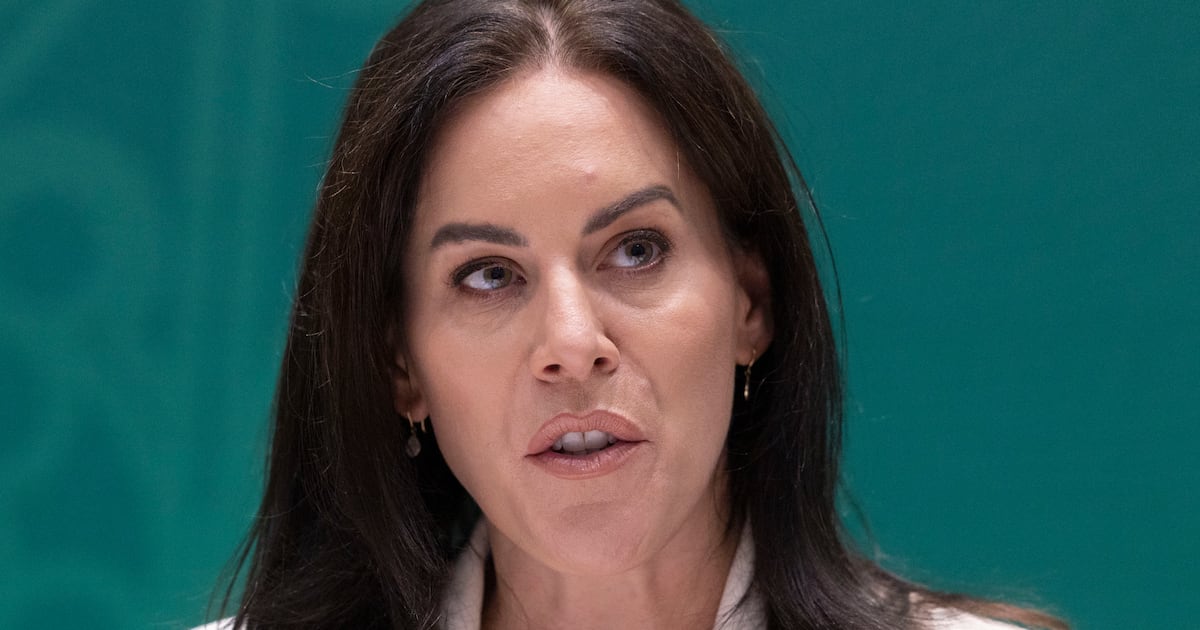
“I wish BAM would just give me the hospital,” Minister for Health Jennifer Carroll MacNeill says when discussing plans for the year ahead.
It’s almost one year since she took up one of the biggest ministerial portfolios in Government, and the Fine Gael TD has her eye on priorities on which she wants to focus during her second year in the job.
But there’s one story that seems like a never-ending headache for any politician in her seat: the new €2.2 billion national children’s hospital, which has been beset by delays and cost overruns.
Children’s Health Ireland (CHI) received early access to the site in December, eight months later than initially had been promised. Cleaning is under way on the floor provided – the sixth floor, which has 360 rooms – before equipment is brought in.
But the Minister said the one floor is “not enough” and the next step will be getting further access. Her frustration with contractor BAM is evident throughout a wide-ranging interview, though she acknowledges the company has been more responsive since October.
When will the hospital be finished? “I’d love to tell you. I would have told you that would be September or I would have told you that would be November and that didn’t happen,” she says.
“I don’t want to say when it’s BAM who are in control of that and you know we’re negotiating early access that we should have had two or three months ago.”
Once keys are handed over, commissioning is expected to take between seven and eight months, Carroll MacNeill says, due to the intricacies of some of the equipment. This has been reduced from the previous plan of nine months.
“We’re trying to do as much as we can. This is why it’s difficult. We shouldn’t be doing one floor. We should be in cleaning the whole thing and moving the equipment in together,” she says.
“We are taking this because this is what BAM has given us. BAM should just finish it, move out and let us do the whole thing in one go and that would expedite the process. If we get it bitty bit, here and there, that makes it more difficult. I wish BAM would just give me the hospital.”
[ National children’s hospital developer BAM’s claims ‘not credible’, says MinisterOpens in new window ]
But the hospital isn’t the only item on her in-tray for the forthcoming 12 months. Sitting at a table in her office in the Department of Health, the Minister has colour-coded spreadsheets laid out in front of her outlining trolley numbers in the various hospitals around the State.
They’ve become a familiar sight since she took up the role, with the South Dublin woman placing a keen focus on improving patient flow and reducing congestion in the acute hospital system.
Provisional health service data showed an 11 per cent reduction in patients waiting on trolleys last year when compared to 2024, despite a 4 per cent increase in attendances. This is something the Minister wants to advance further in 2026.
“One, because it’s a value in itself to patient safety, to the hospital experience and in particular the experiences of the doctors, nurses and healthcare workers in the emergency department who deserve a stable, peaceful environment to work,” she says.
 Jennifer Carroll MacNeill and Northern Ireland’s Minister for Health, Mike Nesbitt, on a visit to the new national children’s hospital. Photograph: Bryan Brophy
“But two, because it’s the gate to predictable hospital management on so many other things. You can’t bring in elective surgeries to a hospital that’s dangerously overcrowded in its ED; you can’t plan cancer care in the correct way. There are so many things contingent on having a hospital that is managing demand in a predictable, managed way.”
One way of doing this has been to change the way the health system works. Doctors and other healthcare staff are now working five over seven days, increasing weekend and evening work.
One of her first statements she issued last year when she was appointed to the role was critical of the spike in trolley numbers during the February bank holiday weekend. During this time, she said, only 10 per cent of hospital consultants were working – resulting in slower discharge of patients and a disruption to patient flow.
There was frustration and disquiet from consultants when the comments were circulated, but Carroll MacNeill shrugs when asked about how the communication was received.
“What I did was I asked for the contract that consultants had signed be implemented. If I had signed a contract, I would expect to be working according to the terms of that contract,” the Fine Gael TD says.
Increasing weekend rostering has been an “incremental process” over the year, she says. Some hospitals were quick – she points to the Mater as a positive example – but others “have taken longer” to get to that point.
The public-only consultant contract (POCC), which seeks to remove private healthcare from the public system, came into full effect this month.
It was first introduced in 2023, with a transitional period that allowed those who signed the new contract to wind down private care in public buildings until the end of last year, but this has since ended.
Consequently, private maternity options for patients have been significantly curbed, due to there being no private maternity hospital in the State.
Carroll MacNeill says the liability for maternity care if something goes wrong is so great that consultants are unable to get insurance for that, and so the State “underpins the liability of private obstetrics”.
Birth injury is the “single biggest liability the State has in terms of injuries that happen”, the Minister said, adding that it costs close to €4 billion.
“And if something goes wrong, I go to a private consultant and pay the private consultant €3,000 or €5,000 and something happens to my baby in the birth, the private consultant isn’t liable. The Irish State is liable for that child,” she says.
“It’s a very, very serious thing. The State underpins and continues to underpin all of that liability for work done in public hospitals, but should the State underpin liability for exclusively private practice in obstetrics? They [the obstetrician] were paid for it. I think that’s a pretty reasonable question to ask,” she adds.
Her department is a big one, having received a record €27.4 billion budget for 2026. There has been a focus on productivity and cost savings, and reducing the reliance on agency work is one thing that will receive attention in the coming months.
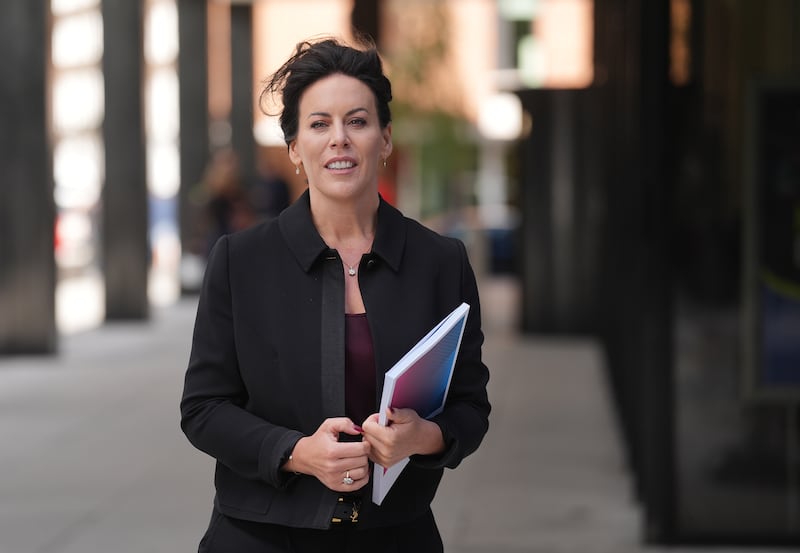 Minister for Health Jennifer Carroll MacNeill following the launch of the national rare disease strategy 2025-2030 in August. Photograph: Brian Lawless/PA Wire
The country’s drugs budget is significant, with €3 to €4 billion this year being spent on pharmaceuticals alone.
“The whole defence budget, everything to do with defence in Ireland, is €1.5 billion. We spend twice that just on medicine. That’s only going in one direction both as population increases, diagnostics improve when people are being treated appropriately with medicine and as more medicines become available,” she says.
“But you have to ask yourself at the most macro level, as a proportion of public spending, how big should that be in any economy?”
In recent months, The Irish Times revealed that four voluntary hospitals have breached public pay scales, with their chief executives receiving salaries higher than those outlined in rules by the Department of Public Expenditure. This, Carroll MacNeill says, is “extraordinary”.
“There’s no justification for it. It’s clearly against the rules. It has to be terminated and the appropriate contract put in place and look at reparation,” she says. “I find it hard to understand how mistakes of that kind can be made, especially more than once.”
Compliance with pay scales wasn’t the only issue that emerged in recent months. Among the biggest challenges were concerns around governance, safety and quality of care for some paediatric spinal and orthopaedic patients at CHI.
“Clearly last year we had a number of different legacy difficult issues, particularly with CHI, that required a lot of time and management. That’s probably the biggest challenge because you can see the human implications for parents and for children,” she says.