
Barra BestSenior weather presenter, BBC News NI
 Getty Images

The Met Office yellow alert for rain lasts from 21:00 GMT on Saturday until 21:00 on Sunday.
A rain warning has come into effect across Northern Ireland as the recent cold spell comes to an end.
The Met Office yellow alert lasts from 21:00 GMT on Saturday until 21:00 on Sunday.
A yellow warning for strong winds has also been issued for Antrim, Armagh, Londonderry, and Tyrone, lasting from midnight on Saturday until 21:00 GMT on Sunday. A further wind warning then comes into force for Antrim, Derry, and Tyrone from 21:00 on Sunday until noon on Monday.
The weather will spread from the west on Saturday night with a drier spell likely for a time on Sunday morning, before further heavy rain moves through later in the day.
 BBC Weather Watcher Fernisky
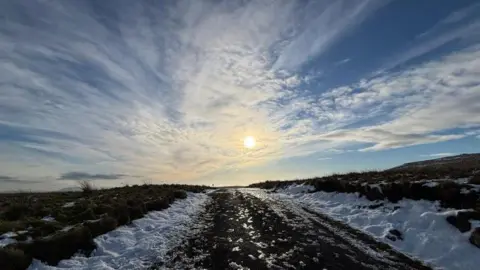
The sun shines bright against a snowy backdrop in Kells, County Antrim
It is thought 20-30 mm of rain could build quite quickly during this period, with 40-60mm possible over higher ground.
It will also turn much milder, leading to the melting of snow and therefore increasing the potential of flooding impacts in some places.
The rain will be coupled by strong winds, with gales likely around coastal and exposed areas, especially from Sunday afternoon.
Strong south to southwesterly winds will affect Northern Ireland with gusts between 45-60mph (70 – 100km/h) expected widely.
Stronger gusts can be expected at times around the coast and over higher ground and especially on Sunday night where there is a risk of gusts reaching 80mph (130km/h) in more exposed coastal areas.
The Met Office has warned that the strength of the wind is likely to exacerbate impacts from heavy rain.
Belfast City Council has issued a reminder that sandbags are available if people think their homes are at immediate risk of flooding.
Wind warnings for Irish coastline
In the Republic of Ireland, wind warnings have been issued around the entire coastline on Sunday.
Irish Weather service, Met Éireann, has warned that it will be very windy with strong and gusty southwesterly winds.
This could lead to large coastal waves, some fallen trees, and travel disruption.
Coldest night this winter
 John O’Neill
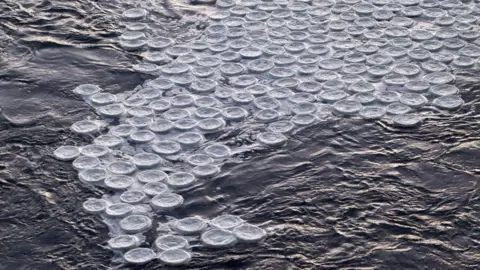
So-called ice pancakes were spotted on the Ballinderry River in County Tyrone
Meanwhile, Northern Ireland had its coldest night of winter, so far, on Friday night, when temperatures fell to -7C.
It was recorded at the weather station at Katesbridge in County Down, which often reports the lowest temperature across the island.
The hamlet sits in a frost hollow where, in the winter, cold air builds up to allow it to become so cold.
In County Tyrone, rare “ice pancakes” were spotted on the Edenderry River on Saturday morning.
They are caused by the freezing of foam floating on a river’s surface.
 Maria McSorley
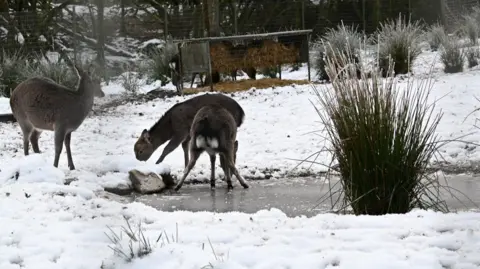
Deer were spotted “skating” in Gortin Glen Forest Park, County Tyrone, on Saturday morning
‘A pure sheet of black ice’
Democratic Unionist Party (DUP) councillor Mark Robinson said the roads in the Clogher Valley area were like “a pure sheet of black ice” on Saturday morning.
“It seems like it has rained first, it froze, then it rained, and it froze again”.
“I was speaking to a lady this morning and she hasn’t seen the roads that bad in 60 years,” he added.
He said several local carers likened the roads to a “bottle” when they were out doing their visits on Saturday morning.
 BBC Weather Watcher Becka
Frost covers the grass, at sunrise at Ballynoe in County Down
What is the coldest it’s been in Northern Ireland?
The lowest temperature ever recorded in NI was -18.7C at Castlederg in Tyrone during the big freeze of December 2010.
The lowest temperature ever recorded on the island of Ireland was -19.1C at Markree in Sligo in January 1881.
When does winter end?
The answer is simple.
It depends on which calendar you follow – ancient Celtic or Irish, meteorological, or astronomical.
The ancient Celtic calendar, also known as the Gaelic or Irish calendar, dates back centuries and is still followed by many in Ireland today.
It marks the winter season in November, December and January, with spring starting on 1 February – or St Brigid’s Day.
The meteorological calendar is also grouped into three full months but the seasons begin a month later with December, January and February making up the winter season.
However, the astronomical calendar seasons are defined by two solstices and two equinoxes.
These are determined by Earth’s tilt and the sun’s position over the equator.
The winter season starts on the winter solstice, around 21 December, and ends on the spring equinox, around 20 March.