
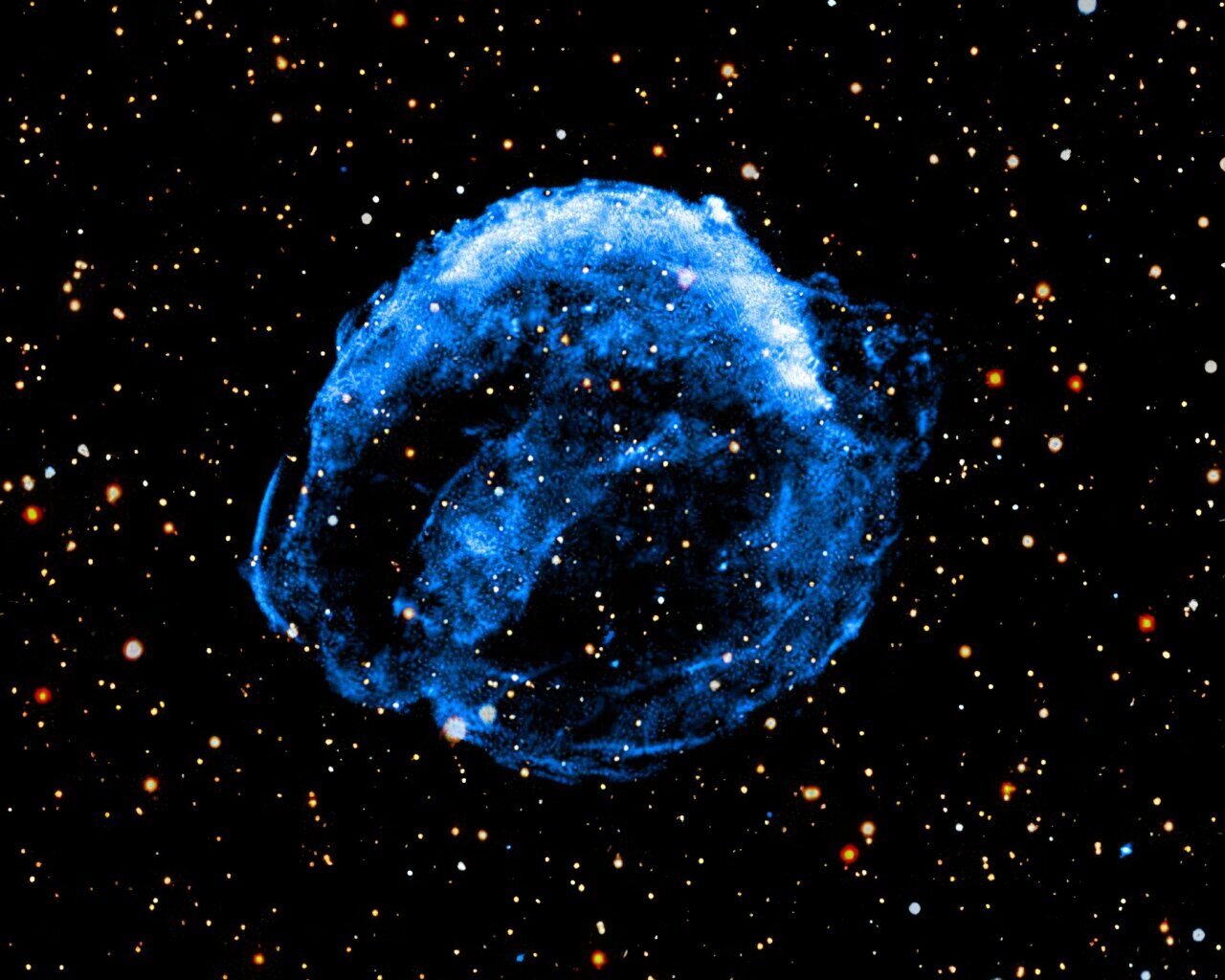
NASA has released a video showing changes in the remnant of Kepler’s supernova. It was obtained using the Chandra X-ray telescope.
In 1604, a new star appeared in the night sky. It was observed by many scientists, including the German astronomer Johannes Kepler, who made a significant contribution to its study. The star was visible for a year, after which it disappeared.
It is now known that Kepler observed a supernova explosion. It occurred when a white dwarf exceeded its theoretical maximum mass, leading to a thermonuclear explosion. This type of supernova is known as a Type Ia supernova. Scientists use it to determine distances in the Universe.
In the 20th century, scientists discovered the remnants of Kepler’s supernova. It is located 17,000 light years from Earth. The remains of the dead star are expanding and colliding with material previously ejected into space. They are heated to a temperature of one million degrees and are a source of powerful X-ray radiation, which allows them to be studied using the Chandra telescope.
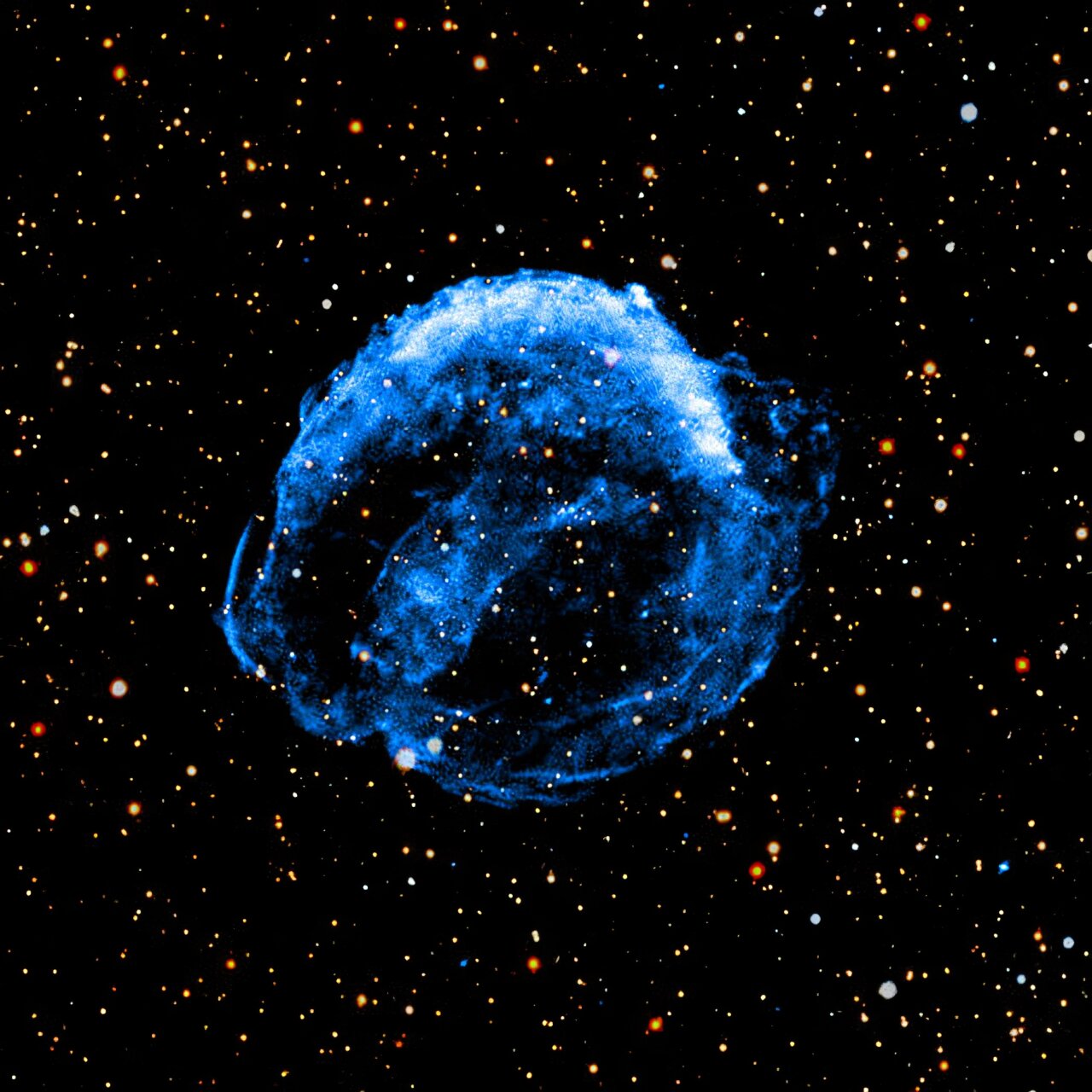 Remnant of Kepler’s supernova. Source: NASA/CXC/SAO; Optical: Pan-STARRS
Over the years, Chandra has repeatedly photographed the remains of Kepler’s supernova. Researchers combined data from its observations made in 2000, 2004, 2006, 2014, and 2025 to create a video. It shows the changes the supernova remnant has undergone over the past quarter-century. The blue color corresponds to X-rays, while the red, green, and blue colors correspond to optical data from the Pan-STARRS telescope.
Researchers found that the fastest parts of the remnant (the lower part of the image) are moving at a speed of about 6,100 km/s. That’s more than 2% of the speed of light. In turn, the slowest parts are moving at a speed of about 1,790 km/s. This is a large difference in speed, and astronomers believe it is due to the fact that the gas into which the remnants of the star collide at the top of the image is denser than the gas at the bottom. This gives scientists information about the environment in which this star exploded.
Supernova explosions and the elements they eject into space are the source of heavy elements that then form the next generation of stars and planets. A precise understanding of their behavior is crucial to our knowledge of cosmic history.
You can learn more about Kepler’s supernova and other supernovae that have exploded in the Milky Way over the last thousand years in our article.
According to chandra.harvard.edu