
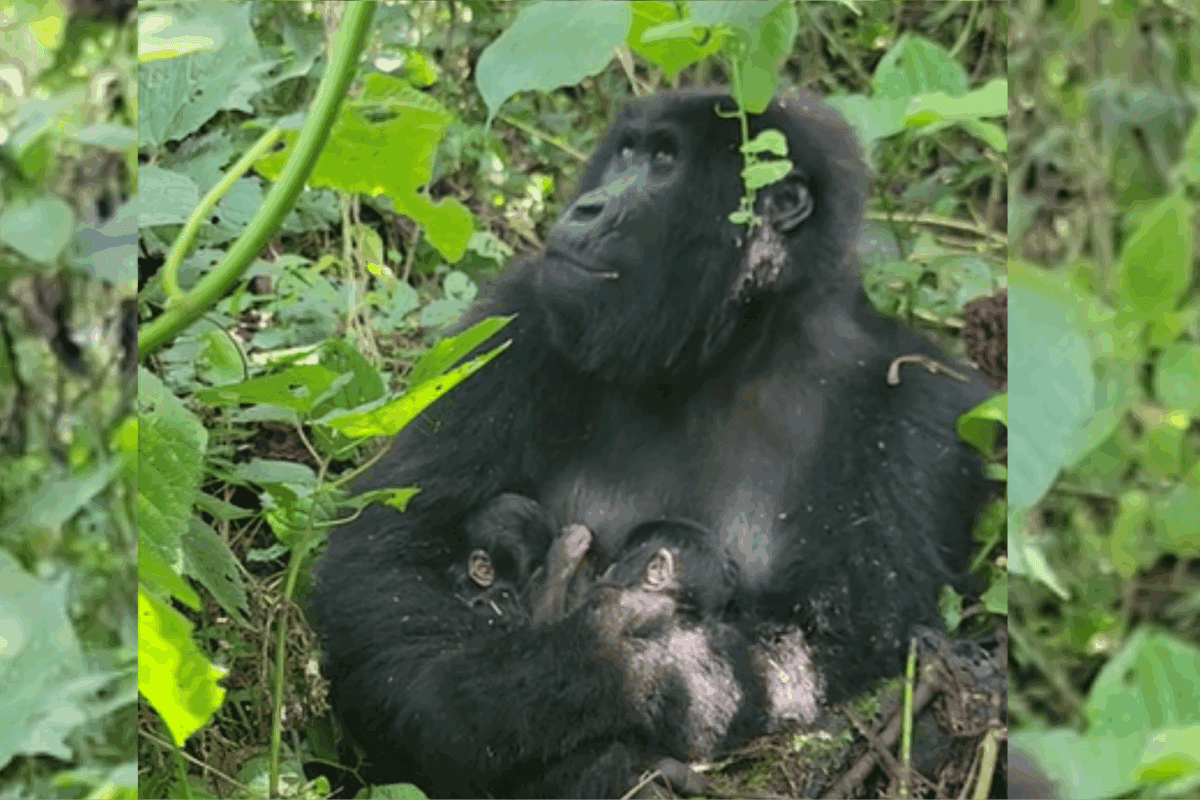
The birth of twin mountain gorillas in the Democratic Republic of Congo (DRC) is raising hopes for the survival of one of the world’s most threatened great apes.
“For me, it is a huge sign of hope and a great way to start the new year,” Katie Fawcett, science director with the DRC-based Gorilla Rehabilitation and Conservation Education Center (GRACE) told Mongabay in a phone call.
The twins were delivered by a mother gorilla named Mafuko and were discovered Jan. 3 in Virunga National Park, in the DRC. The two newborns are male. Both appeared to be in healthy condition, the park team shared in a press release.
“It is very rare. Since I was born, I think it has happened fewer than 10 times. It is a very great and unusual event,” Fawcett said. In 2025 GRACE successfully rewilded three gorillas in Virunga National Park.
Mountain gorillas (Gorilla beringei beringei) are found only in the DRC, Rwanda and Uganda where they live almost entirely in the national parks of East Africa’s Virunga Mountains. Mountain gorillas are one of two subspecies of eastern gorillas (G. beringei). They are considered endangered, while eastern gorillas as a whole are critically endangered, according to the International Union for Conservation of Nature (IUCN).
Virunga park authorities are celebrating the twin birth as a success from “ongoing conservation efforts to support the continued growth of the endangered mountain gorilla population,” the park said in a statement to Mongabay.
However, caring for the twins remains a challenge for their mom and for park staff. Mafuko gave birth to another set of twins in 2016 but they died at just a week old. “Additional monitoring and protection measures will be deployed to closely observe the twins and support their health and survival during this critical early period,” the park said in a statement to Mongabay.
Monitoring efforts are further complicated by ongoing security challenges in the park since the 1994 genocide in neighboring Rwanda. Mafuko lost her mother to armed individuals in 2007, according to the park. That same year, the United Nations Environment Programme (UNEP) recorded 10 mountain gorilla deaths. According to UNEP, one of the main drivers behind these killings was demand for charcoal. Armed groups use the park’s quality trees to produce charcoal, leading to habitat loss and gorillas caught in the crossfire of armed conflict.
The security situation deteriorated further with the resurgence of the M23 armed rebel movement, which now controls a large portion of the park. Escalating conflict between M23, DRC armed forces, militias and local self-defense groups has fueled poaching, deforestation, habitat loss and illegal trafficking. Still, park authorities, supported by local communities, continue their work to protect and support mountain gorillas in Virunga.
Banner image: Mafuko holding her two newborns. Additional monitoring and protection measures will be deployed to make sure they survive, according to the park. Image courtesy of Virunga National Park.
