
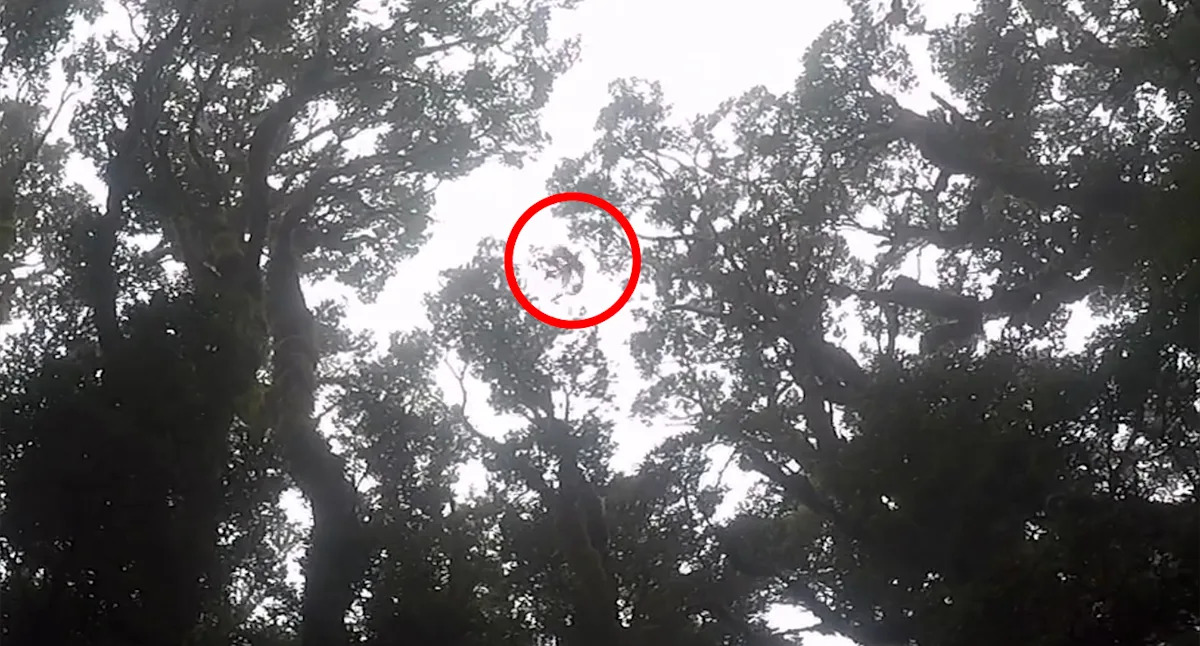
Dozens of adventurers are hoping to claim a $10,000 reward, which is on offer to anyone who can provide proof that the South Island kōkako is still alive. Like the famous dodo from Mauritius, this little-known slate-grey New Zealand bird was once officially declared extinct.
The species hadn’t been documented since 1967, but then a 2007 report was deemed credible enough for the Department of Conservation (DoC) to update its status to “data deficient”, meaning that no one knows if the species survives.
The reward has remained unclaimed since it was first offered by the South Island Kōkako Charitable Trust in 2017, but modelling published in 2025 suggests a reasonable probability (48 per cent) that it’s not extinct.
Inger Perkins, the manager of the Trust, has collated over 500 potential sightings of the bird, many in remote places, and documented them on a publicly available map. A few are simply descriptions, while others include videos, photos and sound recordings.
“Some of them we can dismiss straight away, but maybe a fifth we’re putting in the probable category,” Perkins told Yahoo News Australia.
Fun Fact: The rediscovered Victorian grassland earless dragon hadn’t been seen since 1969.
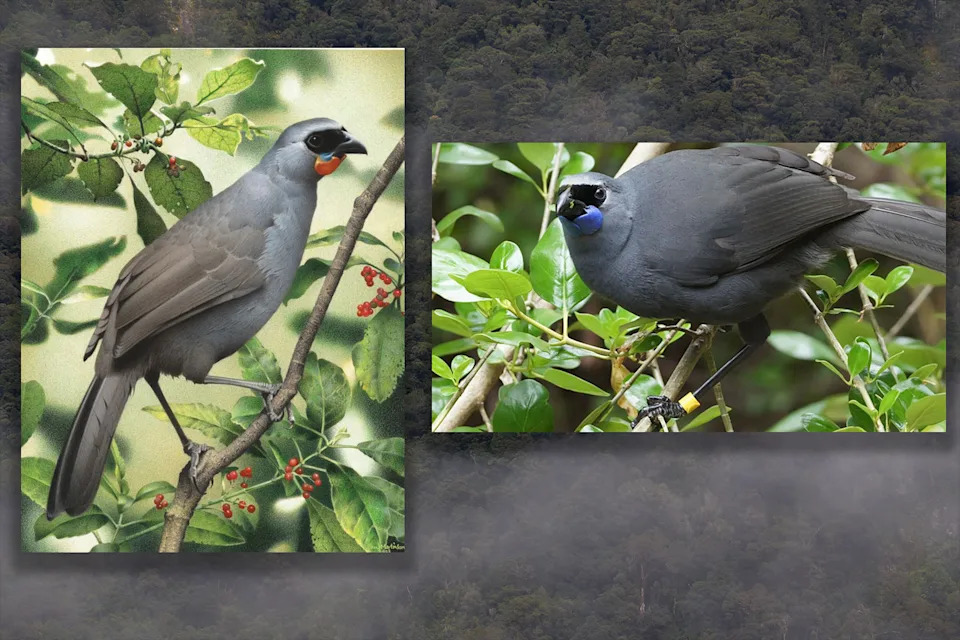
The South Island kōkako (left) is similar in appearance to the North Island kōkako. Source: Paul Martinson via Te Papa Tongarewa, DoC, Getty
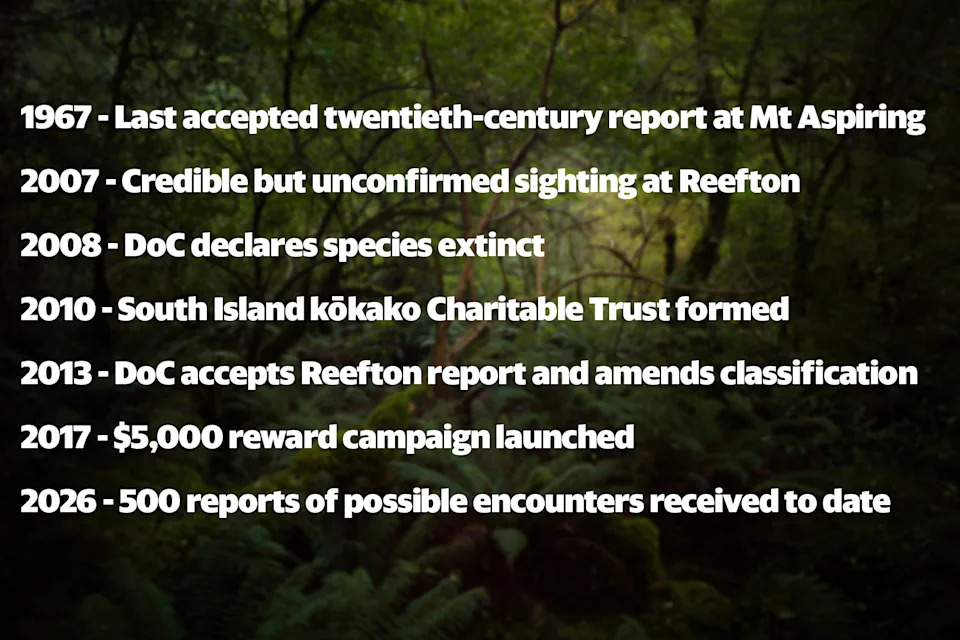
Milestones since the last report of South Island kōkako. Background image: Getty
Bird’s call could be key to rediscovery
No one knows exactly how the bird sounded, as there aren’t any confirmed recordings, but it was likely similar to its cousin, the rare North Island kōkako, which makes a haunting cry that is almost human in tone.
“It seems that it was the most beautiful part of the dawn chorus, when the Maori were first here, and then later when Captain Cook and others were arriving in New Zealand and sitting in their boats offshore,” Perkins said.
Frustratingly for those searching for the species, similar cries are made by other native birds.
“The call is so special it might make the hairs on the back of your neck stand up, and stop you in your tracks,” Perkins said.
“But the tūī can do some mimicking, and the kākā forest parrot does a similar flute-like sound among its squawks.”
You can listen to a verified North Island recording here, and a possible South Island recording from the Kahurangi National Park 2021 here for comparison.
Fifty cameras have now been set up in the area where the recording was made.
What will happen if the bird is rediscovered?
The North Island kōkako suffered significant declines over the last 20 years due to habitat degradation and predation by invasive animals, but it is now on the road to recovery with around 2,800 pairs thought to exist, up from 230 in 1999.
It’s hoped that if populations of the South Island species are rediscovered, they can be protected and rebound.
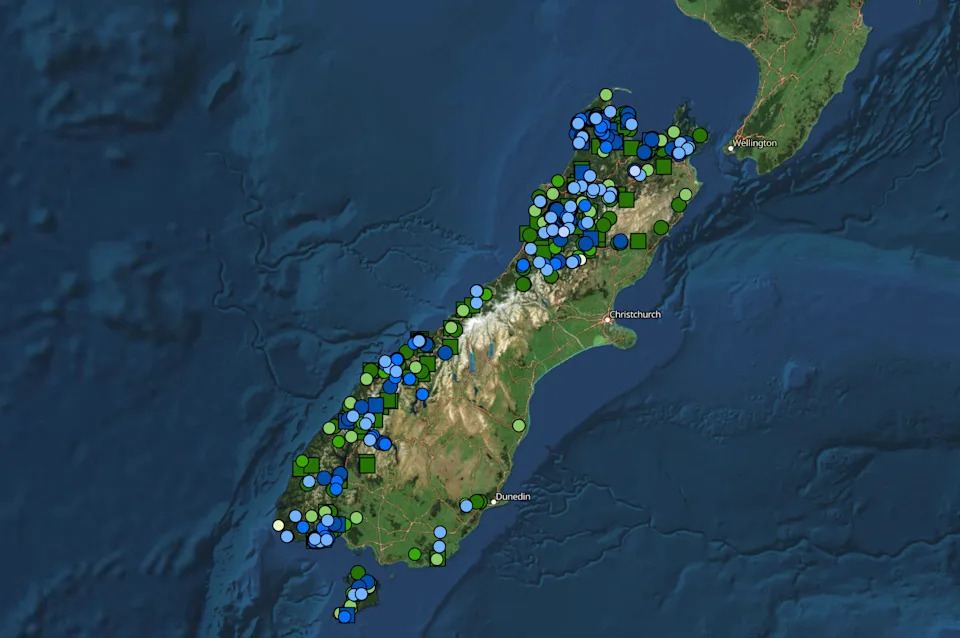
More than 500 reports have been made of possible South Island kōkako sightings. Source: South Island Kōkako Charitable Trust
“Every year we say, ‘Should we continue, do we carry on, is it worth it?’ ” Perkins said.
“There are a few things that always sort of take us forward and propel us into the future, and they are (a) we keep getting good reports, and (b) the science is changing all the time.”
New technologies sharpen hunt for species
Over the last two years, the Trust has been working with the University of Canterbury to develop an animated model of the South Island Kōkako, which can sing and dance.
“Having that as a lure — something that’s more realistic than just a dummy model is our next step,” Perkins said.
The Trust isn’t putting all of its eggs in one basket. It has trialled environmental DNA (eNDA) sampling with the University of Otago.
This process can be used to detect small traces of genetic material from target species, but until recently, it was best at examining water samples, and it wasn’t so good at picking up birds.
But the technology is now improving on land, and synthetic spider-web-like structures are being developed to capture eDNA from the air.
The Trust has also been working with a maths professor at Victoria University in Wellington to train computer systems to listen for the bird’s call.
If successful, this AI system will listen to hours of audio recordings, separating each species’ sound during the dawn chorus of birdsong.
Can I help add to the reward?
Rewards of $1.25 million and $1.75 million were made for anyone who could locate the Tasmanian tiger, but they went unclaimed, and most experts believe the species is extinct.
But the South Island Kōkako may survive in a remote corner of New Zealand, and the more modest $10,000 is ripe for being claimed.
Some precedents offer hope — the little spotted kiwi was only recently rediscovered on the mainland, and the South Island takahē was thought to be extinct until a small remnant population was rediscovered in the 1940s.
“A few people think it’s extinct, but most people are optimistic that this isn’t just another story of extinction,” Perkins said.
“We haven’t given up, there is still hope.”
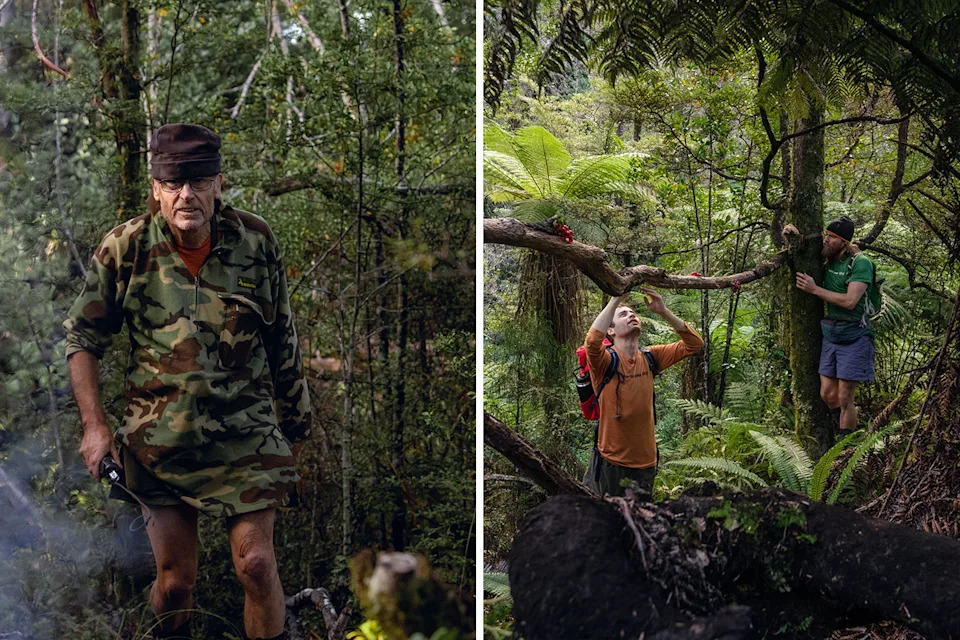
Volunteers search for the South Island kōkako inside the Abel Tasman National Park. Source: South Island Kōkako Charitable Trust
The reward is funded by the Mōhua Investments charity and the Morgan Foundation public interest research group. Anyone wishing to add to the reward can contact the Trust directly.
Love Australia’s weird and wonderful environment? 🐊🦘😳 Get our new newsletter showcasing the week’s best stories.
