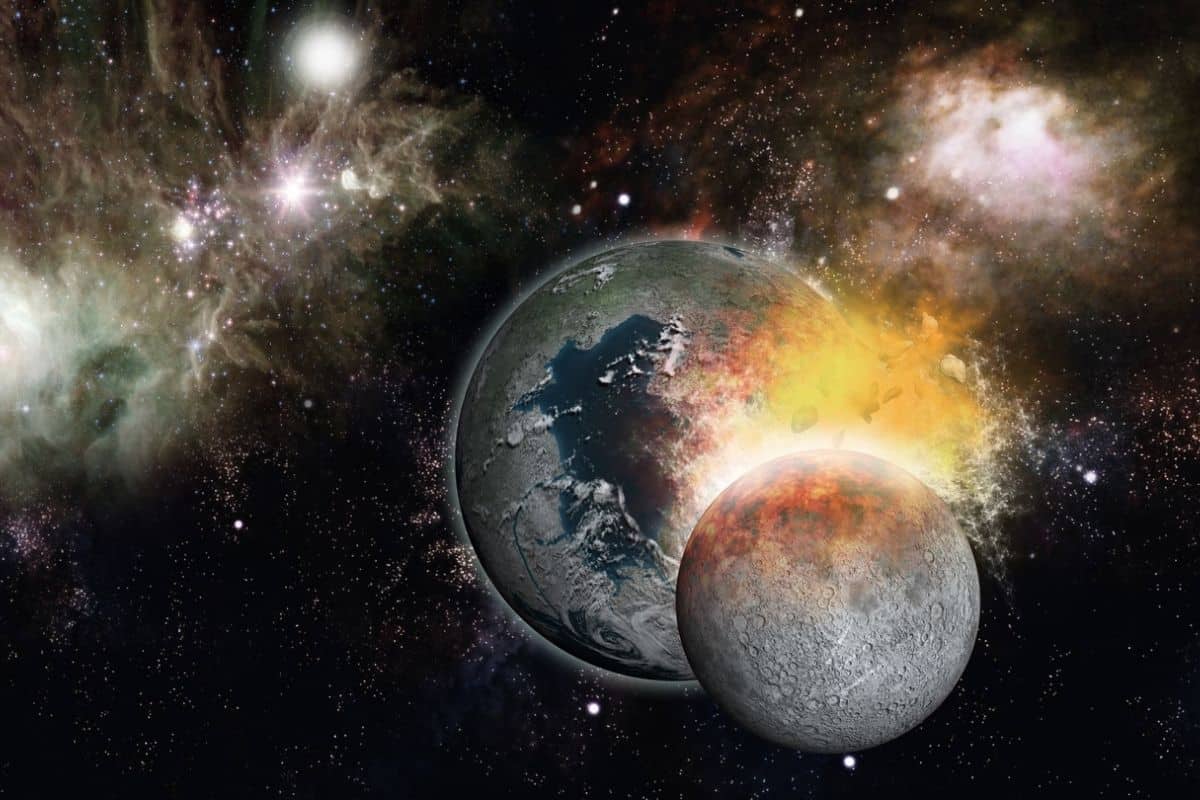
The Moon may owe its existence to a dramatic planetary collision. About 4.5 billion years ago, a Mars-sized body called Theia smashed into the still-forming Earth, launching vast amounts of debris into orbit. Over time, that material merged to become the satellite that lights our night sky.
A new study published in Nature suggests that the impact didn’t just shape the Moon — it also left traces deep inside Earth itself. Fragments of Theia may have sunk into our planet’s mantle, forming two mysterious, ultra-dense zones detected by geophysicists near the core.
Researchers have known for decades that unusually heavy masses sit at the base of Earth’s mantle, but their origin has long puzzled scientists. Using high-resolution computer models, Qian Yuan and his team at Caltech simulated the Moon-forming impact and the planet’s later evolution. Their results point to buried remnants of Theia that have survived for billions of years.
“This is a fascinating and provocative result,” said Robin Canup of the Southwest Research Institute in Boulder, Colorado, who was not involved in the study. “It suggests Earth still holds material from Theia — clues that could reveal more about the collision that created our satellite.”
Voyage to the center of the Earth
Picture Earth as a layered sphere rather than a simple rock. At its heart lies a blazing metal core — a liquid outer layer swirling around a dense inner core about 1,216 kilometers (756 miles) wide. Encasing it is the mantle, which makes up roughly 80 percent of the planet’s volume and supports the thin crust we live on.
The mantle is Earth’s engine room: tectonic plates drift and clash here, and molten rock slowly rises toward volcanoes at the surface. Because it lies so deep, scientists study it mainly through seismic waves produced by earthquakes. These waves speed up or slow down depending on the materials they pass through, allowing researchers to build a 3-D map of the planet’s interior.
Those seismic maps have revealed two colossal structures in the lower mantle — one under southern Africa and another beneath the Pacific Ocean. Seismic waves travel more slowly through them, which is why geologists call them Large Low-Shear-Velocity Provinces, or LLSVPs. Also known as superplumes, these dense regions appear to have existed for billions of years.
How they formed remains an open question. The latest research argues that these giant patches of dense rock could be the long-buried remains of Theia — relics of the cataclysmic impact that gave birth to the Moon.
Building the Moon
When Theia slammed into Earth 4.5 billion years ago, the impact shattered both worlds. Clouds of vapor and molten debris wrapped around our young planet before gradually merging to form the Moon. Over the past half-century, scientists have studied lunar samples brought back by the Apollo missions and meteorite fragments, combining that evidence with advanced computer models to build the leading theory of the Moon’s origin.
Still, one puzzle has long bothered geophysicist Qian Yuan: if Theia truly collided with Earth, why haven’t we found any trace of it here?
Yuan explored that question in his doctoral research at Arizona State University under the supervision of Mingming Li. Together, they reached out to the researchers behind existing giant-impact models.
At the Shanghai Astronomical Observatory, astrophysicist Hongping Deng simulated the colossal crash and what followed — how material from both bodies might have blended, or resisted blending, inside Earth. With more detailed input data than past models, his results suggested that some of Theia’s molten matter stayed behind.
According to those simulations, this denser material sank deep into Earth’s lower mantle, forming a distinct mass that never mixed completely with surrounding rock. “I tried to make them mix,” Deng said, “but they just wouldn’t.”
Molten mixture
The big question, said Robin Canup, is whether that ancient material “could really have avoided mixing and homogenizing within Earth’s mantle over 4.5 billion years.”
Not everyone is convinced. “In our own simulations, Theia’s mantle and Earth’s mixed fairly well,” explained planetary scientist Miki Nakajima of the University of Rochester in New York, who studies how rocky planets evolve internally.
“I doubt the impactor’s material stayed fully separate,” added geodynamicist Maxim Ballmer of University College London, “but this study underestimates how much blending occurred.” Ballmer, though not part of the recent Nature paper, previously collaborated with Deng on related research.
Most experts agree that these dense regions have existed in Earth’s mantle for eons, but their exact age and origin remain unresolved.
“There’s another possible explanation,” Ballmer said. One theory suggests that early Earth’s mantle was once an ocean of magma that slowly differentiated into the layers we know today. The upper layer cooled quickly, solidifying as it lost heat to space, while the lower one cooled more slowly — long enough to form pockets of varying density.
The next step is to compare the chemical makeup of these deep-Earth superplumes with that of the Moon, which itself is largely composed of Theia’s material. “If they share the same geochemical fingerprint,” Yuan said, “they must have come from the same planet.”
Obtaining those samples, however, will be a challenge. We can’t drill down to the superplumes, but occasionally rocks from the deep mantle reach the surface — for example, in basalt from volcanic ocean islands.
Because the Moon’s surface has endured billions of years of cosmic weathering and meteorite contamination, scientists also hope to study samples from its mantle. Most existing specimens come from the surface.
To get new material, researchers must wait for an upcoming lunar-sample-return mission aimed at the Moon’s south pole, where mantle rock is closer to the surface. Until then, they’ll keep refining their models in search of Theia’s lingering spectral signature.