
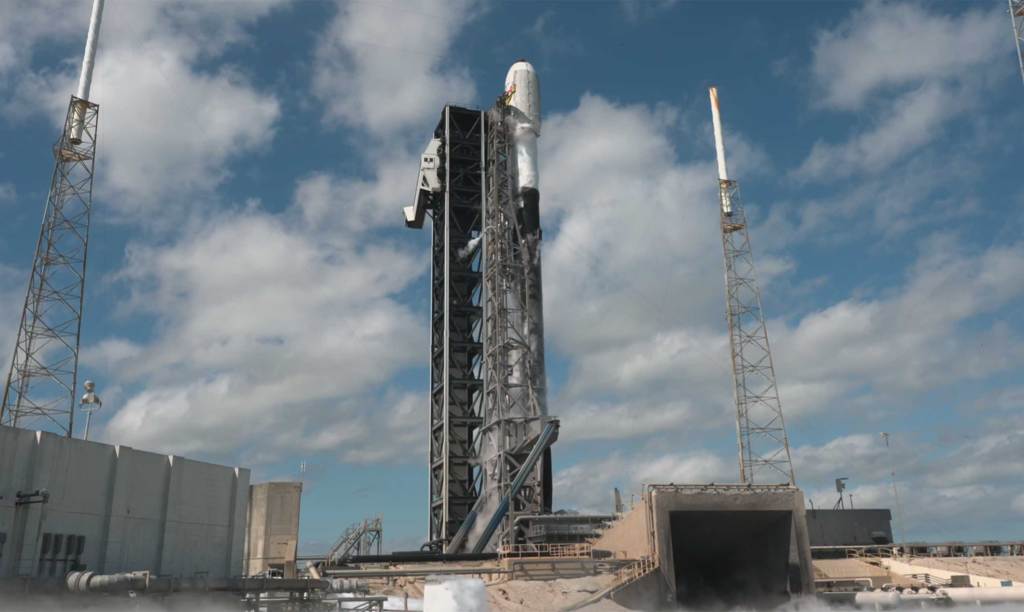
SpaceX is set to launch its third mission of the year from the Space Coast on Monday afternoon while preparing for the early return later this week of Crew-11 from the International Space Station.
A Falcon 9 is set to fly on the Starlink 6-97 mission with 29 Starlink satellites from Cape Canaveral Space Force Station’s Space Launch Complex 40 targeting 12:44 p.m. during launch window that runs from 12:42-4:42 p.m.
This will be the 25th flight of the first-stage booster, which will aim for a recovery landing downrange on the droneship Just Read the Instructions stationed in the Atlantic.
Space Launch Delta 45’s weather squadron forecast an 85% chance for good conditions at the launch site, but noted a low to moderate chance for weather problems at the booster recovery site. A 24-hour delay would see a 90% chance for good conditions at the opening of the four-hour launch window Tuesday, but slide to 70% near the end of the window.
It would mark the third launch so far this year, which so far have all been from SpaceX from SLC-40 on Starlink missions. Its next two planned flights from Florida will follow suit targeting launches on Wednesday during a window that runs from 1:01-5:01 p.m. and then Sunday during a window from midnight to 3:17 a.m., both flying up another 29 Starlink satellites.
NASA and SpaceX have also announced plans to bring the four members of Crew-11 home this week after it was deemed one of the crew who suffered a medical issue on board the International Space Station would fare better if brought home early.
The Crew Dragon Endeavour, which launched with NASA astronauts Mike Fincke, Zena Cardman, JAXA astronaut Kimiya Yui and Roscosmos cosmonaut Oleg Platonov to the station from Kennedy Space Center on Aug. 1, 2025 will cut its stay short with a docking no earlier than 5 p.m. Wednesday.
The quartet would then splash down in Pacific Ocean after a nearly 11-hour trip home around 3:40 a.m. Thursday.
NASA did not say which of the crew members suffered the medical incident, but it did force NASA to postpone a planned spacewalk that was to involve Fincke and Cardman.
Fincke had been in command at the station on what is now Expedition 74, but will be handing over those duties to Roscosmos cosmonaut Sergey Kud-Sverchkov during a ceremony on board the station on Monday afternoon.
The departure of Crew-11 will leave the station with only three people on board until the next SpaceX Crew Dragon arrives, with the two cosmonauts and lone NASA astronaut Chris Williams who flew to the station on a Soyuz spacecraft in November not slated to finish their stay until later this year.
The station has been continuously occupied for more than 25 years, and ran with just three-person crews from 2011-2020 for the most part after the end of the Space Shuttle Program. SpaceX then brought launches from the U.S. back when it flew test mission Demo-2 in May 2020, and have since performed 11 crew rotation missions to the station, so the normal ISS crew complement was seven.
SpaceX has opted to bring its Crew Dragon spacecraft home a few times before the relief crew arrives, but normally there’s a few days of handoff where the station population climbs to 11.
Crew-11 was originally targeting a return in late February after the arrival of Crew-12, which had been targeting a launch to the station no earlier than Feb. 15. NASA and SpaceX, though, are in discussions to see if that timetable can be pushed up.
NASA Administrator Jared Isaacman said the operations around Crew-12 would not compete with the potential launch of the Artemis II mission, which could fly as early as Feb. 6 from KSC’s Launch Pad 39-B.
“These are would be totally separate campaigns. At this point, we would as we mentioned before, we’re still evaluating what earlier dates would be achievable, if any, for Crew-12. So right now, we’re going to look at all operations, all of our standard processes to prepare for Crew-12, and look for opportunities if we can bring it in while simultaneously conducting our Artemis II campaign. There’s no reason to believe at this point in time that there’d be any overlap, that we’d have to deconflict for.”
NASA plans to roll out the Space Launch System rocket and Orion spacecraft to the pad as early as Saturday for more tests ahead of what would be the first crewed Artemis mission. If successful, it could line up launch in early February, although NASA has carved out launch opportunities for early March and April as well.