
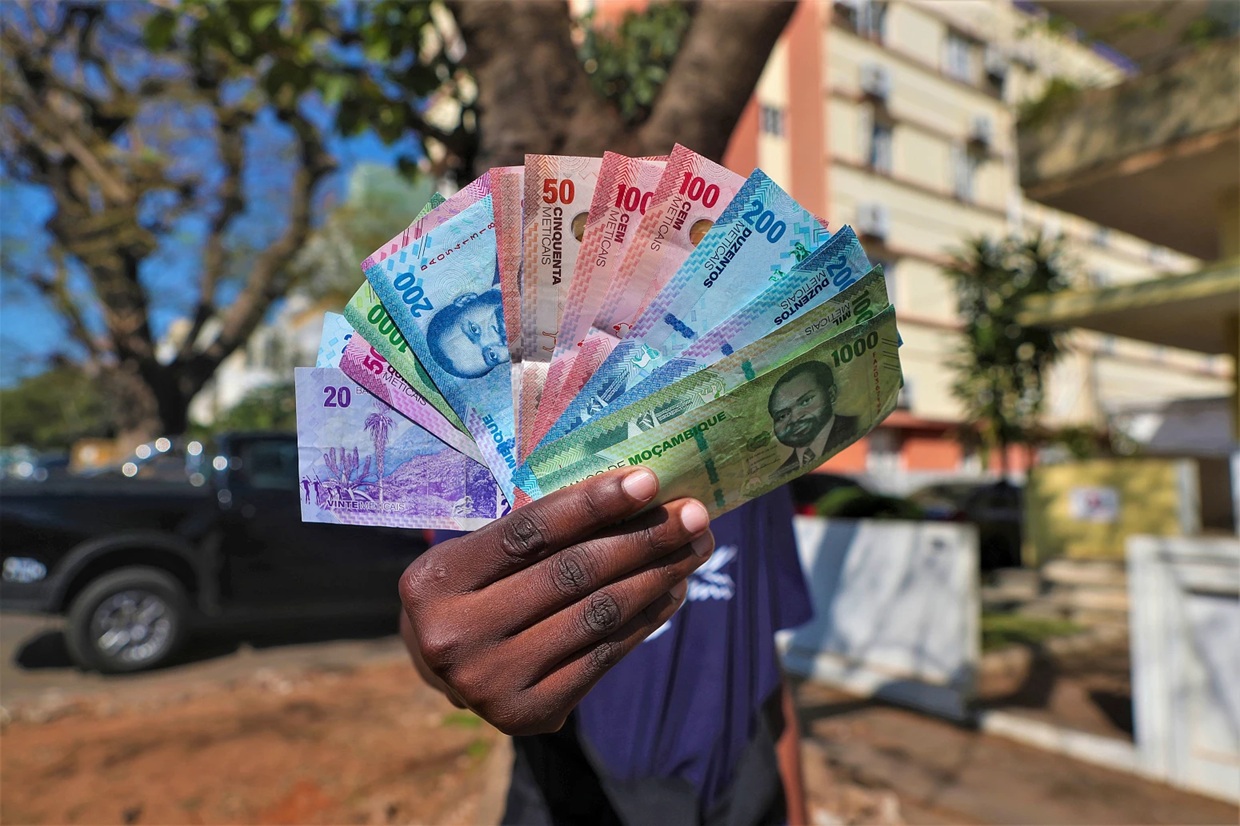
File photo: Lusa
The British consultancy Oxford Economics considers Mozambique and Angola to be among the four African countries at risk of financial default due to the weight of their debt, and predicts that Mozambique will also experience a devaluation of the Metical this year.
“Regarding debt, there are risks of debt restructuring or financial default in four countries – Angola, Malawi, Mozambique, and Senegal,” the experts wrote in an analysis of the main economic themes that will mark 2026 in Sub-Saharan Africa.
In the report, sent to clients and accessed by Lusa, analysts from the firm’s African division note that Angola also faces the possibility of needing to raise its benchmark interest rates due to currency and fiscal policy developments.
“Of the 24 economies we have analysed, our outlook for interest rates is stable in 21 of them; we expect reductions in Egypt and Kenya, and anticipate increases in Angola, amid growing concerns about fiscal policy and exchange rate conditions,” the analysts pointed out.
On Mozambique, Oxford Economics states that the country “is expected to gradually devalue the metical in 2026 to address the severe shortage of foreign exchange reserves, which is primarily due to the overvaluation of the currency.”
The devaluation of the metical is also expected to “be one of the conditions for a new loan from the International Monetary Fund”, still under negotiation, but which Oxford Economics forecasts will be concluded within this quarter.
In the report, the analysts have also revised down their growth forecast for Angola and Mozambique this year, from 3.2% to 2.8%, and from 3.8% to 3.3%, respectively.
Concerns over the evolution of public debt and the ability to repay creditors, particularly commercial creditors of ‘Eurobonds’ (foreign currency-denominated debt issuances), align with the widely held view that Africa is facing a public debt crisis, which has reached levels high enough to hinder investment in essential areas for development, such as education and healthcare.
The United Nations Economic Commission for Africa (UNECA) said in late March that one of the region’s main problems was the high level of public debt, which is crowding out investments in infrastructure needed for economic development.
Nonetheless, public debt in Africa is expected to decrease from 62.5% in 2024 to 62.1% in 2025, after reaching 67.3% in 2023, but this decline is not enough to eliminate the debt crisis that many countries in the region are facing, according to the UN.
“Debt levels remain high and are comparable to those seen before the debt relief initiatives of the mid-2000s,” reads the Economic Report on Africa (REA).
Debt servicing costs are expected to reach $163 billion in 2024, up 12% from the previous year, UNECA states, noting that while 2024 is expected to be the peak year for payments, “values will remain well above pre-COVID-19 pandemic levels in the short to medium term.”
In its most recent assessment of Angola’s economy, in November, the credit rating agency Fitch Ratings wrote that “debt reduction continues, but at a slowing pace,” pointing to a gradual reduction in the debt-to-GDP ratio, from 54.2% at the end of 2024 to 50% in 2025 and 48% in 2026.
“External amortisations are expected to peak at around $7.5 billion in 2025, up from $6.5 billion in 2024, with over half of these payments occurring in the fourth quarter of 2025, before decreasing to around $6.0 billion in 2026 and 2027,” the analysts wrote.
Source: Lusa