
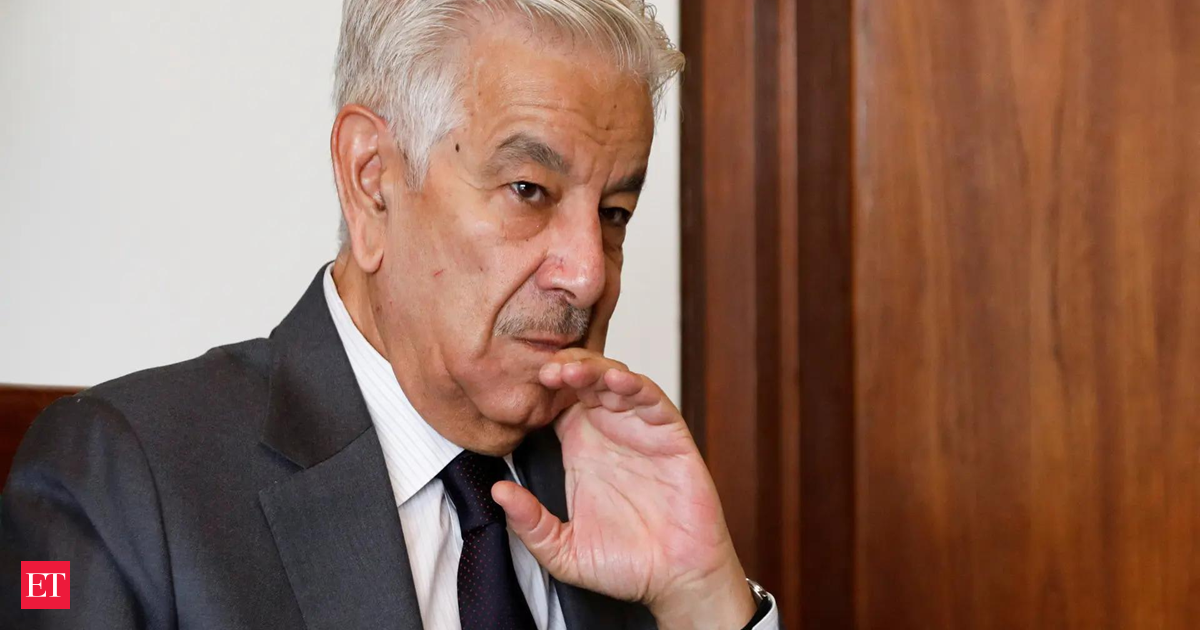
Pakistan defence minister Khawaja Asif has claimed that Islamabad was getting record orders for fighter jets, expressing confidence that the country might not need International Monetary Funds (IMF) financial assistance after six months. Speaking at a Geo News programme, the minister of the cash-strapped nation made a tall claim that the Islamabad may no longer need an IMF bailout, saying that its aircraft were selling like hotcakes after four-day military clash with India last year. “Our aircraft have been tested, and we are receiving so many orders that Pakistan may not need the IMF in six months,” Asif, who is known for making exaggerating claims said, arguing that the world has taken notice of Pakistan’s military capabilities. The Pakistan minister went a step ahead and made a fanciful claim that the India-Pakistan conflict in May 2025 showcased Pakistan’s “resolve and military effectiveness” to the world. The statement of Khawaja Asif comes amid Pakistan and Saudi Arabia’s talks to convert about $2 billion of Saudi loans into a JF-17 fighter jet deal, Reuters reported two Pakistani sources. The talks underscore how the two allies are moving to operationalise defence cooperation at a time when Pakistan is facing acute financial strain and Saudi Arabia is reshaping its security partnerships to hedge against uncertainty about US commitments in the Middle East, Reuters report said. Pakistan’s Air Chief Zaheer Ahmed Baber Sidhu was in Saudi Arabia for bilateral talks including on “military cooperation between the two sides”, Saudi media outlet SaudiNews50 said on social media platform X on Monday.
“The total deal was worth $4bn, with an additional $2bn to be spent on equipment over and above the loan conversion,” Reuters reported, quoting one of the sources. Defence analyst and Air Marshal Amir Masood (Retd) told the news agency that Pakistan was in negotiating or had finalised deals with six countries to export defence equipment, including Saudi Arabia, including JF-17 jets and electronic and weapons systems for the fighters.
ALSO READ: Who was Agnivesh Agarwal and how did Vedanta chief Anil Agarwal’s son, ‘a sportsman, leader and musician’, died?
‘We will not IMF over six months’Pakistan’s Defence Minister Khawaja Asif has claimed that Pakistan has witnessed a surge in aircraft orders after a four-day military standoff with India last year and, if materialised, they could end the country’s reliance. “Right now, the number of orders we are receiving after reaching this point is significant because our aircraft have been tested,” defence minister Asif told Pakistan’s Geo News channel. “We are receiving these orders, and it is possible that after six months we may not even need the IMF,” he said. “I am saying this with full confidence,” Asif said. “If all these orders materialise over the next six months, we will not need the IMF.”
For those unaware, the military tensions between Pakistan and India were at an all-time high in May 2025 after Pakistan-sponsored terrorists carried out a terror attack in Jammu and Kashmir’s Pahalgam in April, killing 26 civilians. In response, India launched a strong military operation ‘Operation Sindoor‘ to destroy multiple terror bases and camps behind the attack.
However, Khawaja Asif, appearing out of touch with the ground reality, made the remarks shortly after a Bangladeshi defence delegation met Pakistan’s air chief to discuss a potential sale of the JF-17 Thunder, the multi-role fighter aircraft jointly developed by China and Pakistan. Pakistan promotes the Chinese co-developed JF-17 as a cost-effective multi-role fighter and has positioned itself as a supplier that can provide aircraft, training and maintenance independent of Western supply chains.
 Live Events
ALSO READ: Stranger Things episode 9 on Netflix: Fans of popular sci-fi series go wild as ‘conformity gate’ theory sparks frenzy online. Here’s what happened
The JF-17s marketability has been increased because “it is tested and has been used in combat,” Amir Masood told Reuters, adding that it’s also cost effective. Pakistan has said the aircraft was deployed during its conflict with India in May last year, the heaviest fighting between the neighbours in decades.
The JF-17, jointly developed by China and Pakistan, was deployed by Pakistan against India during the May 7–10 hostilities. In November last year, Indian Air Force chief Air Chief Marshal A. P. Singh said the aircraft was among at least five advanced Pakistani fighter jets shot down during Operation Sindoor. This development, along with the growing closeness between Pakistan and Bangladesh, is unfolding against the backdrop of Dhaka’s increasingly strained relations with India.
Pak and its reliance on IMFPakistan has for a long time provided military support to Saudi Arabia, including training and advisory deployments. On the other hand, Saudi Arabia has time and again come forward to support Pakistan financially during times of economic stress. In 2018, Riyadh announced a $6 billion support package for Pakistan, including a $3 billion deposit at the central bank and $3 billion worth of oil supplies on deferred payment. Saudi Arabia has since rolled over deposits multiple times, including a $1.2 billion deferment last year, helping Islamabad stabilise its foreign exchange reserves amid chronic balance-of-payments pressures.
ALSO READ: Vijay’s Rs 500 crore film ‘Jana Nayagan’ release postponed reason: Why has the political drama landed in a trouble and is the new date out?
Pakistan has repeatedly sought assistance from the International Monetary Fund to shore up its fragile economy, with each bailout coming with stringent conditions such as fiscal reforms, subsidy reductions and revenue-raising measures. In September 2024, the IMF approved a $7 billion bailout for Pakistan under its Extended Fund Facility, followed in May 2025 by a separate $1.4 billion loan from its climate resilience fund, aimed at strengthening the country’s economic stability and capacity to withstand climate shocks.