
Bones carried into rivers and floodplains form a large part of the fossil record. However, their movement and burial have often been explained using experiments from decades ago that focused on mammal bones in constant-flow water. Those studies gave rise to the Voorhies Groups, a classification system that paleontologists have used to predict which bones are most likely to be transported or left behind.
Now, a new study from the University of Minnesota Twin Cities suggests that this traditional system may not tell the whole story. By testing how bones behave in unsteady flood conditions, researchers found that water dynamics can dramatically change how far bones travel, how they settle, and ultimately how they’re preserved.
Unsteady flows, like sheet floods, levee breaches, or debris surges, are often invoked in paleontology to explain bone dispersal. But until now, the fine details of how bones move in such chaotic conditions hadn’t been experimentally explored.
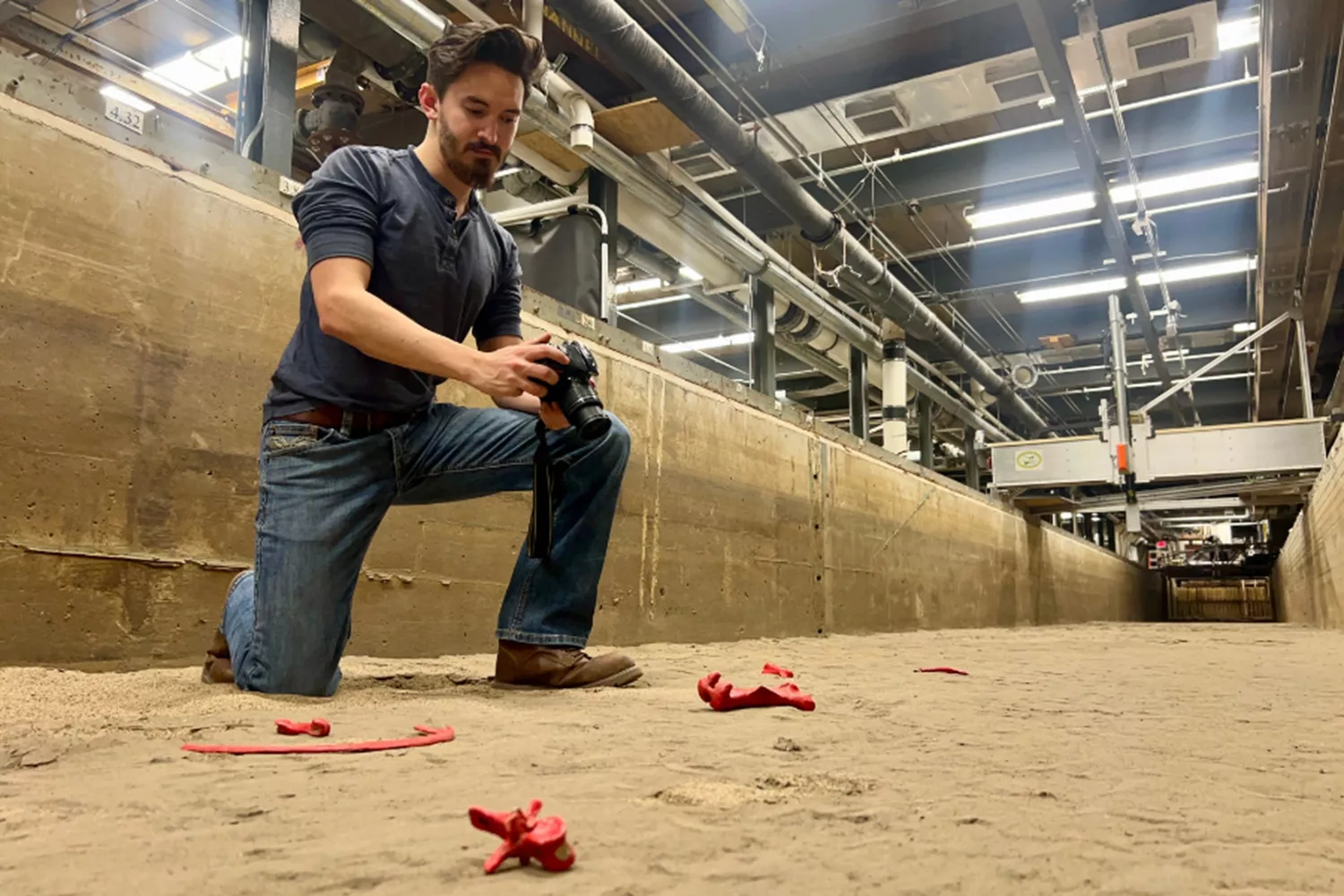
Using the St. Anthony Falls Laboratory, the team recreated surging waves that mimic real floods, complete with ripples, dunes, and bars. Into these flows they placed models of hadrosauroid dinosaur bones alongside modern sheep bones, watching how size, shape, and density determined their fate.
Understanding link between extreme rainfall events and floods
The experiments revealed striking differences: Under stronger flows (0.8 m/s), mobile bones traveled much farther, sometimes leaving the test area entirely, compared to weaker flows (0.55 m/s).
Bones that spun around in the water or got lifted by swirling currents were carried downstream more easily than bones that just dragged or rolled along the bottom. Big, heavy bones like skulls often dug into the riverbed, carving little pits that held them in place, even when the water was rushing fast.
Overall, the data suggest that in typical seasonal floods, most bones don’t travel far from where the animal died, unless the flood was mighty or the bones were tiny.
By recreating real flood conditions, the study shows that bone sorting doesn’t always align with the Voorhies classification’s predictions. This means paleontologists may need to consider additional variables when reconstructing extinct animals and their environments.
Most mass extinctions occurred after mega-eruptions
“The results from our experiments will help us better interpret how bones were sorted, accumulated, and buried at paleontological sites we excavate,” said Peter Makovicky, professor and paleontologist at the University of Minnesota. “This provides the basic information we work back from to reconstruct extinct animals and the environments they lived in.”
Beyond dinosaurs, the findings offer fresh clues about how environmental changes and extinction events are recorded in sediments. They highlight that floods, long seen as destructive, were also powerful agents of preservation, shaping the fossil record we study today.
Journal Reference:
Michael Chiappone, Michele Guala, Raymond Rogers and Peter Makovicky. When the levee breaks: experimentally testing dinosaur and mammal bone transport in unsteady flows. Paleobiology. DOI: 10.1017/pab.2025.10087