
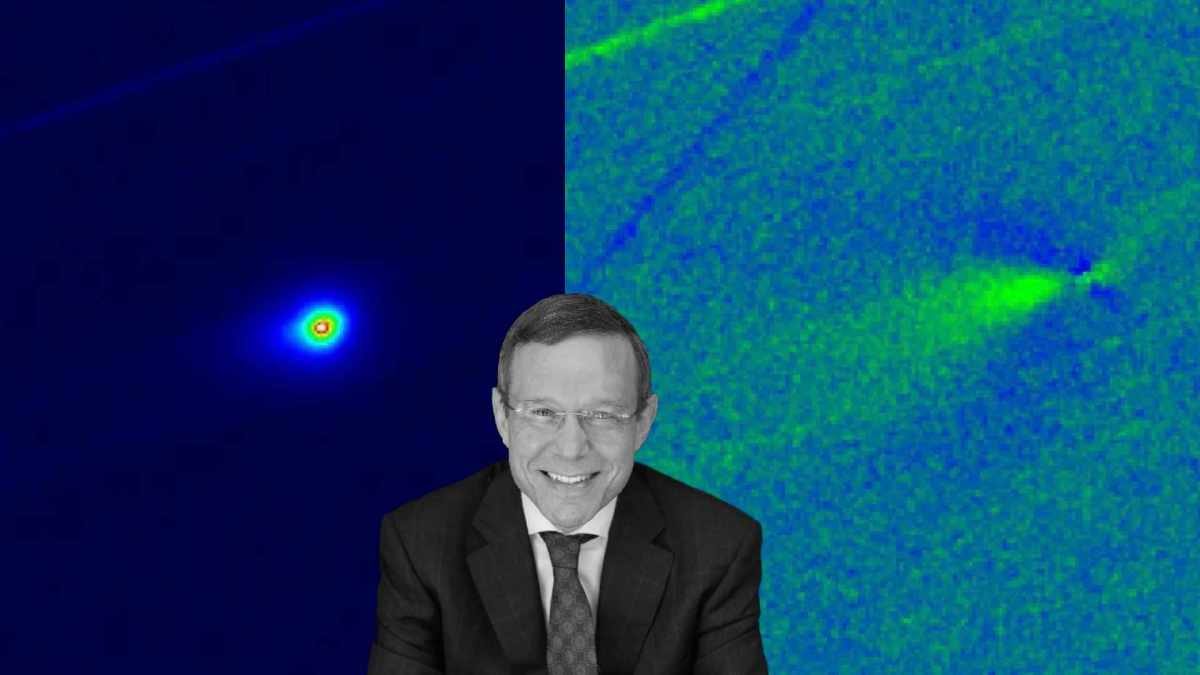
Harvard astrophysicist Avi Loeb, in his recent interview on Fox 32 Chicago’s Chicago Live program, remarked on the Search for Extraterrestrial Intelligence, aka SETI’s Breakthrough Listen Project, which found no anomalous radio signal after five hours of scanning. The agency posted on X/Twitter, with findings here.
No-one would be more excited than us if 3I/ATLAS were a spaceship. But we’ve been looking at it since shortly after it was discovered, and there’s no sign it’s anything other than a natural (albeit interesting) object.
The paper by the researchers concluded
3I/ATLAS, an interstellar object, made its closest approach to Earth on 2025 December 19. On 2025 December 18, the Breakthrough Listen program conducted a technosignature search toward 3I/ATLAS using the 100 m Robert C. Byrd Green Bank Telescope at 1-12 GHz. We report a nondetection of candidate signals down to the 100 mW level.
End of speculations over 3I/ATLAS, the third ever recorded interstellar interloper after 1I/Oumuamua (2017) and 2I/Borisov (2019)?
Prof Loeb quips,
You know, it’s not clear that there would be a transmission in our direction. It may be beamed in a completely different direction. It may not be in the frequency range that we search for, but it may not be in the time window that we search for.
He argues
And moreover, an interstellar traveler will not correspond with its senders because there is no benefit to that. It takes 30,000 years for light to cross the Milky Way galaxy to get to another star far away. And so there is no point in exchanging information in real time.
He continues
What would make sense is after completing the journey through the solar system to relay all the relevant information in a burst of radio waves, maybe, but not every five hours the way that these SETI people imagined.
Loeb breaks down the argument for the lay
So, you know, it’s just like sending a kid out of home. You don’t expect the kid to be in constant contact with you. The kid has its own brain and makes decisions on their own, and they send a post or a tweet every now and then or some message. But imagining that we can rule out the technological just based on our most primitive technologies that we invented back 100 years ago is really inappropriate. We should be more humble.
Further in the interview the distinguished Harvard scientist states
I do believe that it’s very likely that we have neighbors, and, of course, it doesn’t really matter whether we appreciate that or not, whether we dismiss that, or whether we search for that. It’s completely irrelevant. They are either out there or not, and it’s very likely that they are out there because there are 100 billion stars.
Ten percent of them have a planet the size of the Earth and roughly the same separation from a sun-like star, and most of the sun-like stars formed billions of years before the sun. So there was plenty of time for them to be much more advanced than we are and to reach our backyard.
And the most important reason for us to search for them proactively is because it can help us be better because probably those successful civilizations that managed to reach us are far more accomplished, and they would serve as a role model for us.
So what do we make of it all? Loeb remarks,
So it’s for our benefit to be agnostic, not to dismiss the idea, and not to argue that we must be the smartest and not search for anything else because that would resemble, as I mentioned at the beginning, a person who wants to date, to find a partner, but then argues, oh, there is nobody good enough for me.
And, you know, when you go on dates, you better aim high.
#PPOD: Comet 3I/ATLAS from ESA’s Juice🛰️
During November 2025, @ESA_JUICE used five of its science instruments to observe 3I/ATLAS. The instruments collected information about how the comet is behaving and what it is made of.
In addition, Juice snapped the comet with its… pic.twitter.com/zvgRpJi46k
— The SETI Institute (@SETIInstitute) December 23, 2025
Most data is noise.
Some isn’t. 👽📡
Help us tell the difference.https://t.co/d1yo9fq35o
— UC Berkeley SETI (@BerkeleySETI) January 6, 2026
No-one would be more excited than us if 3I/ATLAS was a spaceship. But we’ve been looking at it since shortly after it was discovered, and there’s no sign it’s anything other than a natural (albeit interesting) object. https://t.co/T3B2t6Kk2E pic.twitter.com/u7tXIULk19
— UC Berkeley SETI (@BerkeleySETI) December 24, 2025
A Search For Radio Technosignatures From Interstellar Object 3I/ATLAS With The Allen Telescope Arrayhttps://t.co/OuCyWPJaZ1 #astrobiology #SETI #technosignature pic.twitter.com/fbYBBeF7AS
— Astrobiology (@astrobiology) December 23, 2025