
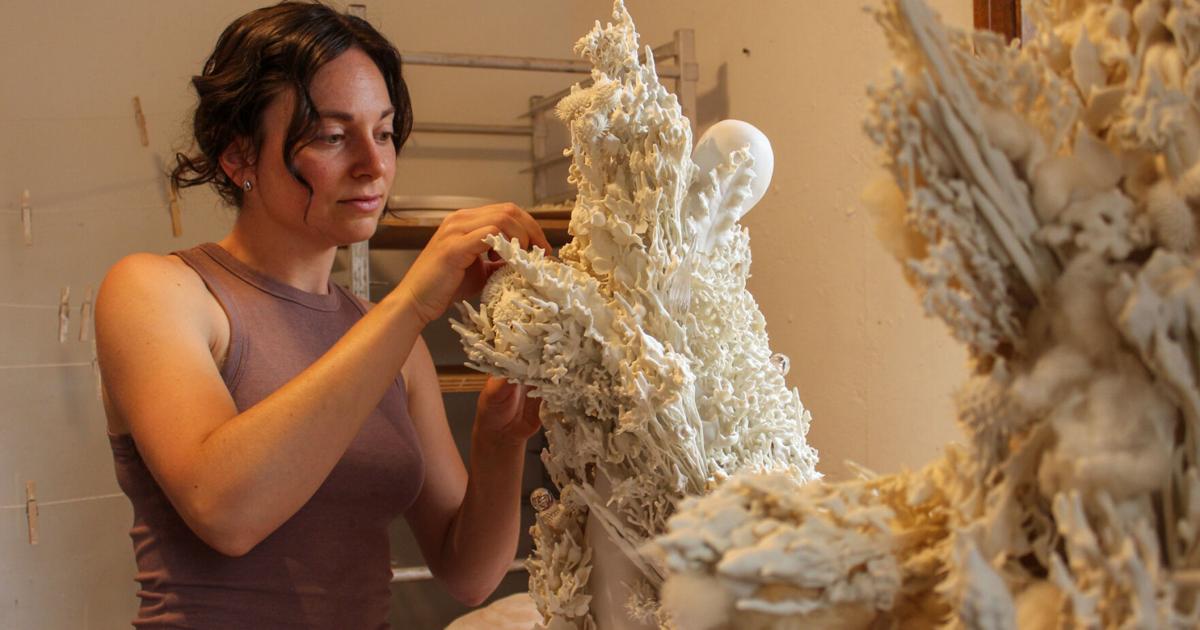

Artist Molly Altman came to Carbondale for a residency at the Carbondale Clay Center and decided to move there. Her show “Always So” at the Aspen Collective begins Saturday and runs until Feb. 13.
Photo by D.J. Watkins
When an artist seeks to capture nature in Colorado, one thinks of the colors of the fall or the lingering light in summer. But Carbondale artist Molly Altman is drawn to January.
“January in Aspen is a season marked by powerful sensations, of cold, of vast beauty, of extreme darkness and light, of environmental stillness contrasting with the town’s vibrancy,” Altman said. “Winter in the mountains is a time of unpredictable challenges and beauty, but inevitably it tethers us to a geologic time scale that extends immeasurably beyond our daily lives.”
Altman is a ceramic artist who works directly with the local floral ecology to create intricate porcelain sculptures. She is presenting her show “Always So” at Aspen Collective. The show, which runs until Feb.13, kicks off with a reception for the artist on Saturday at 6 p.m.
“Anyone who encounters Molly Altman’s porcelain work up close is blown away by the detail, depth and texture of her pieces,” said D.J. Watkins, owner and artistic curator at Aspen Collective. “She has an incredible practice and philosophy behind the art and working with her for this show has been a joy. I encourage the community to come to the Aspen Collective over the next month to immerse yourself in her dreamscape.”
Altman discovered clay at age 15 in her hometown of Amherst, Massachusetts. She went on to receive a bachelor’s degree in ceramics from Bennington College in Bennington, Vermont in 2019.
She has since done artist residencies at Green River Pottery in Santa Fe, New Mexico; Recipiente Estudio in Mexico City; Cobb Mountain Art and Ecology in Loch Lomond, California; and at the Carbondale Clay Center in Carbondale.
Altman has taught and shown work nationally and internationally, and her works are featured in private and public collections, including the Bennington College Permanent Collection and the Minnesota Museum of American Art.
Altman moved to the Roaring Fork Valley in 2022 for a two-year residency at the Carbondale Clay Center, where she fell in love with the area’s natural beauty and artistic community.
“I’ve learned that my environment has everything to do with my studio practice,” Altman said. “I can’t make art in a landscape that I’m not inspired by. And beyond that, the community in Carbodale has been astonishing to me. It is a really small town but the amount of momentum and support within the arts here feels unique. I have an incredible group of close friends here who are artists. I’ve loved watching our work and careers change and grow. The community of Carbondale, in general, feels like it really values the role that artists play, it feels like a big part of the town’s identity.”
“Timescapes” is one of seven pieces in Molly Altman’s show “Always So” that will show at the Aspen Collective beginning Saturday until Feb. 13.
Courtesy of Aspen Collective
Altman said that with her work she hopes to capture life cycles by gathering local fauna at the height of the growing season. “My process seeks to capture fleeting moments through the collection of local flora at the height of its growing season which I cast in porcelain and fire. This causes a transformation in clay through which the ephemeral becomes something enduring. The culminating works become reflections of frozen moments in time within an endless cycle of change.”
Altman said the work she created for “Always So” is some of the most ambitious she has ever created.
“This fall I finished a two-year residency at the Carbondale Clay Center and I decided to stay in the Valley and I moved into a gorgeous studio space (formally the studio of local ceramic artist Diane Kenney).With the move my working space more than doubled in size, and the expansion is really apparent in some of my work.”
Altman draws her greatest inspiration from nature and she has been particularly drawn to the Roaring Fork Valley.
“Seasonal cycles play a large role in my studio processes and are often reflected in the energy of my work,” Altman said. “I also gain huge inspiration from the qualities of the materials I work with themselves, like the way that porcelain plays with light, and by certain processes in the studio. Sometimes I can find myself obsessed with a certain activity to a point at which the creative action becomes the driving inspiration for the final piece itself.”
Altman said her piece “The Harkening” is the centerpiece of the show.
“The Harkening” is a tall branching candelabra that starts at the base with Rocky Mountain snail shells I collected from around my Carbondale studio,” Altman said. “Then it transitions into porcelain tansy flowers, then into a cratered glaze, and finally terminates in four leafy porcelain cups for holding candles. Both the shells and the glaze are totally new materials to me, and the form is a departure from anything I’ve attempted previously. But at the same time, this piece feels like one of the most familiar ever. In making it, I felt extremely in touch with myself at previous points in my life, from childhood to present, and it feels like a piece in which I’ve really been able to tap into the images and behaviors that have been a part of me all my life and which I’m only just starting to have the space and conviction to express.”
Altman said Aspen Collective is an ideal space to exhibit her art.
“Aspen Collective is one of those spaces that is spacious enough to invite works of an ambitious scale, but small enough to still create an intimate experience; not to mention the natural lighting and the building itself are beautiful. It is a dream venue for me.”
Altman says she hopes that viewers experience her work on a sensory level.
“In my work, I am always trying to get myself out of my head and into a zone that is much more sensory,” Altman said. “I do this a lot through repetitive action, intense concentration on tedious detail, and a lot of observation in being outside. My hope is that this translates into the viewer experience, and that when the work is being seen there is no immediate urge to intellectualize it, it can simply stand on its own as an emotional experience — in a similar way to when we’re confronted with nature or beauty, we are able to have a profound experience with it without any conscious effort.
“The best-case scenario is when the work causes someone to consider their own connection to nature, sometimes by recognizing a plant they know or making an association to an environment they love.”