
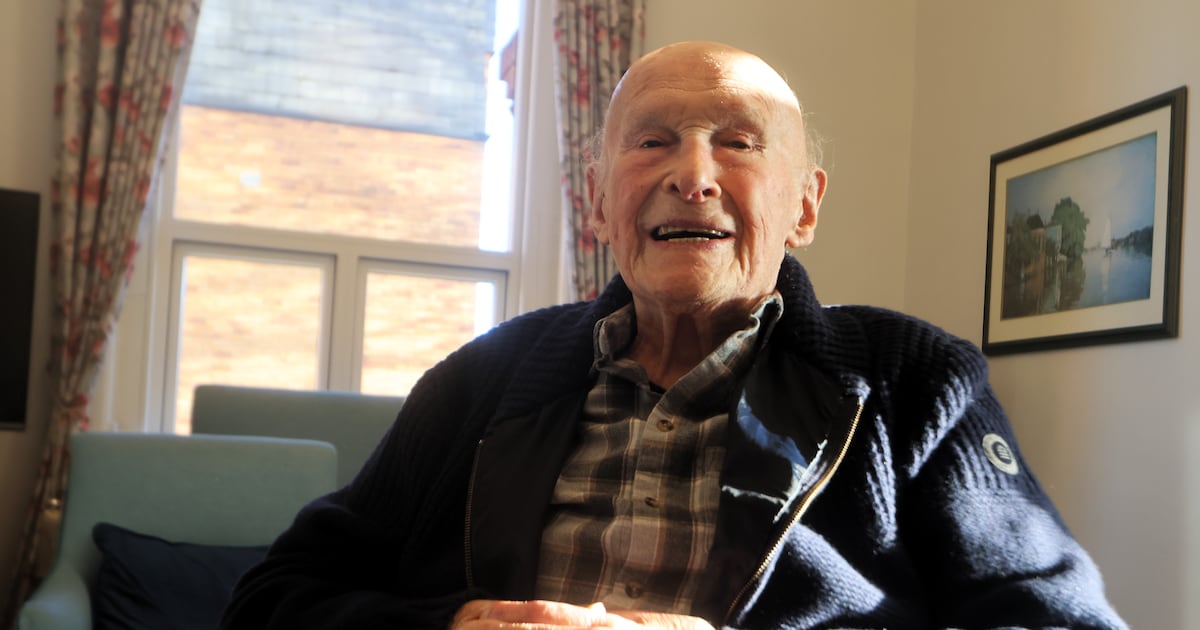
At the height of the second World War, Josef Veselsky received a note from his brother Hugo Weiss who had been deported from the former Czechoslovakia to the Nazi extermination camp at Auschwitz in German-occupied Poland.
To counter rumours of mistreatment and worse in German camps, Jewish prisoners were forced to send postcards home conveying a false message of comfort. Surrounded though he was by slaughter and starvation and facing an immediate threat of death, Hugo had no choice but to write that all was well in Auschwitz, saying he and his new wife had a very nice flat with a bathroom.
The word bathroom was underlined. Veselsky came to see that as a reference to the gas chambers that were designed to look like communal showers.
“After the war a Jewish fellow came to visit me,” he recalled decades later. “He said he saw my brother digging his own grave and he was shot then and he fell into the grave.”
Born Josef Weiss and known to all as Joe, he had changed his surname during the war when his mother urged him to adopt “something a bit more Slovak”.
He was Ireland’s oldest man when he died aged 107. After surviving the Holocaust, he lived for three quarters of a century in Dublin. He forged a successful career in Irish business, importing Swiss watches and Japanese pearls. He was captain of the Irish table tennis team for more than 20 years, a role he previously held in the Czech national team, and served as a director with Shamrock Rovers and UCD soccer clubs.
Veselsky’s sunny disposition and outgoing personality belied the cruelty of war horrors he had seen.
By the time he landed in Shannon Airport in the summer of 1949, he had lost not only his brother to the Nazis but his parents also and the sister-in-law he never met. He was decorated for fighting in the underground Slovak resistance against the Germans but fled his homeland as a marked man after the 1948 communist coup d’état.
In a remarkable personal testimony recorded for NewsTalk radio by Éamon Little, he recalled how fellow Jews around him in Bratislava carried “shoes for work” when deported to their deaths because they were told they were going to work camps for six months. The last time he saw his parents was when they were “pushed into the cattle truck”, his mother desperately imploring him to change his religion as they were taken away forever. Soon afterwards he officially converted to Calvinism but he regarded himself as an atheist.
His father was Max Weiss, a former carpenter who once owned a hardware store. He was prisoner number 26 in the deportation to Auschwitz of April 13th 1942. His mother Berta was prisoner number 35 in the same deportation. Veselsky was in his 80s when he finally learned the detail of their fate. His parents and Hugo, a medical doctor, were killed on August 15th, 1942. Hugo’s wife Eva (née Rothova) was also killed – they had known each other only for three months and married about four weeks before they were taken away.
They were among some 263,000 of the Jews of Czechoslovakia murdered by Nazis and collaborators.
Veselsky was born in October 1918 at the dawn of Czechoslovak independence, as the Austro-Hungarian empire collapsed at the end of the first World War. He told of “football day and night” during his happy childhood in Trnava, a town of 15,000 about 55km from Bratislava, now capital of Slovakia. When Germany rearmed in the 1930s, he listened to Hitler’s speeches on radio.
As war broke out in 1939, he was a young official at Bratislava Allgemeine Bank. This post offered some protection when laws penalising Jews were passed by the puppet Nazi Slovak republic, the regime set up after Germany’s invasion of Czechoslovakia.
According to a private family history, Veselsky was one of 25,000 Jews deemed “economically vital” who were granted “certificates of exemption” from wearing the Star of David. “He was deemed ‘irreplaceable’, largely due to his connections at the police headquarters, which meant he could get visas and other permits for bank staff.”
It was in the bank that he met his future wife Katarina Laszlo, who predeceased him. She was the daughter of minor aristocratic Hungarian landowners. Her father, prosperous enough to retire as a railway stationmaster aged 28, was head of the local Calvinist community.
Veselsky was present in the Bratislava Jewish centre when senior Nazi Adolf Eichmann arrived in 1942 for an inspection on the progress of deportations to the camps. Veselsky was in a loud conversation when Eichmann walked in and was abruptly told to “shut up”.
In 1943 his name appeared on a list of people deemed “politically unreliable” by the Slovak justice ministry, prompting the bank to send him to Budapest to lay low while covert efforts were made to remedy the situation. “Fixing meant bribing,” Veselsky told Little.
The next year he joined the Slovak national uprising, a two-month offensive against German occupiers. The fight began in August 1944 but was suppressed in October by an enemy better armed and greater in number. He faced near certain death when captured but escaped with nine comrades.
Veselsky’s party retreated to the Carpathian Mountains for the remainder of the war. He recalled hundreds of dead comrades, sleeping in forests, digging tunnels in snow, robbing food to survive and eating fish killed by grenades thrown into lakes. “It wasn’t comfortable but everyone had only one aim by that time: to survive.”
Among them was a Red Army liaison officer from Siberia. The Slovaks viewed this man dimly, as a tough, violent and illiterate fighter but he surprised them by playing Mozart on piano when they took refuge in a remote village school. It was “the first time they had heard music in a long time”, said the family history.
As the war ended, he was reunited with Katarina. They married on May 19th, 1945, 11 days after VE Day. The bride’s family did not attend the wedding as they did not initially approve of it. The groom had no family to attend. Their son Peter was born in March 1946, their daughter Kate in December 1947. They survive him.
As steps were taken towards a new peacetime order, Veselsky became private secretary to the industry and commerce minister in the new Czech government. Later he returned to work in his old bank and then took a job importing watches into Czechoslovakia, a foretaste of his Irish career.
Coming under pressure after the communist takeover, he and his wife decided to leave after their home was turned over by the political security force. Carrying only a couple of suitcases as they left, Katarina told neighbours they were visiting family in Hungary because house painters were coming. Arriving at Budapest station, they quickly crossed the platform to take another train to Zurich, Switzerland.
They left for Ireland one year later. This was suggestion of a Slovak friend in Zurich who had an Irish business. They had decided against going to Australia, as their baby daughter was too weak for a long journey by sea.
Veselsky travelled first to Ireland, followed a fortnight later by his wife and children. Their first Dublin home was at St Helen’s, Booterstown, where they rented a house for five years before buying the house next door. He was still living there after he turned 100.